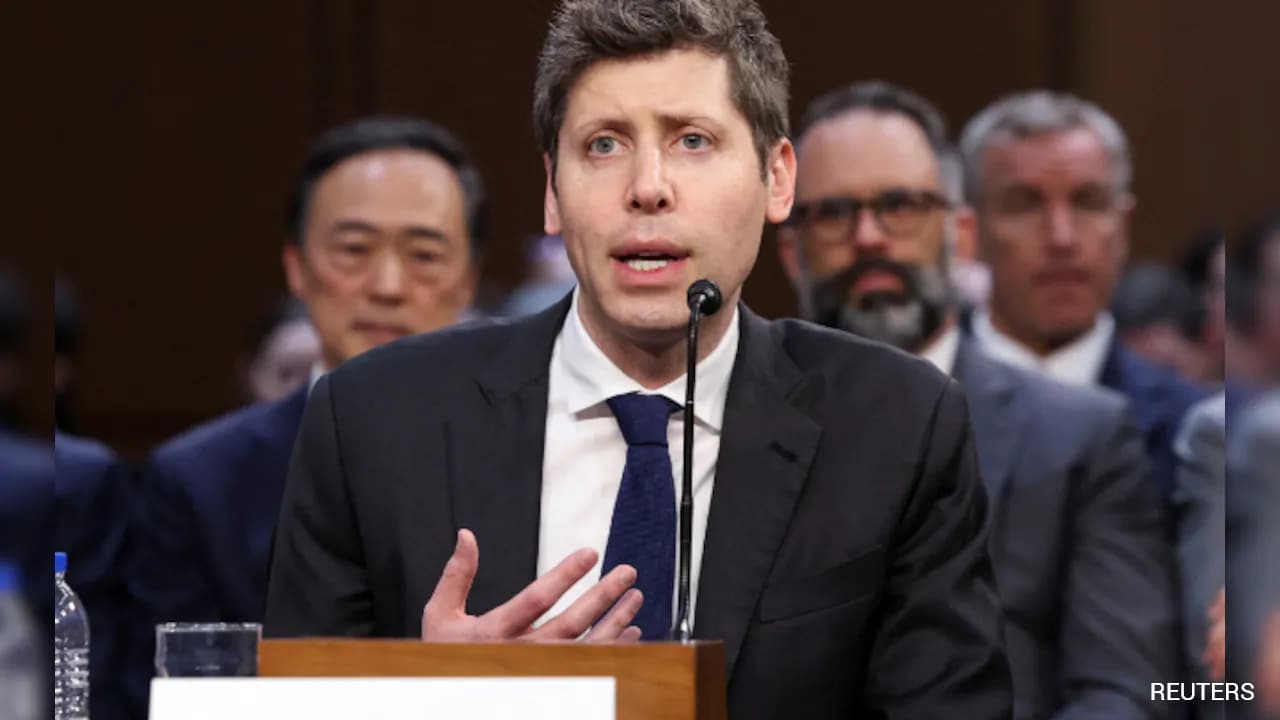
The tech press is swooning over Sam Altman’s apparent civic duty. When the OpenAI CEO advocates for a federal licensing body to approve major AI model releases, commentators paint him as a responsible steward of world-changing technology. They buy the narrative that these systems are too dangerous for the wild west of the open-market internet.
They are getting played. In related developments, take a look at: The Paper Tiger Benchmark Why a Chinese Robotics Startup Beating Nvidia Means Absolutely Nothing.
This has nothing to do with saving humanity from a rogue superintelligence. It is a textbook regulatory capture play, executed by a dominant incumbent who realizes that his moat is evaporating. Altman is not trying to protect you from AI. He is trying to protect OpenAI from open-source developers working out of their bedrooms.
The Illusion of Corporate Altruism
When the leader of a multi-billion-dollar tech company begs Congress to regulate his industry, your default reaction should be intense skepticism. History shows that sweeping federal regulations rarely hurt the giants who helped write them. Instead, they suffocate the upstarts who cannot afford a legal team of fifty people just to ship an update. Engadget has also covered this important subject in great detail.
The current narrative treats AI safety as a straightforward equation: bigger models equal more danger, which requires more government oversight. This logic is fundamentally flawed.
Consider how actual software security works. We do not require Microsoft or Apple to get federal clearance before releasing an operating system patch. We rely on a distributed ecosystem of researchers, bug bounties, and open deployment to identify and fix vulnerabilities. Locking model weights behind a bureaucratic wall does not make them safer; it just ensures that only a select few corporate entities get to decide what flaws are worth fixing.
The True Cost of Licensing
If the US government implements an approval process for AI models based on compute thresholds, the immediate consequence is the destruction of the open-source community.
- Compliance Moats: A compliance audit for a new foundation model could easily cost millions of dollars and take months. OpenAI, backed by Microsoft's billions, handles that as a rounding error. A startup raising a seed round is dead on arrival.
- The Chilling Effect on Research: Academic institutions will stop pushing the boundaries of architecture because they cannot navigate the legal liability of training a "unlicensed" system.
- Monopoly Pricing: Once competition is regulated out of existence, the cost of API access will skyrocket. The enterprise market will have no choice but to pay the tax.
I have watched tech companies pull this lever for twenty years. The moment a market transitions from rapid innovation to consolidation, the dominant players suddenly discover their conscience and ask for rules. It happened with social media data privacy, it happened with fintech, and it is happening now with machine learning.
Dismantling the Premise of "Dangerous" Compute
The foundational argument for government pre-approval rests on a flawed premise: that compute power is a direct proxy for weaponization potential. The consensus asserts that a model trained on $10^{26}$ total floating-point operations (FLOPs) is inherently a threat to national security, while a smaller model is safe.
This is a profound misunderstanding of algorithmic efficiency.
[Traditional Paradigm] More Compute = More Intelligence = More Risk
[The Reality] Better Data + Optimization = High Capability at Fraction of the Cost
We are already seeing smaller, fine-tuned models outperform last year's massive proprietary giants on specific tasks. By capping or policing models based on the size of the compute cluster used to train them, the government is regulating the hardware rather than the application. It is equivalent to banning high-performance engines because someone might use a car to commit a crime.
Why Open Source is Actually Safer
The closed-source crowd argues that open-sourcing model weights is like handing a blueprint for a nuclear weapon to the public. This analogy is absurd. AI models are statistical engines, not step-by-step instruction manuals for destruction.
When a model is closed, the public relies entirely on the vendor's internal red-teaming. We have to trust that their alignment techniques—which are often just brittle layers of reinforcement learning from human feedback (RLHF)—will hold up under pressure. They rarely do. Users bypass these corporate guardrails within hours of every major release using simple prompt engineering.
With open weights, the global developer community can analyze the underlying vectors, identify systemic biases, and build hardcoded defense mechanisms directly into the runtime environments. Sunlight remains the best disinfectant for software, no matter how complex the code.
The Threat of Global Regulatory Arbitrage
Let's look at the geopolitical reality that the "pro-licensing" crowd ignores. If the United States establishes a slow, bureaucratic approval process for AI models, innovation does not stop. It just moves.
An engineer in Paris, Shenzhen, or Bangalore is not going to wait for a US federal agency to sign off on their architecture. They will train, ship, and iterate while American companies are stuck in a cycle of compliance audits.
"Regulations don't stop the development of technology; they merely dictate the geography of where that technology is born."
By forcing American developers to clear a government hurdle before releasing a model, we guarantee that the next major breakthrough happens outside our jurisdiction. We sacrifice our technological edge on the altar of hypothetical safety.
The Real Agenda: Stopping the Commodities Market
The nightmare scenario for OpenAI is not an artificial general intelligence (AGI) destroying the world. The nightmare scenario is that frontier capability becomes a commodity.
Right now, the cost of training models is dropping exponentially. What cost $10 million to train two years ago can now be replicated for a fraction of that amount thanks to open datasets and better distillation techniques. If anyone can run a highly competent model locally on consumer hardware, the business model of selling access to a proprietary cloud-based API collapses.
An approval mandate halts this commoditization instantly. It draws a line in the sand and declares that any model capable of meaningful reasoning is a controlled substance.
If you want to build a competitive product, you will be forced to rent intelligence from one of the three or four approved entities that hold a federal license. It turns a vibrant, decentralized software revolution into a utilities market, heavily regulated and completely stagnant, ran by a cartel of tech executives and Washington bureaucrats.
Stop listening to the theatrical warnings about existential risk. Look at the balance sheets. The call for regulation is not a warning; it is a defensive wall.
And we are volunteering to build it for them.