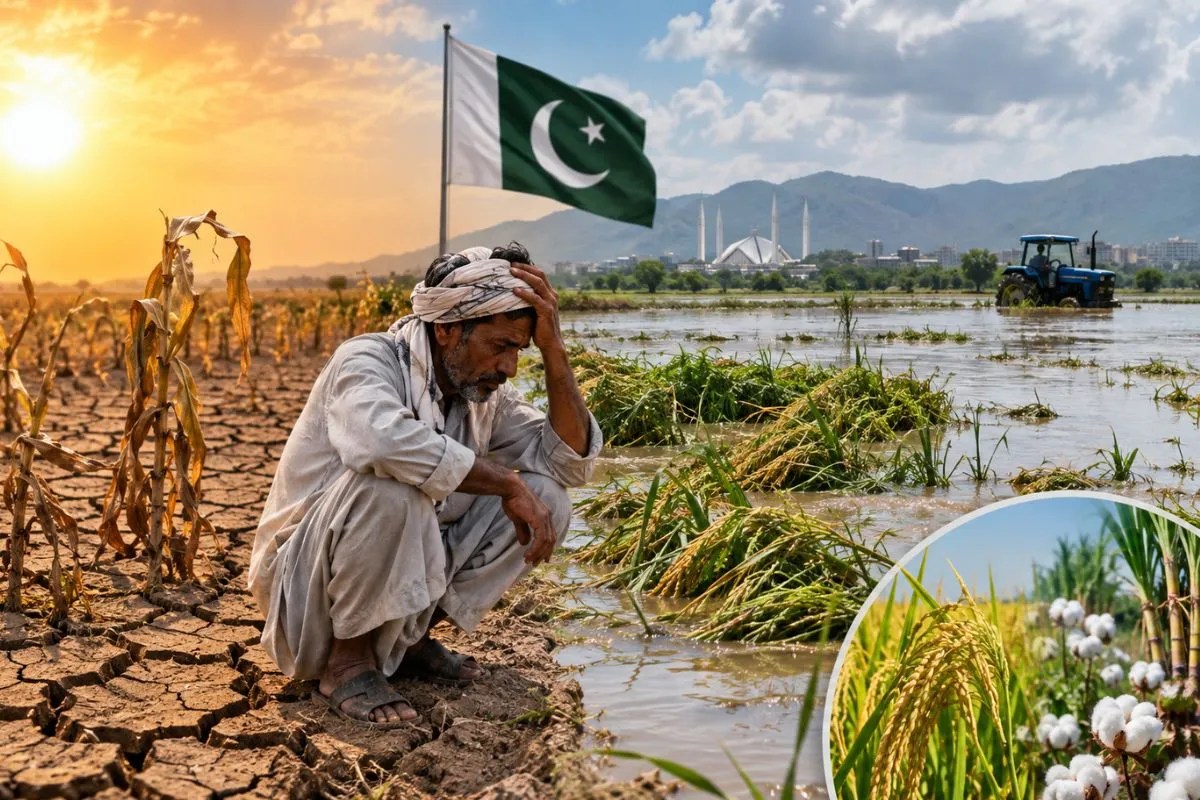
Everyone agrees on the narrative. Pakistan is burning. Glaciers melt into raging torrents, monsoons smash through riverbanks, and parched fields gasp for moisture as the Indus basin runs dry. The conventional prescription is always the same. Modernize the farms. Install drip irrigation. Line the canals. Import smart sensors. Teach farmers how to squeeze every single drop out of a dying soil bed.
It sounds rational. It sounds humane. And it is entirely backwards.
When you subsidize efficiency in a resource-scarce environment, you do not save the resource. You consume more of it. Economists call this the Jevons Paradox, though policy-makers in Islamabad prefer to ignore it because it ruins a good speech. If a farmer upgrades to a high-efficiency drip system and cuts water
Why Pakistan is Fixing the Wrong Water Crisis
news, business
Everybody loves a simple villain. In Pakistan, the script writes itself: soaring heatwaves bake the plains, glaciers melt into temporary floods followed by bone-dry droughts, and traditional farmers watch their wheat and cotton wither away. The standard prescription from every bureaucrat, NGO report, and think-tank white paper is predictable. We are told to modernize agriculture, install drip irrigation, line canals, and teach farmers how to squeeze every drop out of a dying system.
It sounds sensible. It sounds modern. It is also a complete waste of time.
I have spent years watching capital and policy get poured into microscopic fixes for a macroscopic structural failure. The lazy consensus says Pakistan has a water shortage. The data says something entirely different. Pakistan does not suffer from a lack of water; it suffers from a catastrophic failure of economic allocation.
The Great Subsidy Scam
Let us look at the actual mechanics of the crisis. Agriculture consumes roughly ninety percent of Pakistan's available water resources. That is not the scandalous part. Agriculture dominates water use in most developing economies. The scandal is what is grown, how it is priced, and who gets protected.
For decades, the state has incentivized the cultivation of water-guzzling crops like sugarcane and rice in regions that receive minimal rainfall. Why? Because of political patronage, guaranteed procurement prices, and entrenched sugar lobbies that treat water as a free, infinite subsidy. When you give free electricity for tubewells and guarantee a market for thirsty crops in an arid climate, you do not encourage conservation. You encourage extraction until the aquifer goes dry.
When international donors show up with millions of dollars for drip irrigation kits, they are treating a gunshot wound with a band-aid. Sprinklers and smart valves will not save a crop that shouldn't exist in that soil to begin with. If you double the efficiency of pumping water to grow sugarcane in southern Punjab, farmers will simply plant more sugarcane. The volumetric footprint expands, the aquifer drops faster, and the heat gets trapped in an urban-rural feedback loop of intensive monoculture.
Pricing the Invisible
Economists have a dirty word for what needs to happen next, and politicians run from it like it carries a plague: pricing.
Water in Pakistan is treated as a constitutional birthright with zero marginal cost. When something costs nothing, it is treated as worth nothing. Until water carries a real, market-reflective price that accounts for scarcity and opportunity cost, every technical fix is just an expensive delay of the inevitable collapse.
Imagine a scenario where agricultural water rights are commodified and metered, shifting the incentive structure overnight. When a farmer realizes that wasting a thousand liters of water on low-value, flood-irrigated crops hits their bottom line directly, behavior changes faster than any government awareness campaign could dream of. High-value horticulture, high-yield greenhouses, and drought-resistant millets suddenly become attractive. Sugarcane moves to regions with natural rainfall, where it belongs, or it ceases to be economically viable.
The pushback is immediate and predictable. Critics argue that pricing water starves the smallholder farmer and creates a dystopian corporate grab. This is a false choice built on populist sentiment. The current system already starves the smallholder by depleting the water table entirely, leaving deep-pocketed landlords with private deep-bore tubewells to suck the remaining moisture out of the earth while small farmers go bankrupt.
The Heat Trap is a Land Use Problem
The second half of the standard narrative blames climate change and rising temperatures for evaporating agricultural viability. Temperatures are undeniably climbing. Heatwaves in Sindh and Punjab are pushing past thresholds that human bodies and traditional crops can handle.
Yet, pointing at global carbon emissions as the sole culprit is a convenient excuse for local institutional paralysis. The microclimate of the Indus Basin is being actively cooked by how the land is managed. Massive expanses of flat, unshaded, flood-irrigated fields act as solar collectors. When you strip away perennial cover, destroy local wetlands, and pave over natural drainage basins for suburban expansion, you create localized heat domes.
Modernizing agriculture cannot mean just buying imported smart-irrigation gear from German catalogues. It means radical agroforestry. It means integrating trees back into the farmscape to act as natural windbreaks and cooling mechanisms. It means recognizing that soil health—specifically organic carbon content—is the ultimate water reservoir. Soil packed with organic matter holds multiples of its weight in water, acting as a sponge during flash floods and a slow-release tank during dry spells. Right now, chemical-heavy farming has turned vast swathes of Pakistan's topsoil into dead, compacted dust that sheds water like concrete.
Stop Saving the Wrong Crops
We need to stop asking how to grow thirsty crops more efficiently. The question we should be asking is why we are subsidizing national suicide in the name of food security.
True reform requires political courage that has been missing for generations. It means phasing out support prices for water-intensive commodities. It means redirecting state subsidies away from tubewell electricity and toward soil regeneration, agricultural R&D for native arid-zone crops, and direct cash transfers to vulnerable rural populations instead of distorting commodity markets.
The window to pivot is closing. The aquifers beneath the Indus Basin are nearing critical exhaustion, and no amount of drip tubing will refill an empty underground ocean.
Stop trying to fix the plumbing of a broken house. Tear down the walls and build something that belongs in this climate.