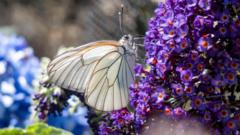
Every summer, the press releases drop with predictable timing. A prominent UK zoo announces it has successfully bred a few thousand caterpillars of a critically endangered species. The local news runs a glossy segment. Politicians nod approvingly on social media. The narrative is firmly set: the zoo is heroically stepping in to save one of the UK's rarest butterflies from extinction.
It feels good. It looks great on a donor report. For an alternative perspective, consider: this related article.
It is also a catastrophic misdirection.
While we are distracted by the photogenic release of a few hundred Chequered Skippers or Heath Fritillaries, the actual environments required to sustain them are being quietly bulldozed, poisoned, and mismanaged. We are applauding a hospital for breeding healthy patients while we actively poison the town's water supply. Further analysis on this matter has been shared by BBC News.
Captive breeding is an admission of failure. It means we have destroyed the wild so thoroughly that wild animals can only survive in climate-controlled plastic boxes. It is crisis management disguised as a permanent solution.
The Ex Situ Delusion
To understand why the zoo narrative is flawed, you need to understand the difference between ex situ and in situ conservation.
Ex situ conservation happens outside the natural habitat. It happens in zoos, botanical gardens, and laboratories. In situ conservation happens in the mud, in the forests, and on the moors.
Zoos excel at ex situ operations. They have the temperature-controlled enclosures, the entomologists on staff, and the resources to manually feed caterpillars. They can take a dwindling population of fifty insects and turn them into five thousand in a single breeding season.
But insects do not go extinct because they suddenly forgot how to breed.
They go extinct because we paved their meadows. They go extinct because industrial farming sprays neonicotinoids across vast swathes of the countryside. They go extinct because traditional woodland coppicing was abandoned in favor of dense, dark commercial forestry.
Imagine a scenario where a high-tech zoo facility breeds 10,000 extremely rare butterflies. They possess perfect genetic diversity. They are completely disease-free. Now, the zoo releases them into a field bordering an intensive wheat farm.
They will be dead in a week.
The millions spent on the breeding facility just bought very expensive insect feed for local birds. We are treating the symptom of numerical decline, while entirely ignoring the disease of habitat annihilation.
The Money Trap
I have spent years watching conservation budgets get allocated. I have seen the internal fights over where the grant money goes. There is a distinct, unavoidable bias toward the visible and the immediate.
Captive breeding programs secure funding because they offer a guaranteed, measurable product. A zoo can promise a donor: "Give us £500,000, and we will produce 2,000 rare butterflies by next spring." They can invite the donor to the release day. They can take photos of a child opening a mesh enclosure.
Buying a dreary, overgrown field to stop agricultural runoff? Fighting local councils to change their roadside mowing schedules? Battling massive chemical companies in court to restrict pesticide use?
That work is ugly. It is slow. It takes decades. It does not yield immediate photo opportunities. Consequently, it is exponentially harder to fund.
When the public and policymakers believe that zoos are "fixing" the extinction crisis, the pressure to reform systemic land use evaporates. Why force a massive agricultural conglomerate to change its profitable, pesticide-heavy practices if a zoo is taking care of the wildlife problem in a lab? The zoo becomes an unwitting shield for the industries destroying the environment.
The Illusion of the Large Blue
The defenders of the zoo model always point to the Large Blue butterfly.
The Large Blue went officially extinct in the UK in 1979. Through massive, coordinated efforts involving zoos, conservation groups, and ecologists, caterpillars were brought over from Sweden, bred in captivity, and reintroduced to specific sites in the UK. Today, there are estimated to be over 10,000 Large Blues in Britain.
It is hailed as the ultimate conservation victory. Look closer, and the reality is far more unsettling.
The Large Blue has a bizarre, parasitic biological dependency. Its caterpillars secrete a chemical that tricks a specific species of red ant (Myrmica sabuleti) into thinking the caterpillar is an ant grub. The ants carry the caterpillar into their underground nest, where the caterpillar proceeds to eat the ant grubs for ten months before emerging as a butterfly.
But Myrmica sabuleti ants require very specific soil temperatures. If the grass above their nest grows taller than a few centimeters, the ground cools down. The red ants abandon the nest. A different species of ant moves in. The new ants do not fall for the caterpillar's chemical trick, and they kill it.
To keep the Large Blue alive, conservationists have to micromanage the length of the grass on the reintroduction sites with exact precision. They use carefully timed livestock grazing to keep the turf cropped to the exact millimeter required by the ants.
This is not wild nature. This is outdoor museum curation.
The Large Blue is entirely dependent on relentless human intervention. If the funding stops, if the grazing schedules are missed by a few weeks, the butterfly will go extinct again. We have not saved a wild species; we have created a high-maintenance garden pet.
The Numerical Fallacy
When a zoo repopulates a species, they boast about the numbers. "We released 5,000 butterflies."
In ecology, releasing sheer numbers into a depleted environment is meaningless if the "carrying capacity" of that environment has not changed. Carrying capacity is the maximum population size of a species that an environment can sustain indefinitely, given the food, habitat, water, and other necessities available.
If you release 5,000 butterflies into a habitat with a carrying capacity of zero, you will soon have zero butterflies.
Butterflies are indicator species. They are fragile, reactive barometers for the health of an entire ecosystem. When a butterfly population crashes, it is the ecosystem's check-engine light turning on. It tells us that the soil microbiome is dying, that the native plant diversity is collapsing, and that the insect food web is disintegrating.
Catching the remaining butterflies and putting them in a zoo does not fix the engine. It just unplugs the warning light so we do not have to look at it.
The Uncomfortable Truth About Rewilding
If captive breeding is a distraction, what is the actual solution? The answer is rewilding, but not the romanticized, aesthetically pleasing version of rewilding sold in lifestyle magazines.
Real conservation is messy.
It means letting land look unkempt, thorny, and chaotic. It means abandoning the uniquely British obsession with neat, hyper-managed countryside. Many rare butterflies rely on transitional habitats—areas recovering from fires, clearings made by large herbivores, or scrubland that looks like a wasteland to the untrained human eye.
The High Brown Fritillary requires dead bracken litter and violet plants. The Duke of Burgundy butterfly needs cowslips growing in patchy, scrubby grassland.
Creating these habitats requires systemic changes to how the UK manages its land. It requires the government to heavily penalize landowners who degrade biodiversity, rather than subsidizing them for owning barren acres of sheep-grazed biological deserts. It requires outright bans on the chemicals that wipe out insect populations entirely.
This is the real fight. It is political, it is economic, and it is vicious.
The Fire Extinguisher Concession
Am I saying that zoos should immediately shut down their butterfly breeding programs?
No.
If these captive programs stop tomorrow, several UK butterfly species will vanish entirely within a year. When your house is on fire, you absolutely need a fire extinguisher.
The problem is that we are applauding the fire extinguisher while continuing to pour gasoline on the floorboards.
Zoos buy us time. They preserve the genetic material while we are supposed to be fixing the burning house. But we are not fixing the house. We are just building bigger, better fire extinguishers and calling it a victory.
Conservationists working in zoos know this better than anyone. Talk to the entomologists off the record, away from the PR departments. They are exhausted. They know they are bailing water out of a sinking ship with a teaspoon while the fossil fuel and agricultural industries drill new holes in the hull. They want to see these creatures survive on their own. They do not want to be permanent zookeepers for species that have no wild home left to return to.
The next time you see a headline celebrating a zoo for releasing rare butterflies, refuse the urge to feel relieved. Do not accept the comforting lie that the problem is being handled by experts in white coats. Recognize it for what it is: a desperate, temporary stay of execution for a species whose home we have already stolen.