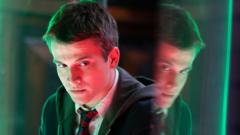
Gabriel Avery is a pickpocket. Not the kind who haunts damp subway platforms or slick tourist traps with a practiced, predatory sneer. He is a boy who steals because the hunger in his stomach has finally started to drown out the voice of his conscience. When he slips a wallet from a pocket, it isn't about the leather or the brand; it is about the binary choice between a meal and a memory.
This is the heartbeat of Crookhaven.
The world of children’s television often feels sanitized, scrubbed clean of the grit that actually defines growing up. We are used to bright colors, easy lessons, and heroes who are born with a moral compass that never wavers. But J.J. Arcanjo’s beloved book series, now being breathed into life for the screen, understands a deeper, more uncomfortable truth. Sometimes, to do the right thing, you have to do a very bad thing first.
The Secret Geography of Merit
Imagine a sprawling, ancient estate tucked away from the prying eyes of the law. It isn't a school for magic, though what happens there looks like sorcery to the uninitiated. This is Crookhaven. It is an academy for the "differently gifted"—the lock-pickers, the digital infiltrators, the silver-tongued liars, and the light-fingered orphans.
The Caspian Royal, the school's enigmatic headmaster, doesn't see a room full of criminals. He sees a generation of Robin Hoods in training. The curriculum isn't trigonometry or Latin; it is the art of the "Grum-Heist."
Students are taught to break into high-security vaults not to keep the gold, but to prove that the gold was never safe to begin with. They are taught to deceive not to hurt, but to expose the deceptions of the powerful. It is a school that weaponizes the flaws of society to protect the people society forgot.
Why We Root for the Thief
There is a specific kind of magic in the heist genre that resonates with our deepest sense of justice. We live in a world where the rules often feel like they were written by people who don't have to follow them. When we see a kid like Gabriel—someone the world has already discarded—suddenly hold the keys to the kingdom, it hits a primal nerve.
The stakes are invisible but heavy.
For Gabriel, Crookhaven isn't just about learning how to crack a safe. It is the first time he has ever belonged to something bigger than his own survival. This is the human element that the "hit book adaptation" headlines often miss. The show isn't just about the "cool factor" of a high-tech robbery. It is about the crushing weight of loneliness and the terrifying, exhilarating moment you realize you have a family—even if that family is a pack of thieves.
The Architecture of a Modern Hit
The industry is watching Crookhaven closely for a reason. Production companies are moving away from the loud, CGI-heavy spectacles that defined the last decade. They are looking for "sticky" stories.
A sticky story is one where the viewer sees their own flaws reflected in the protagonist. We have all felt like outsiders. We have all wondered if we were "bad" because we didn't fit into the narrow boxes of school or work. By centering the narrative on a school for crooks, the show provides a safe space to explore the grey areas of morality.
The adaptation arrives at a time when family-friendly drama is undergoing a radical shift. Parents are tired of the mindless neon noise of standard cartoons, and teenagers are too savvy for the melodrama of traditional "teen soaps." Crookhaven occupies the middle ground. It treats its audience with respect. It assumes that a twelve-year-old can handle the complexity of a world where the "villains" are sometimes the ones wearing the badges and the "heroes" are the ones breaking the locks.
A Legacy of Found Families
Consider the legacy of the "special school" trope. From the X-Mansion to Hogwarts, these stories work because they promise us that our weirdness is actually a superpower.
In Crookhaven, this concept is grounded in the tangible. There are no wands. There are no mutations. There is only skill, practice, and the bond between teammates. When a hypothetical student—let’s call her Maya—spends six hours failing to bypass a digital firewall, only to have Gabriel offer her a piece of stolen chocolate and a new perspective on the code, that is the scene that matters.
The heist is the engine, but the friendship is the fuel.
The production has the monumental task of capturing the sensory details of Arcanjo’s prose. The click of a tumbler. The cold sweat on a palm. The silent communication between two people who are about to do something dangerous. These aren't just technical cues; they are the language of trust.
The Truth Behind the Fiction
While the school itself is a beautiful metaphor for late-bloomer potential, the skills being taught are grounded in real-world psychology. Social engineering—the art of talking your way into a building or a secret—is a very real, very human vulnerability. The show deconstructs how we trust, who we trust, and why we are so easily fooled by a confident smile.
It reminds us that the world is built on systems. And every system has a back door.
The real question Crookhaven poses isn't whether Gabriel will get caught. It’s whether he can stay good in a world that has been so bad to him. It’s a question we all ask ourselves in the mirror, whether we’re picking a lock or just trying to navigate a difficult day at the office.
We watch these stories because we want to believe that our mistakes don't define us. We want to believe that even a thief can be a savior.
As the cameras roll and the pages turn into pixels, the world waits to see if Gabriel Avery can pull off his biggest heist yet: stealing the hearts of a global audience that is desperate for a story about finding home in the most unlikely of places.
The light in the headmaster's office stays on long after the students have gone to bed. Somewhere in the shadows of the hallway, a lock clicks open.
Gabriel is home.