Cold.
Not the crisp, romantic chill of a mountain cabin, nor the brisk snap of an autumn morning in New England, but the sterile, hyper-air-conditioned freeze of a Las Vegas casino floor at three in the morning. Outside on the Strip, the Mojave Desert drops into the forties, a dry, indifferent dark that smells of exhaust, spilled beer, and cold concrete. Inside, the air tastes of stale cigarette smoke and recycled oxygen, vibrating with the frantic, metallic chime of ten thousand slot machines demanding attention.
I stood at the edge of that noise last November, exhausted, nursing a lukewarm coffee, and watching a man lose his rent money in ninety seconds flat. You go to Las Vegas expecting spectacle, yet after forty-eight hours of neon and velvet ropes, the sensory overload curdles into a strange, hollow numbness. Everything is engineered to separate you from your time and your wallet.
Then, you turn a corner past the marble lobby of the Bellagio, step under a fifty-foot glass ceiling, and the air changes.
It hits you in the chest before your eyes even adjust. The smell of wet peat moss. Crushed pine needles. Damp earth and cold, living sap. The temperature drops a degree or two, and the frantic acoustic clatter of the casino vanishes, absorbed by tens of thousands of living leaves and petals.
Most travel articles will treat the annual Bellagio Conservatory & Botanical Gardens holiday display like a glorified floral arrangement—a bulleted list of flower counts, tree heights, and convenient visiting hours. They miss the point entirely. What happens inside those 14,000 square feet every November isn't a decoration. It is an act of botanical defiance against the Mojave Desert, executed by a small army of exhausted artists working entirely in the dark.
The Invisible Shift
To understand what you are actually looking at when you stand beneath the Conservatory’s towering silver-tip fir, you have to picture a hypothetical night shift—let’s call her Elena, a composite of the roughly eighty horticulturists, engineers, and theatrical technicians who pull off this transformation every single year.
For Elena, Christmas doesn't start on December twenty-fifth. It starts at two in the morning in mid-November during what the staff simply calls "Dark Week."
While three thousand guests sleep upstairs in Egyptian cotton sheets, the Conservatory becomes a high-stakes construction zone. Cranes roll across reinforced marble floors. Forklifts maneuver around priceless glass sculptures. For six consecutive days, working exclusively between midnight and six in the morning so the daytime illusion remains unbroken, this crew dismantles the autumn harvest display—hauling out tons of pumpkins, gourds, and dried cornstalks—and replaces every square inch of soil with a winter wonderland.
Think of the Conservatory not as a garden, but as a Broadway stage where the actors breathe, drink water, and die if the backstage thermostat drifts four degrees off mark.
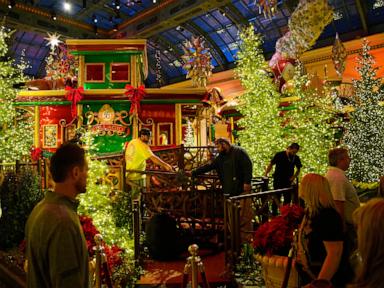
Consider the logistics of that fir tree. Every year, Bellagio sources a massive live tree—often soaring forty-two feet into the glass atrium—from the Pacific Northwest. Getting a forty-two-foot living organism across state lines, through the narrow loading docks of a mega-resort, and upright inside a climate-controlled dome without snapping its crown is an engineering miracle. Once standing, it isn't just plugged into a wall outlet; it is hooked up to an automated life-support system, drinking dozens of gallons of water daily while carrying upwards of seven thousand twinkling lights and hundreds of custom ornaments.
And then come the flowers.
Seventy Thousand Heartbeats
If you walk the winding paths of the holiday display and stop to count, you will lose track before you clear the first archway. Over the course of the season, the horticulture team rotates roughly seventy thousand live plants and flowers through the beds. Poinsettias in shades of crimson, marbled pink, and stark white form sweeping rivers of color. Cyclamen, white hydrangeas, carnations, and blooming evergreens fill the gaps until not a single square inch of black irrigation tubing remains visible.
Here is the secret that separates a real botanical conservatory from a theme park: nothing here is plastic.
A silk poinsettia is easy. You dust it off in November, pack it in a cardboard box in January, and forget about it for ten months. Living flowers are fragile, demanding, and stubbornly mortal. Under the magnifying glass of the Bellagio’s massive copper-and-glass dome, the desert sun beats down relentlessly even in December, baking the upper canopy while the casino air conditioning chills the roots.
To keep those seventy thousand blooms looking as fresh on New Year’s Eve as they did on opening morning, the overnight crew operates like trauma surgeons. Every single night after the crowds thin out around two in the morning, technicians slip through the garden beds with watering wands, pruning shears, and flats of fresh replacements. Any poinsettia whose bracts begin to curl, any hydrangea showing a brown edge, is quietly swapped out before the morning coffee rush arrives.
I admit, before I spent an hour watching an elderly couple sit on a wooden bench near the animated polar bears, I viewed the whole thing with a cynic’s eye. Vegas is built on illusion. Why should a giant indoor flower show be any different from a fake Eiffel Tower or an indoor canal?
I was wrong. The difference lies in the vulnerability of living things. You cannot fake the scent of wet earth, and you cannot manufacture the quiet, involuntary sigh people let out when they step out of a windowless gambling hall and see something genuinely alive.
The Architecture of Nostalgia
Every holiday season, the Conservatory unveils a distinct creative theme—past installations have ranged from "Holiday Time," anchored by a massive twenty-eight-foot Swiss cuckoo clock, to whimsical tributes to the Nutcracker, snow globes, and Victorian villages. Yet regardless of the specific props, the emotional architecture remains identical.
The designers rely on a psychological principle that architects call prospect and refuge—the deep human need to feel sheltered while looking out over an abundant, safe world.
Watch the crowd if you want to see how it works. People walk through the entrance archway and immediately slow their pace by half. Shoulders drop. Phones come out, yes, but after the obligatory family photo in front of the towering sleigh or the shimmering ice-castle bridge, something else happens. People linger.
They lean over the low stone walls to inspect the tiny, hand-painted details on a miniature train winding through a bed of white cyclamen. They watch a family of mechanized polar bears—crafted from thousands of individual white carnations and dried botanicals—nod gently over a pond of real, circulating water. Because the Conservatory is completely free to the public and open twenty-four hours a day, it strips away the transactional anxiety that defines almost every other square foot of the Las Vegas Strip. Nobody is asking for a cover charge. Nobody is waving a drink menu in your face.
Let’s look at the practical reality for anyone planning to see it, because knowing when to go changes the experience from a stressful shuffle into a private sanctuary.
Between noon and ten at night, especially on weekends leading up to Christmas, the narrow brick pathways turn into slow-moving human traffic jams. You spend more time dodging strollers and selfie sticks than smelling the pine. But if you walk down from your room—or stroll in off the Strip—at four in the morning, the Conservatory belongs entirely to you. You can hear the low hum of the water pumps, the gentle rustle of misting nozzles kicking on in the upper beds, and the soft footsteps of a lone gardener pruning back a fern.
The Cost of Beauty
There is a legitimate criticism leveled at displays like this, and pretending it doesn't exist would be dishonest. Building a lush, temperate forest inside one of the driest cities in North America requires massive amounts of water, electricity, and climate control. In a region perpetually locked in anxious negotiations over the shrinking Colorado River, a seventy-thousand-flower desert conservatory feels, on paper, like pure excess.
Yet if you dig into how modern horticultural teams operate on the Strip, the reality is far more nuanced than simple waste. Nearly every drop of water used inside the Conservatory’s fountains and misting systems is captured, filtered, and recirculated through closed-loop reclamation systems—Las Vegas actually recycles close to ninety-nine percent of its indoor water, making it one of the most water-efficient desert metropolises on earth.
Even more surprising is what happens when the holiday show closes in early January. The crew doesn't simply toss seventy thousand plants into a dumpster. Poinsettias, evergreens, and potted blooms are donated to local schools, senior centers, and community gardens across the Clark County valley, while organic trimmings are hauled off to local composting facilities to enrich Nevada’s notoriously alkaline, nutrient-starved soil.
It is an imperfect, expensive, labor-intensive compromise, much like the city itself. Humans have always built gardens in impossible places—from the terraced slopes of ancient Mesopotamia to glass wintergardens in Victorian London—not because it was practical, but because barren landscapes make the soul ache for green.
When the Lights Dim
When I finally walked out of the Conservatory that November night, the casino floor hadn't changed. The slot machines were still screaming for quarters; the neon was still buzzing against the ceiling; the desert wind outside was still scraping dry dust against the glass doors.
Yet the numbness was gone. Carrying the faint scent of crushed fir needles on my coat sleeve, I realized why millions of people make the pilgrimage past those marble columns every winter. We don't travel to Las Vegas to see things that make sense. We go to see what happens when human obsession refuses to accept the limitations of geography.
Somewhere under that glass dome right now, while the rest of the city sleeps off its hangovers, a pair of gloved hands is gently lifting a bruised poinsettia out of damp peat moss and tucking a fresh crimson bloom into its place, holding back the desert for one more day.