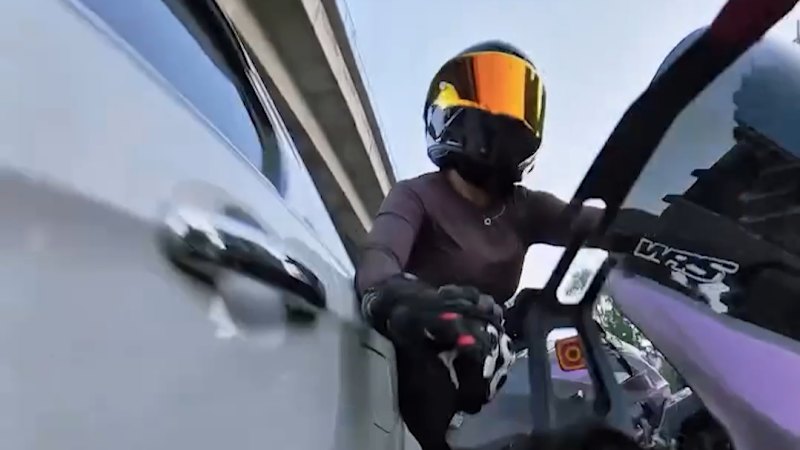
Thumb flicks down. A screen glows in a darkened room, casting a cold blue pallor against the wall. Dust motes drift lazily through the light. A loop of video plays on autoplay.
Asphalt, blurred by a high-angle dashcam lens. A sleek sedan sliding across a wet lane with terrifying momentum. A motorcycle, lean and exposed, upright one millisecond and folding into a chaotic heap of plastic and bone the next.
It takes seven seconds.
We watch it twice. Maybe three times, just to catch the precise moment of impact—the exact frame where glass shatters into a glittering cloud and metal screams against pavement—before swiping away to a video of a golden retriever catching a frisbee. The transition is instantaneous. The tragedy is consumed, digested, and discarded in less time than it takes to tie a shoe.
We live in an era where catastrophe is packaged as entertainment, delivered directly to our palms with a swipe and a tap. But behind the pixelated explosion of the viral clip lies a deeper, more unsettling truth about how we navigate the modern world. It is a story about the invisible barriers we build around ourselves, the fragility of human attention, and the brutal physics of a world moving faster than our biology was ever designed to handle.
The Sovereign State Inside the Metal Box
Consider the automobile.
To step inside a modern car is to enter a sovereign state. You pull the heavy door closed, and the chaotic roar of the outside world is instantly muffled by acoustic glass and rubber seals. Heated leather cradles your spine. A climate-control system maintains eternal spring. A curated playlist murmurs softly through surround-sound speakers.
Inside this rolling fortress, you are insulated. You are safe. You are a king in a castle of steel, airbags, and crumple zones. You sit behind a tinted windshield that flattens the world into a movie, viewing pedestrians, cyclists, and fellow drivers not as living human beings, but as obstacles in a video game simulation. The car encourages a dangerous psychological distance. It whispers a subtle lie into the driver's ear: Nothing can hurt you here.
Now step out of the car. Step onto two wheels.
A motorcycle rider does not drive; they inhabit motion. There is no chassis wrapped around their ribs, no steel cage to absorb the kinetic punishment of a mistake. Every muscle in a rider's body acts as a gyroscope. Every breath is shared directly with the environment—the sharp smell of burning diesel, the damp scent of approaching rain, the raw, unfiltered wind tearing at a leather jacket.
To ride a motorcycle is to accept a profound, unvarnished vulnerability. There are no blind spots you can ignore because your life depends on seeing everything. Yet, that very vulnerability breeds a heightened state of presence. A rider is acutely aware that a patch of spilled diesel, a rogue pothole, or a distracted driver looking down at a glowing screen represents the line between living and vanishing.
Anatomy of a Catastrophe
What happens in those seven viral seconds is rarely a random act of God. It is a collision of human limitation and systemic distraction.
Imagine the driver of the sedan. Let us call him David. David is not a monster. He is a tired father of two driving home after a twelve-hour shift, his mind weighed down by a looming mortgage payment and an unread mountain of work emails. At an intersection, his phone buzzes in the cup holder. A brief flash of light. A subtle vibration against plastic.
For half a second, David's eyes leave the road.
At forty miles per hour, half a second covers nearly sixty feet of blacktop. Sixty feet of absolute, unmitigated blindness.
Meanwhile, three hundred feet away, a motorcyclist approaches the same intersection. The rider trusts the invisible, fragile social contract of the highway—the unspoken agreement that says I am seen, therefore I am safe.
David looks up. The light is green, or perhaps yellow turning red. He checks his mirrors, turns his steering wheel, and executes a left turn across oncoming traffic. His eyes sweep across the intersection, yet they fail to register the single narrow headlight approaching in the distance.
To the human brain—evolved over millennia to spot large, slow-moving predators across open savannas—a motorcycle occupies a cruel cognitive blind spot. It is too thin, too fast, too visually insignificant to trigger the primitive alarm bells that say Stop, danger ahead. To David's tired brain, the space looks empty.
Until it isn't.
The impact is an explosion of kinetic energy. Mass multiplied by velocity squared, transferred in a fraction of a heartbeat from dead metal to living flesh. The bike stops instantly; the rider does not. Laws of momentum take over, turning a human being into a projectile dancing briefly with the laws of physics before gravity reasserts its absolute authority.
The Panopticon of the Feed
Why do we watch these videos?
Why do millions of people pull up clips of horrific highway smashes on their phones, watching them over and over again with a morbid, hypnotic fascination?
We slow down on the highway to gawk at wrecks, our cars creeping past shattered glass and flashing emergency lights like tourists visiting a monument. The viral dashcam video is simply the digital evolution of that ancient, inescapable impulse. We stare at the catastrophe because, deep down beneath our civilized veneer, we are terrified of the fragility of our own existence.
We watch the disaster happen to someone else to reassure ourselves that we are still here. Safe. Watching from the couch.
Yet, there is a corrosive cost to this digital voyeurism. When human trauma is compressed into a seven-second loop and fed into an algorithm designed to reward outrage and shock, empathy becomes a casualty. The rider spinning through the air in the video is not a person with a family, a job, a mortgage, and a handful of unfulfilled dreams. They are content. They are engagement metrics. They are pixels on a glowing screen, meant to be consumed and swiped away before the next notification chimes.
When we turn real-world carnage into casual scrolling material, we dull our capacity to recognize the shared vulnerability of public space. We forget that the asphalt is not a video game map. It is a shared ecosystem where every single participant carries the weight of a fragile, irreplaceable life.
The Quiet Aftermath
The video always ends too soon.
In the viral clip, the screen cuts to black right after the impact, or loops back to the beginning for the next viewer. That is the ultimate luxury of the digital spectator.
For the rider, the video is merely the prologue to a very long, very silent nightmare.
Suppose the rider survives. Suppose the helmet held, the leather resisted the asphalt, and the surgeons in the trauma ward worked miracles with titanium rods and skin grafts. The real trial begins long after the flashing lights of the ambulance fade away.
It is found in the sterile white room smelling of antiseptic and old paper. It is the rhythmic, maddening beep of a heart monitor in the dead of night. It is the realization that your body—once a vehicle of freedom, adventure, and fluid motion—has been reduced to a broken machine chained to a hospital bed.
The physical pain is only half the battle. The psychological ghosts are far more persistent. Months later, when the bones have knitted back together and the scars have faded to a dull silver, the trauma remains. The sound of an engine accelerating outside an open window causes a sudden spike of adrenaline. The simple act of stepping out onto the street triggers a cold sweat. The world has moved on, but the survivor is trapped forever in those seven seconds of breaking glass.
Designing for Survival
We must stop calling them accidents.
An accident implies inevitability, like bad weather dropping uninvited from a cloudless sky. But the carnage we capture on dashcams and spread across social media is the predictable output of a broken system.
We have engineered automobiles that weigh three tons, insulated from reality, equipped with massive infotainment touchscreens that demand the visual attention of a commercial airline pilot. We have designed sprawling, hostile road networks that prioritize speed over safety, where a momentary lapse in concentration carries a death sentence. We have built a culture of constant distraction, where every citizen walks around with a pocket-sized casino firing dopamine hits into their brain while they navigate machinery capable of mass destruction.
Safety is not a passive state. It is an active choice. It requires reclaiming our attention from the glowing screens that tether us to illusions. It requires designing infrastructure that forces us to slow down, to look closer, to acknowledge the human beings sharing our physical space.
The phone screen goes dark.
Your reflection stares back at you from the black glass. The room is quiet. Somewhere out in the dark, headlights sweep across an empty intersection. The wind rattles the windowpane.
We walk through a world made of heavy metal and fragile flesh, pretending we are invincible until the exact moment we are reminded that we are not. And as the night deepens, the asphalt waits, smooth and cold, for the next sunrise.