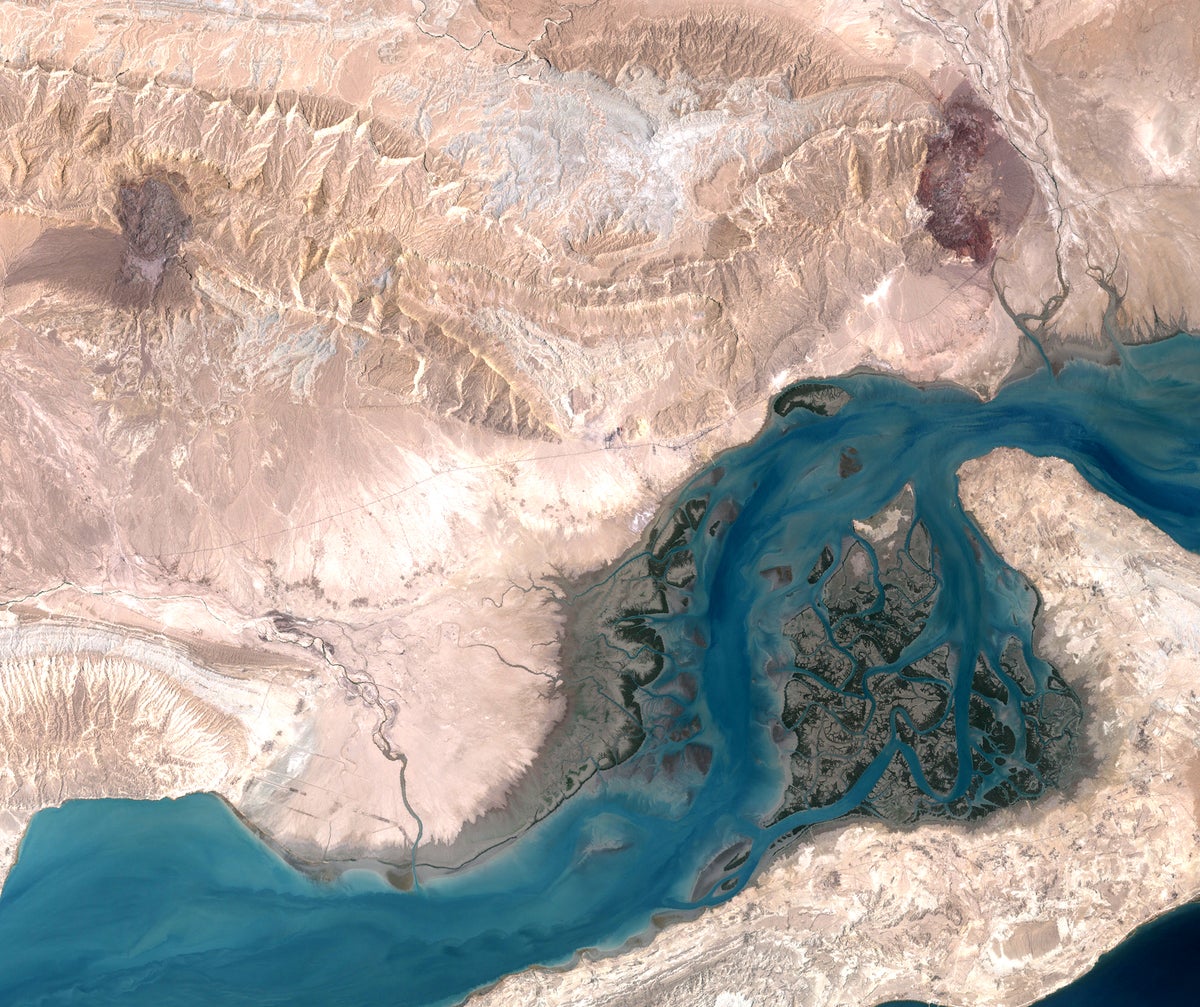
The water in the Strait of Hormuz does not look like a geopolitical chokepoint. It looks like silk. On a warm morning, the Persian Gulf stretches out in shades of aquamarine so brilliant they seem fake, punctured only by the gray, slick backs of Indo-Pacific humpback dolphins breaking the surface.
If you sit on the southern cliffs of Qeshm Island, the air smells of salt, dried lime, and diesel. You can watch the giant container ships and oil tankers crawl across the horizon. They look small from here. Lazy. They glide through a narrow ribbon of water where twenty percent of the world’s petroleum passes every single day. To the global economy, this strait is a jugular vein.
To the people who live on Qeshm, it is simply home.
For centuries, this dolphin-shaped island has been a place of wind-catchers, mangrove forests, and shipwrights who build wooden lenj boats by hand, hammering teak without a single blueprint. But beneath the ancient red soil and the salt caves, something else has been built.
The island has become a fortress.
The Two Faces of the Island
Consider a fisherman named Reza. He is a hypothetical composite of the men who work these waters, but his reality is shared by thousands. Reza wakes up at 4:00 AM. He checks the tides. He knows every sandbar from the dust-choked streets of Qeshm City to the quiet beaches of Hengam Island. He worries about the price of fuel, the repair of his nets, and whether the midday heat will spoil his catch.
When Reza looks out at the strait, he sees his livelihood. When a naval strategist in Washington or Tehran looks at the exact same water, they see a chessboard.
Qeshm is the largest island in the Persian Gulf, stretching nearly eighty miles from tip to tail. Its geography is a natural gift to any military force. It sits like a massive, jagged wedge right at the entrance of the strait. If you control Qeshm, you control the gate.
For years, travelers came here to escape the glittering, hyper-modern chaos of Dubai, which sits just a short flight to the south. They came to wander through the Stars Valley, a surreal canyon carved by millennia of wind and rain, where locals swear meteors once struck the earth. They came to see the ancient Portuguese castle, a crumbling reminder of the last time a global empire tried to lock down this trade route.
But over the last decade, a different kind of architecture has overtaken the island.
Away from the eco-tourist trails, behind ridges of sun-baked mudstone, the earth has been hollowed out. Western intelligence agencies and satellite imagery analysts have spent years tracking the construction of what military planners call "missile cities."
These are not mere bunkers. They are sprawling, subterranean networks of tunnels carved deep into the island’s interior bedrock.
The Subterranean Arsenal
It is difficult to conceptualize the scale of an underground military complex without falling into the trap of cinematic exaggeration. This is not a villain's lair from a spy movie. It is an exercise in brutal, practical engineering.
Imagine a highway tunnel. Now imagine that tunnel stretching for miles beneath layers of solid rock and reinforced concrete, wide enough to allow heavy transport vehicles to maneuver in total darkness. Deep inside these bunkers sit rows of anti-ship cruise missiles and ballistic platforms, shielded from the heat of the Gulf and, more importantly, from the eyes of American satellites orbiting overhead.
The strategic logic is simple: survivability.
If a conflict were to break out in the Gulf, surface launch sites would be destroyed within hours by superior Western airpower. But a missile city buried under a mountain of rock is incredibly difficult to neutralize. The weapons can be fueled, armed, and prepped entirely underground. When the order comes, a mobile launcher can roll out of a concealed tunnel mouth, fire its payload into the shipping lanes within minutes, and retreat back into the subterranean dark before a counter-strike can be coordinated.
From these hidden positions, Iran’s Islamic Revolutionary Guard Corps (IRGC) commands weapons capable of striking targets hundreds of miles away. The distance across the strait at its narrowest point is just twenty-one miles.
A missile fired from Qeshm doesn't need to be sophisticated to be lethal. At that range, flight times are measured in seconds.
The Human Cost of High Stakes
This brings us back to the surface. It brings us back to the tension that defines modern life on the island.
The people of Qeshm are unique. They are Bandaris—people of the coast. Their culture is a rich, syncretic blend of Persian, Arab, Indian, and African influences, a testament to centuries of maritime trade. The women wear intricate, colorful boregheh masks that shield their faces from the blinding sun, looking like magnificent birds of prey. The music here features the heavy thrum of the damammam drum, carrying rhythms brought over by sailors from the Swahili coast generations ago.
They are a people defined by openness, by the sea. Yet, they live on top of a powder keg.
The juxtaposition is jarring. On one side of the island, local conservationists work tirelessly to protect the fragile green sea turtle nesting grounds at Shibdaraz Village. On the other side, convoys of military vehicles move under the cover of night.
The fear is rarely spoken aloud. In a region where security forces keep a tight grip on dissent, you do not openly discuss the tunnels. But the anxiety exists in the spaces between words. It is there when a sonic boom from a routine jet patrol rattles the teacups in a traditional guesthouse. It is there when the internet slows to a crawl during military exercises, or when certain coastal roads are suddenly blocked by checkpoints guarded by young men in olive-drab uniforms holding Kalashnikovs.
The uncertainty is the heaviest burden. If a mistake happens—if a nervous commander misidentifies a commercial vessel, or if a rogue drone sparks a chain reaction—the retaliation will not just target the tunnels. It will shatter the island.
The Illusion of Distance
We live with the comforting illusion that global friction points are far away. We read about the Strait of Hormuz in financial columns, usually accompanied by charts showing the fluctuating price of West Texas Intermediate crude oil. We treat it as a math problem.
But the friction is physical.
Step aboard a US Navy guided-missile destroyer transiting the strait. The energy on the bridge is palpable. The crew doesn't see a beautiful blue waterway; they see a gauntlet. Every small, fast-moving Iranian patrol boat that buzzes out from the hidden coves of Qeshm is analyzed. Is it a routine harassment tactic? Or is it the vanguard of a swarm attack designed to overwhelm the ship’s Aegis defense system?
The sailors look at the cliffs of Qeshm through binoculars, knowing that behind those beautiful, wind-carved rock formations, targeting radars could be painting their hull.
Then look back from the island. The locals watch the massive gray warships pass by, symbols of a distant superpower that could, with the push of a button, bring fire down upon their ancestral shores.
Two entirely different worlds, separated by a few miles of water, looking at each other through lenses of profound mistrust.
The Silent Trade
The irony of Qeshm’s militarization is that the island’s true history is rooted in integration, not isolation.
For centuries, Qeshm was a free-trade hub before the concept even had a name. Smugglers—or "informal traders," as locals prefer—have long operated between Qeshm and the Omani enclave of Musandam, just across the water. Under the cover of dusk, fast fiberglass boats loaded with everything from household appliances to American cigarettes would zip across the strait, dodging coast guards with the casual bravado of people who know the water better than they know their own backyards.
This trade is a reminder that borders are human inventions, often ignored by the people who actually live on them. To a Bandari sailor, the opposite coast isn't the enemy; it’s a market.
But the geopolitical reality is slowly choking out the old ways. The expansion of the naval bases and the tightening of international sanctions have made the waters more treacherous. The free-spirited maritime culture is being squeezed by the iron fist of state security. The lenj builders are dying out, their wooden masterpieces replaced by utilitarian steel hulls. The younger generation looks less to the sea and more toward the mainland for work, weary of living in a zone of perpetual anticipation.
The island is being forced to choose between its identity as a crossroads of civilizations and its role as an unsinkable aircraft carrier.
The Unseen Horizon
The sun sets late over the salt marshes of the Hara Forest. The mangroves, rooted in the saltwater mud, seem to defy nature, creating a dense, green labyrinth that acts as a nursery for countless species of fish and migratory birds. It is quiet here. The only sound is the gentle slap of water against the side of a fiberglass skiff and the distant cry of a curlew.
It is easy to forget the missiles when you are deep in the mangroves. It is easy to forget that just a few miles away, men are sitting in air-conditioned bunkers beneath millions of tons of rock, watching radar screens, waiting for a war that everyone prepares for but no one truly wants.
The tragedy of places like Qeshm is that their beauty becomes their curse. Its strategic perfection ensures that it can never just be an island. It must always be a statement of power.
The dolphins still swim in the wake of the supertankers. They do not care about the flags flying from the sterns, nor do they care about the payloads hidden in the cliffs. They move through the water with a fluid, timeless grace, oblivious to the fact that the world above them is holding its breath.
The light fades, turning the jagged ridges of the island into a sharp, dark silhouette against a purple sky. The tankers keep moving, their amber running lights blinking in the gathering gloom, passing silently under the gaze of the hidden fortress.