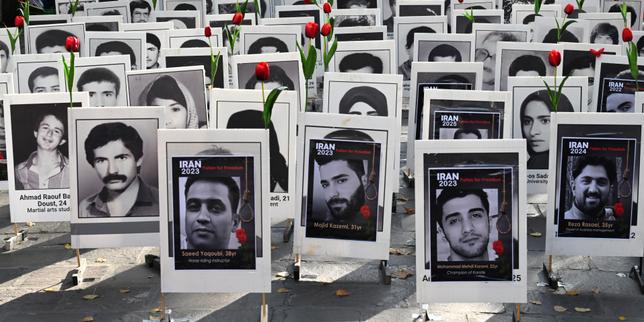
The sun has not yet crested the jagged peaks of the Alborz Mountains, but in the courtyard of a prison near Tehran, the air is already heavy. It is a specific kind of silence. Not the peaceful quiet of a sleeping city, but the pressurized, suffocating stillness that precedes a crack of thunder. Somewhere in the corridors, a key turns in a heavy iron lock. The sound vibrates through the concrete floor, traveling up the soles of the feet of men who know they will never see another sunset.
They are not just names on a ledger. One might be a father who once sold his watch to buy his daughter a birthday cake. Another might be a young man whose only crime was a desperate need for the world to hear his voice. But in the eyes of the state, they have been reduced to a statistic in a grim, accelerating tally.
Since the fires of regional conflict began to roar beyond Iran’s borders, a quieter, deadlier fire has been burning within them. While the world fixes its gaze on the flight paths of missiles and the rhetoric of generals, the gallows are working overtime.
The Fog of External War
War is a convenient curtain. When the drums of international conflict beat loud enough, they drown out the protests of the condemned and the weeping of their families. It is a pattern as old as governance itself: when a regime feels the pressure of external threats, it tightens its grip on the internal pulse.
In Iran, the intensification of the death penalty has mirrored the escalation of regional tensions with chilling precision. It is no coincidence. As the threat of escalation with Israel and the West looms, the domestic judicial system has shifted into a higher gear.
Consider a hypothetical citizen—let’s call him Arash. Arash isn't a spy or a general. He is a man caught in the machinery of a system that views dissent as treason and poverty-driven crime as a threat to the moral fabric of the nation. In a time of peace, Arash might have languished in a cell for years, his case winding through a labyrinth of appeals. But in a time of "national emergency," the labyrinth is straightened into a direct line to the rope.
The logic is brutal and binary. The state must project strength. It must signal to its own people that any internal fracture will be met with absolute finality. The gallows are not just for punishment; they are for theater.
The Math of Human Loss
Numbers are cold, but they tell a story that prose sometimes cannot. In the past year, the rate of executions in Iran has surged to levels not seen in nearly a decade. We are talking about hundreds of lives extinguished.
The charges vary. Many are tied to drug offenses—a desperate trade in a sanctioned, struggling economy. Others are labeled "enmity against God" or "corruption on earth," vague, elastic terms that can be stretched to fit a protester’s chant or a blogger’s critique.
But the real story is in the timing.
When the news cycle is dominated by drone strikes in Isfahan or naval skirmishes in the Red Sea, the execution count spikes. It is a strategic shadow-play. The international community, preoccupied with preventing a third world war, finds its bandwidth for human rights advocacy stretched thin. The diplomats are busy. The headlines are full. And so, the trapdoor swings open in the dark.
The Invisible Stakes
We often talk about the death penalty as a legal or political issue. We debate the ethics of the state’s right to kill. But the invisible stakes are found in the living rooms of Karaj, Mashhad, and Shiraz.
Imagine a mother sitting by a phone that she knows will eventually bring the worst news of her life. She is not thinking about geopolitics. She is not thinking about the "Axis of Resistance" or the price of Brent crude. She is thinking about the way her son used to take his tea with two cubes of sugar. She is thinking about the last time she was allowed to touch his hand through a glass partition.
The state uses these executions to "foster" a sense of order, but it reaps a harvest of resentment. Every rope tightened around a neck is a cord cut between the government and its people. The trauma is multi-generational. It seeps into the soil.
The psychological toll on the Iranian public is a heavy, unspoken weight. There is a sense of "اعدام" (execution) becoming a background noise to daily life—a terrifying, rhythmic thrumming that reminds everyone of their own fragility. When the state kills more frequently, it doesn't necessarily make people more obedient; it makes them more desperate.
The Logic of the Cornered
Why now? Why this sudden, frantic pace?
To understand the surge, one must understand the vulnerability of the machine. The 2022 protests sparked by the death of Mahsa Amini didn't just rattle the windows of the parliament; they shook the foundation. For the first time in decades, the regime saw a generation that was not afraid.
Then came the regional war.
A regime that feels squeezed from the outside and challenged from the inside reacts like a cornered animal. It lashes out. It shows its teeth. The spike in executions is a desperate attempt to regain the "aura of invincibility" that was lost on the streets of Tehran two years ago.
It is a grizzly form of communication. The message isn't for the diplomats in Geneva. It is for the teenager in Isfahan who is thinking about making a placard. It says: Look at how little we value a life. Imagine what we will do to yours.
The Architecture of the End
There is a grim efficiency to the process now. Trials that used to take months are condensed into minutes. Legal representation is often a formality, a ghost in the room. In some cases, the families are only notified after the burial has already taken place in a remote corner of a cemetery.
This is the "human-centric" reality of the statistics.
The world sees a graph with an upward-sloping line. The people of Iran see a fatherless house. They see an empty chair at the dinner table. They see a judicial system that has abandoned the pursuit of justice in favor of the pursuit of survival.
The tragedy is that this escalation works, in the shortest of terms. It clears the streets. It silences the critics. But it is a temporary fix, like trying to put out a fire by throwing a heavy blanket over it while the embers still glow underneath. The oxygen is gone, but the heat remains.
The sun finally rises over the prison walls. The shift changes. The guards go home to their own families. The world wakes up and checks the news for updates on the latest missile ranges or diplomatic stalemates.
The tally has increased by three today. Somewhere, a phone rings in a small apartment. A mother picks it up. The silence on the other end of the line is the loudest sound in the world.
The shadow of the scaffold grows longer as the day begins, stretching across the country, touching every doorstep, reminding a nation that while the war might be at the borders, the real casualties are being claimed in the courtyard at dawn.


