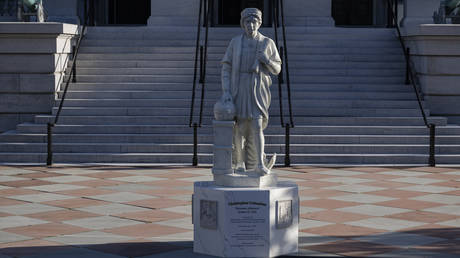
Six years after the explosive civil unrest of 2020 saw hundreds of confederate and colonial statues toppled or quietly carted away into storage, a well-funded, highly coordinated counter-offensive is underway to put them back. Activists, legal foundations, and local heritage groups are quietly moving from public protests to municipal courtrooms and state legislatures, demanding the reinstatement of monuments removed during the Black Lives Matter demonstrations. This isn't just a nostalgic yearning for the past. It is a sophisticated legal and political campaign aimed at rewriting municipal property laws and punishing cities that bucked state-level heritage preservation mandates.
The battle lines have shifted entirely. While the initial "statue wars" were fought in the streets with ropes and spray paint, today’s conflict is waged through bureaucratic maneuvers, open-records requests, and high-stakes litigation.
The Legal Trapdoors Snaring American Cities
When mayors and city councils ordered the rapid removal of controversial statues in 2020, many did so under emergency declarations. They cited public safety. Protests were volatile, and the risk of heavy bronze figures falling on demonstrators was real. But emergency powers are temporary by nature. Now, conservative legal advocacy groups are using that exact vulnerability to trap municipalities in court.
The core legal argument is straightforward. Activists argue that city officials exceeded their authority by turning temporary safety removals into permanent banishments. In states across the American South, including Virginia, North Carolina, Tennessee, and Alabama, strict monument protection laws were already on the books before 2020. These statutes explicitly forbid the removal, damaging, or relocation of monuments dedicated to historical figures or military conflicts.
Consider how this plays out in practice. A city council votes to remove a bust of a Confederate general to appease local protests, paying a contractor hundreds of thousands of dollars to store it in a secure warehouse. Two years later, a historical preservation society sues the city, arguing the removal violated state law. The court agrees. The city is then faced with a brutal choice: spend millions of taxpayer dollars fighting a losing appeal, pay hefty statutory fines, or put the statue right back where it came from.
Alabama has aggressively weaponized this strategy. The state's Monument Preservation Act levies a one-time $25,000 fine on entities that remove historic structures. For major cities like Birmingham or Mobile, that fine was a drop in the bucket—a flat fee paid willingly to ensure public order. However, newer legislative proposals aim to change the fine from a one-time penalty to a daily accruing charge. That turns a manageable expense into a municipal bankruptcy trap.
The Warehouse Crisis and the Secret Relocation Network
Where do statues go to die? Right now, hundreds of millions of dollars worth of American public art sits in undisclosed locations. They are wrapped in industrial plastic, crated in wood, and stored in gravel lots, military bases, and anonymous industrial parks.
The Cost of Storing History
Maintaining these hidden repositories is costing taxpayers a fortune. Climate control is necessary to prevent bronze disease and the degradation of marble or limestone. Security is an even greater expense. Cities must guard these warehouses against two entirely different groups: anti-monument activists looking to finish the job, and far-right groups seeking to reclaim the relics.
- Climate Management: Preventing moisture buildup that corrodes century-old metal work.
- Active Security: 24-hour surveillance to prevent theft or vandalism of high-profile political targets.
- Insurance Liability: Skyrocketing premiums for municipalities housing high-value, highly controversial assets.
Because of these mounting costs, a quiet secondary market has emerged. Heritage organizations are offering to take the monuments off the cities' hands entirely. On the surface, this looks like a win-win for cash-strapped local governments. The city rids itself of a political lightning rod and a budgetary drain, while the heritage group preserves the artifact.
The reality is far more complicated. These groups rarely intend to keep the statues hidden in private museums. Instead, they are leveraging property transfer loopholes to place the monuments on private land that sits immediately adjacent to public spaces. A statue of a plantation owner might be removed from a courthouse square, only to reappear three months later on a private lot across the street, fully visible to every citizen entering the court. By shifting the monument from public to private property, activists insulate the statue from constitutional challenges regarding government speech while keeping it firmly in the public eye.
The Heritage Defense Funding Machine
This resurgence did not happen organically. It is fueled by an influx of capital from private donors, family foundations, and specialized political action committees.
For decades, organizations like the United Daughters of the Confederacy or the Sons of Confederate Veterans were viewed as aging, largely ceremonial clubs. That perception is dangerously outdated. Today, these organizations have aligned themselves with sophisticated constitutional litigation firms. They aren't just filing boilerplate lawsuits; they are hiring top-tier appellate lawyers who specialize in property rights and historical preservation law.
[Private Donors / Foundations] ──> [Legal Defense Funds] ──> [Targeted Municipal Lawsuits]
                                                                     │
[Local Heritage Chapters] ───────> [Statute Tracking Databases] ─────┘
They have built comprehensive tracking databases that monitor every single monument removed since 2015. They log the exact date of removal, the legal mechanism used by the city, the current storage location, and the specific state statutes in play. When a municipality shows signs of political shift—perhaps a more conservative city council is elected—the legal machine strikes, offering the new administration a ready-made blueprint to return the statues with minimal political friction.
The Counter Argument and the Battle for Public Space
Proponents of returning the monuments reject the idea that they are reviving lost causes or white supremacy. They frame their argument around the concept of historical erasure and the rule of law. They argue that removing a monument because it represents an uncomfortable or objectionable era of American history is a slippery slope that ends with the destruction of all civic history.
They also point to the undemocratic nature of many removals. In the heat of 2020, many decisions were made during late-night, unannounced city council sessions or via executive orders that bypassed the standard public comment periods required for altering civic spaces. By forcing the issue back onto the agenda, activists claim they are restoring due process.
But this argument ignores the profound psychological weight these monuments hold for a significant portion of the population. Most of the Confederate monuments in question were not erected immediately after the Civil War to honor the dead. They were mass-produced and installed during two distinct periods: the implementation of Jim Crow laws in the early 1900s, and the height of the Civil Rights Movement in the 1950s and 1960s. They were designed as explicit assertions of political dominance.
Returning these statues to positions of civic honor sends a clear, chilling message to minority communities about who owns the public square. It reopens wounds that cities spent years trying to heal, virtually guaranteeing a return to the civic unrest that prompted the removals in the first place.
Re-inscription Versus Re-installation
Some municipalities are trying to find a middle ground, though neither side seems particularly interested in compromise. The concept of "re-inscription" involves putting statues back but radically altering their context. This means stripping away the celebratory plaques and replacing them with historical markers that detail the subject's involvement in slavery, treason, or systemic oppression.
The Problem with Contextualization
It rarely works. To the activist groups funding the return campaigns, adding a critical plaque is a desecration of the monument's original intent, leading to further lawsuits over architectural altering of historic properties. To the groups who fought to take them down, a contextualized statue of an oppressor is still a statue of an oppressor occupying a position of prominence.
Furthermore, the physical reality of these monuments makes neutral presentation nearly impossible. They were engineered to intimidate. They stand on massive granite plinths, towering fifteen to twenty feet above the pedestrian. You cannot easily contextualize a figure designed to look down upon the citizenry; the architecture itself forces a relationship of submission.
The Fractured Future of the American Square
We are entering a volatile phase where the American civic landscape will look like a patchwork of historical resentment. As red states tighten monument laws and blue urban centers resist them, the physical makeup of our cities will depend entirely on which political party holds power at the state capitol.
This is no longer a debate about history. The statues have become proxy soldiers in a larger war over institutional control, property rights, and the power of local governments to define their own cultural identity. Cities that thought they had closed this chapter when the cranes drove away in 2020 are finding out that history, when bolted to a granite foundation, is incredibly difficult to bury.
The legal notices are being served. The warehouse locks are being turned. The statues are waiting.