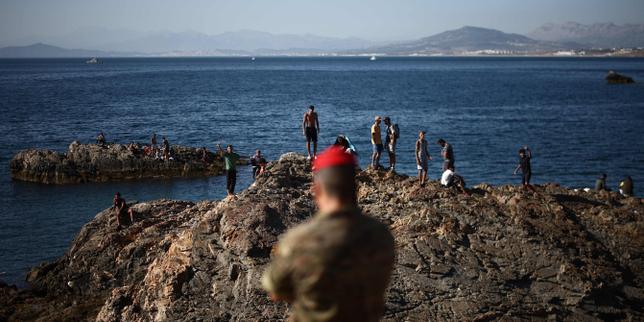
The air in the north of Morocco smells of salt and old dust, a sharp reminder that the African continent does not simply end at the water. It pushes forward. It breathes against the southern belly of Europe through two small, stubborn pins on the map: Ceuta and Melilla.
Standing on the ridge overlooking Ceuta, the sea stretches out like a sheet of hammered tin. Across that water lies mainland Spain, a mere fourteen kilometers away. But down below, pressed hard against the perimeter fence, the reality is entirely different. This is not just a border. It is a slow-motion pressure valve.
Consider the daily rhythm. Trucks rumble across the border crossing of Tarajal, loaded with crates of fruit, electronics, and textiles. For decades, this trade was the lifeblood of thousands of families. Women known locally as porteadoras, or burden-bearers, would load their backs with bales of merchandise, walking across the threshold to sell goods in Spanish territory without paying standard customs duties. It was a chaotic, punishing existence. It was also an economic lifeline.
Then, the valve turned.
In late 2019, Rabat unilaterally suspended commercial customs at Ceuta's Tarajal checkpoint. Melilla followed soon after. The official explanations were bureaucratic, citing the need to modernize infrastructure and combat smuggling. But the geopolitical subtext was impossible to ignore. Morocco was shifting its weight.
To understand why this matters, look at the geography. Ceuta and Melilla are the only European Union land borders on the African continent. They are tiny anomalies, remnants of an imperial past, inherited by Spain centuries ago. For Morocco, their very existence is an open sore on national sovereignty. For Spain, they are integral municipalities, protected by NATO and defended with fierce political rhetoric.
Imagine standing in the shoes of a merchant in Melilla whose business model vanished overnight. (Hypothetically, let us call him Tariq, though his story echoes a hundred others.) Tariq spent twenty years building a wholesale export business supplying goods across the border. When the crossings closed to commercial goods, his customer base evaporated. The warehouses emptied. The banks came calling.
"We are collateral damage in a game of chess we never agreed to play," Tariq told me once, his voice flat with exhaustion, gesturing to a row of shuttered storefronts.
That is the human cost of high-level diplomacy.
The pressure is not only economic. It is migratory, demographic, and psychological. Morocco holds the keys to the southern migration route. When diplomatic relations between Madrid and Rabat are warm, the gates hold. When tensions flare—such as the diplomatic crisis in 2021 when thousands of migrants swam or waded into Ceuta after Rabat seemingly relaxed border controls—the pressure becomes an inundation.
It is an invisible lever. Rabat does not need to fire a shot to remind Madrid of its influence. It merely needs to look away for a weekend.
The Spanish government finds itself in a perpetual tightrope walk. To push back too hard is to risk a complete collapse of cooperation on counter-terrorism and migration management. To yield too much is to invite questions about the long-term viability of these two Spanish outposts.
Economics, after all, follows the path of least resistance. With the traditional border trade strangled, smuggling routes dried up, and Morocco investing heavily in its own northern infrastructure—including the massive Tanger-Med port complex just down the coast—the gravitational pull of the mainland has shifted. Morocco is building its own economic gravity. It wants Ceuta and Melilla to wither on the vine, dependent, isolated, and ultimately untenable.
Talks between Madrid and Rabat have sputtered on and off regarding the reopening of customs. Pilot tests have been announced and delayed. Officials meet in gilded rooms, shaking hands for the cameras, while on the ground, the fences remain high and the economic blood supply stays pinched.
The historical irony is stark. For centuries, Europe projected power outward into Africa. Today, Europe finds itself playing defense on the margins, holding onto tiny historical footholds while the surrounding continent rises in economic and demographic confidence.
The fence at Ceuta is made of steel and mesh, topped with razor wire that gleams cruelly under the Mediterranean sun. It separates two worlds, yet it binds them together in a tense, inescapable embrace.
When the sun sets over the Strait of Gibraltar, the lights of Spain twinkle faintly on the northern horizon, so close you feel you could reach out and touch them. Yet between those lights and the rocky shores of Africa lies a deep, unbridgeable gulf of history, ambition, and quiet, relentless pressure. The question is not whether the enclaves can survive. The question is how much weight they can bear before something finally gives way.