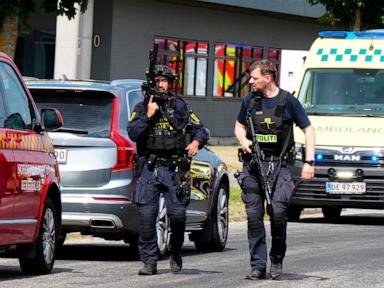
The coffee in a Danish patrol car is almost always lukewarm by the time the real work begins. It sits in a dented metal cup holder, vibrating slightly against the plastic dashboard as the vehicle navigates the clean, predictable streets of a society built on the very idea of safety. For generations, wearing the uniform of the Rigspolitiet—the Danish National Police—carried a specific kind of weight. It was the weight of authority, yes, but mostly it was the weight of trust. You walked into situations expecting compliance because the social contract was thick, signed in the invisible ink of mutual respect.
Then the glass breaks. The metal tears. The illusion of absolute safety evaporates in the span of a single heartbeat.
When the call came through the radio, it didn't sound like history changing. It sounded like standard procedure. A routine intervention, a neighborhood disturbance, the kind of friction that occurs when human lives rub too closely together in tight urban spaces. The officers who responded did what they always do. They checked their gear, adjusted their belts, and stepped out into the crisp European air. They brought with them the training of a modern, de-escalation-first police force. They brought patience.
They did not expect the gunfire.
The Anatomy of a Second
A bullet travels faster than the human brain can process the concept of betrayal. When the suspect opened fire, the immediate reality was not one of tactical precision, but of profound, chaotic disorientation. The sound of a gunshot in a quiet Danish neighborhood does not belong. It is an alien frequency, a violent tear in the fabric of a Tuesday afternoon.
The first round found its mark, striking a veteran officer.
In that precise moment, the uniform ceases to be a symbol of the state and becomes nothing more than fabric pressing against a sudden, catastrophic wound. The human body inside that uniform reacts exactly like any other. The adrenaline surges, blinding and hot. The pavement feels harder. The sky seems suddenly distant.
But the chaos did not stop with the law. In the frantic seconds that followed, the trajectory of the violence expanded, swallowing those who happened to be standing in the wrong square of geography at the wrong tick of the clock. A bystander, completely disconnected from the grievance driving the shooter, was caught in the crossfire.
Blood spilled onto the clean pavement.
To understand the gravity of this moment, one must understand Denmark’s relationship with violence. This is a nation where police officers routinely patrol without the heavy, militarized posture seen in other corners of the globe. The authority of the law is maintained through presence, not the threat of overwhelming force. When three people—an officer, an innocent citizen, and the suspected perpetrator himself—end up bleeding on the street, the shockwave ripples far beyond the police tape.
The Echoes in the Neighborhood
The immediate aftermath of a shooting is strangely quiet. Once the sirens fade and the ambulances scream toward the nearest trauma center, a heavy, suffocating silence descends on the scene.
Consider the people looking out from their apartment windows. They saw the flashing blue lights reflecting off the brick facades. They saw the discarded medical wrappers, the chalk circles, the dropped equipment left behind in the rush to save lives. For these residents, the neighborhood changed permanently in those few minutes. The street they walk every morning to buy rye bread or drop their children off at daycare is now a crime scene.
The suspect, too, lay on the ground, neutralized by returning fire but bound to the same human frailty as the victims he created. The ambulance rides for the wounded are filled with the same frantic energy, regardless of who wore the badge and who held the gun. The monitors beep with the same desperate urgency. The sterile smell of the emergency room welcomes them all without judgment.
This is the hidden cost of public service in an era where predictability is dying. Every time an officer steps out of a vehicle, there is a silent calculation being made. They leave behind families who watch the news with a tight, recurring knot in their stomachs.
The Myth of the Safe Haven
We often look at Scandinavia as a fortress of social stability, a place where the darker impulses of humanity have been successfully managed by good governance and strong social safety nets. It is a comforting narrative. We want to believe that somewhere on Earth, the formula has been perfected.
But human nature is remarkably stubborn. Isolation, mental fracture, and sudden rage do not respect borders or social welfare models. When the suspect pulled the trigger, he proved that no society is entirely insulated from the raw, unpredictable flash of violence. The stakes are always alive, humming just beneath the surface of the cleanest cities.
The conversation that follows an event like this usually turns toward policy. Experts will debate gun access, mental health interventions, and police tactics. They will analyze the response times and the caliber of the weapons used.
But the real truth lives in the hospital rooms where three families are currently waiting for updates. It lives in the precinct communal room, where officers stare at an empty locker, wondering if the next shift will demand the same price. The true measure of the event is found in the sudden, sharp realization that safety is not a permanent state of being. It is an ongoing, fragile agreement that requires constant protection, often at a terrible human cost.