The blue light of a laptop screen at 4:32 AM hits a face differently when it illuminates an severance package rather than a line of code.
For Sarah—a composite profile of the senior product designers who spent the last half-decade building the visual architecture of our digital social lives—the notification didn't arrive with a dramatic boardroom confrontation. It came as a sudden, sterile digital lockout. A Slack channel disappearing. An internal directory yielding a 404 error.
Meta just cut eight thousand human beings from its payroll.
The corporate press release framed the decision in the bloodless vocabulary of Wall Street: "strategic realignments," "operational efficiencies," and "the optimization of infrastructure." But behind the sterile mathematics of an 8,000-person layoff lies a deeper, far more unsettling reality about the future of work, intelligence, and the value of human ingenuity in an era dominated by automation.
This isn't a story about a company correcting a pandemic-era hiring binge. This is the first major casualty list of the artificial intelligence revolution.
The Ghost in the Server Room
To understand how we arrived at this moment, we have to look past the stock prices and look at the physical architecture of Silicon Valley. For twenty years, the formula for tech dominance was simple: hoard talent. Companies competed in a fierce arms race to hire the brightest minds from the world's top universities, offering six-figure starting salaries, gourmet cafeterias, and on-site dry cleaning. Human capital was the ultimate status symbol.
But the servers grew hungrier.
Over the past eighteen months, a quiet panic took hold of the upper echelons of tech leadership. The massive language models and predictive algorithms that once felt like neat parlor tricks suddenly mutated into highly competent engines of productivity. A task that once required a team of five engineers, three weeks, and twenty thousand dollars in espresso-fueled late nights can now be generated by a single prompt in less than ninety seconds.
The equation changed overnight. Humans are expensive. They require healthcare, dental plans, maternity leave, and psychological safety. Code, once trained on the collective output of human civilization, requires only electricity and cooling fluid.
When Mark Zuckerberg announced the "Year of Efficiency," many insiders assumed it was a temporary belt-tightening measure to appease nervous shareholders. It wasn't. It was a structural teardown. The reduction of 8,000 roles isn't a sign that Meta is shrinking; it is a sign that Meta is mutating. The company is actively stripping away the human layer of its organization to fund the unimaginably expensive hardware required to build the future of artificial intelligence. They are trading salaries for semiconductors.
The Friction of the Pivot
Think of a massive cruise ship trying to make a hard right turn at sixty knots. That is what a legacy tech giant looks like when it decides to pivot toward AI.
The sheer capital required to compete in the current technology race is staggering. It is no longer enough to build software; companies must now buy up the world's supply of advanced microchips, build data centers that consume as much power as small European nations, and secure the intellectual property rights to massive troves of human data. Every dollar spent on a mid-level manager's salary is a dollar that cannot be spent purchasing an H100 graphics processing unit.
The tragedy of the modern tech worker is that they built the tools that made them redundant.
Every time a developer committed code to a repository, every time a designer refined a user interface, they were unknowingly training the very algorithms that would eventually replace them. The machine learned by watching them work. Now, it can mimic their output with terrifying accuracy and infinite patience.
Consider what happens next inside the walls of Menlo Park. The remaining workforce will not simply absorb the duties of their departed colleagues. Instead, they are being asked to become "AI whisperers"—managers of digital systems rather than creators of original work. The job shifts from writing code to auditing the code written by an algorithm. It is a psychological demotion disguised as an advancement.
The Myth of the Safe Profession
For a generation, parents gave their children a universal piece of advice: learn to code. It was viewed as the ultimate hedge against economic volatility, a golden ticket to the upper middle class. The tech sector was deemed immune to the forces of automation that had previously hollowed out the manufacturing plants of the Rust Belt and the textile mills of the American South.
That shield has shattered.
The current wave of restructuring proves that intellectual labor is just as vulnerable to automation as manual labor—perhaps even more so. It is far easier for an AI to write a functional Python script or generate a marketing strategy than it is for a mechanical robot to navigate a crowded room and fold a basket of laundry. The white-collar fortress is under siege, and the gates are being opened from the inside.
This shift creates a profound cultural crisis within the tech industry. The identity of the Silicon Valley worker was always tied to a sense of messianic purpose. They weren't just employees; they were "changing the world." But when you are replaced by a line of code, the illusion of indispensability vanishes. You realize you were never an architect of the future; you were just a temporary construction worker building the platform for the machine.
The New Economic Architecture
The ripple effects of Meta's decision will extend far beyond the immediate families of the eight thousand affected workers. They will reshape the entire economic ecosystem of the technology sector.
We are witnessing the end of the hyper-growth startup era. For years, the goal of every young tech company was to scale up their headcount as quickly as possible to attract venture capital. A large employee base was proof of traction. In the new paradigm, the most valuable companies will be those that keep their human footprint as small as possible. We are fast approaching the era of the billion-dollar, three-person company—an organization where a handful of founders direct an army of autonomous digital agents.
This leaves a massive population of highly skilled, highly educated workers adrift. Where do they go when the entire industry is experiencing the same contraction? Some will attempt to build their own AI-native startups, entering a hyper-competitive market where capital is scarce and computing power is hoarded by a few corporate gatekeepers. Others will be forced to reinvent themselves entirely, searching for roles where human empathy, physical presence, and emotional nuance cannot be replicated by a machine.
The market is delivering a brutal lesson in economic reality: value is determined by scarcity. And right now, standard intellectual labor is becoming abundant, cheap, and commodified.
The Invisible Ledger
The corporate balance sheet will show this layoff as a triumph. The stock price will likely tick upward. Analysts will write glowing reports about fiscal discipline and strategic foresight. The company will appear leaner, faster, and more prepared for the technological arms race that lies ahead.
But the real ledger—the human one—tells a different story.
It is a story told in the quiet conversations between partners at kitchen tables, trying to figure out how to pay a Silicon Valley mortgage without an enterprise-level income. It is the sudden loss of community among teams that spent years solving complex problems together, now scattered to the winds by an automated email. It is the creeping realization among the younger generation of engineers that the industry they spent their youth preparing for no longer exists.
The transition to an AI-driven economy is not a bloodless evolution. It is a collision. And as the machines grow more capable, the impact zone will only widen.
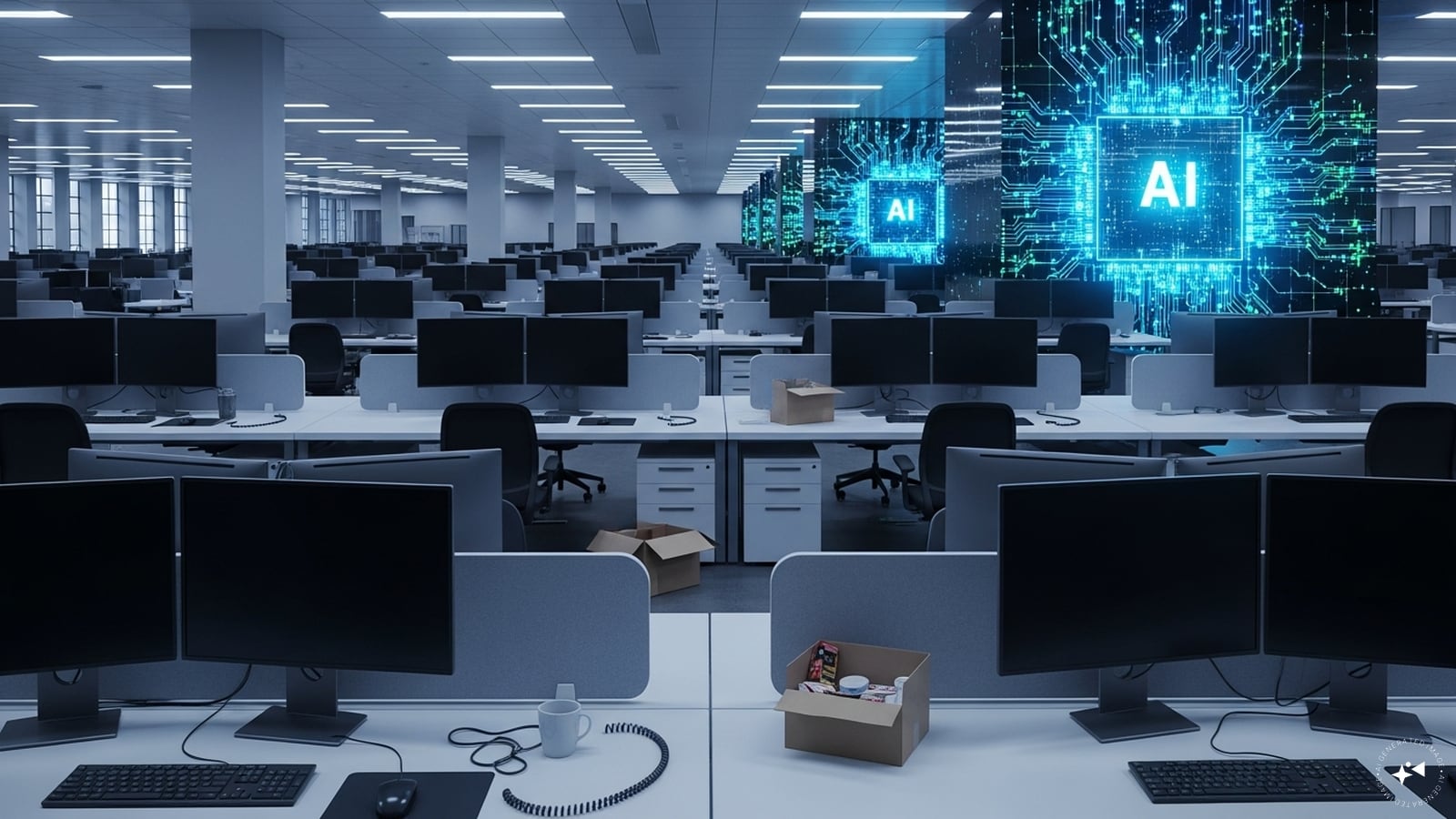
The sun rises over the quiet office parks of Menlo Park, casting long shadows across empty desks and dark computer screens. The servers in the basement hum with a new, uninterrupted intensity, processing petabytes of data, generating code, optimizing systems, and working through the night without a single pause for breath.