Hunger has a sound.
If you have ever sat beside someone who has refused food for seventy-two hours, you know it is not a dramatic wail or a theatrical collapse, but rather a dry, papery rasp in the throat, the faintest click of a swallowing reflex that has nothing left to move, and a stillness so heavy it seems to pull the humidity right out of the tropical air. You might also find this connected article interesting: When Sacred Stones Become Political Weapons in India.
In Sri Lanka, three Buddhist monks have chosen that stillness.
They sat down on woven mats beneath the blazing sun, folded their saffron robes neatly around their knees, and stopped eating. Not out of spite. Not for political office, nor for the cameras that inevitably cluster around human suffering like moths to a lantern. They stopped eating because concrete mixers are rolling toward a sacred ancient ground, and nobody in power seemed willing to listen to a quiet plea. As discussed in recent reports by TIME, the effects are significant.
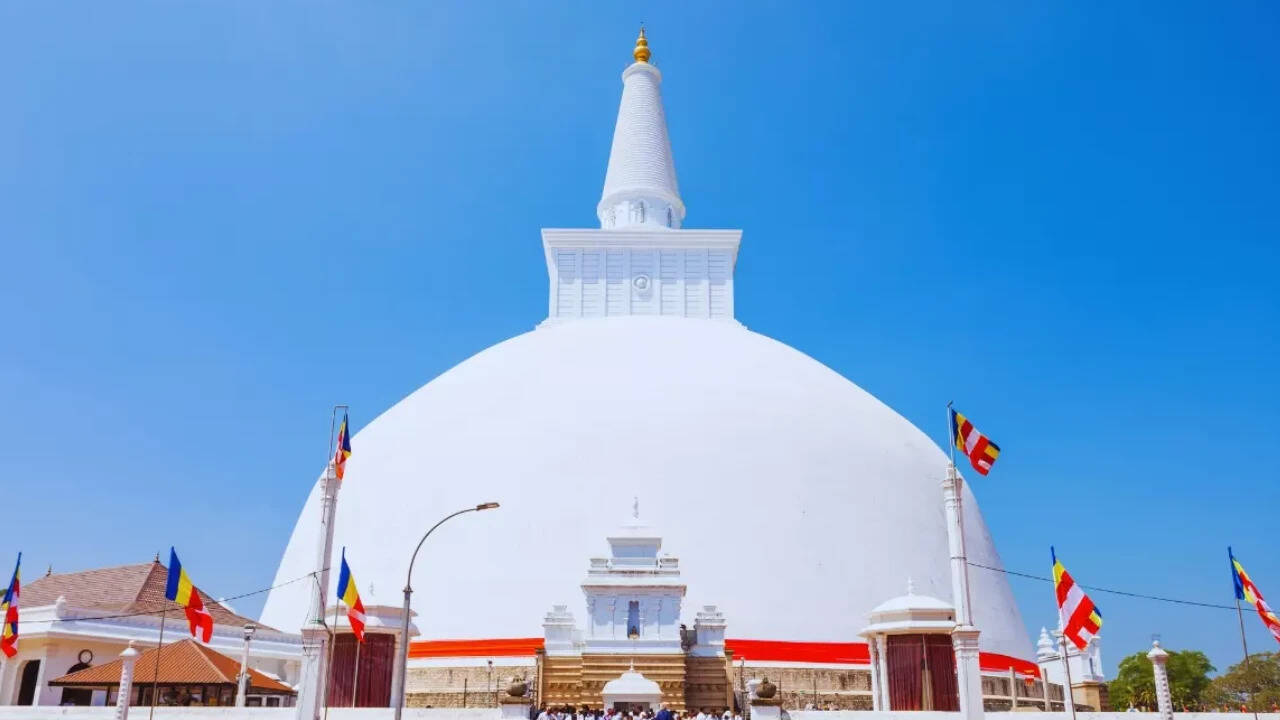
To understand why three men would weaponize their own starvation against a construction blueprint, you have to step away from the cold, sterile phrasing of municipal zoning laws and press releases. You have to smell the crushed frangipani blossoms under bare feet at dawn. You have to feel the cool, worn granite of a thousand-year-old stupa pressing against your forehead while the rest of the modern world screams past on motorbikes.
The Architecture of Memory
Consider a hypothetical pilgrim—let us call her Nimali—who has walked the same dusty path to this temple complex every full moon since she was seven years old.
For Nimali, the site is not an "archaeological asset" or a "underutilized tourism corridor." It is the physical spine of her family's memory. Her grandfather laid bricks along the outer wall during the monsoon of 1954. Her mother lit clay oil lamps in the exact alcove where state planners now envision a wide, paved promenade flanked by commercial stalls, modern ticketing booths, and gleaming concrete rest stops.
When government officials look at a major Buddhist heritage site in Sri Lanka, they often see spreadsheets. They see visitor capacity, foreign exchange revenue, crowd-flow bottlenecks, and infrastructure grants. Following the economic collapse that battered the island in recent years, the pressure to monetize every square inch of cultural heritage has become relentless. Tourism is the lifeline, and modernizing ancient sites is sold to the public as common sense.
Who, after all, argues against cleaner restrooms, wider access roads, and better lighting?
The monks do. Not because they hate progress, and certainly not because they want pilgrims to suffer in the mud. They are protesting because sacred spaces operate on a completely different physics than theme parks.
Think of an ancient forest compared to a manicured city park. Both have trees. Both offer shade. Yet when you pave over the forest floor, install floodlights, and straighten the winding trails so tour buses can park closer to the canopy, you do not merely improve access to the wilderness—you erase the wilderness itself. You turn a sanctuary into a spectacle.
The Invisible Stakes of Concrete
The dispute tearing through this community is rooted in a planned state-backed redevelopment project at a revered Buddhist temple complex, an initiative framed by authorities as essential preservation and visitor enhancement. Local clergy and heritage defenders, however, see something far darker: the irreversible alteration of a living monastic sanctuary without genuine consultation with the people who guard its spiritual pulse.
I still remember the first time I watched a historic temple courtyard in South Asia get "upgraded." Over the course of a single dry season, ancient irregular flagstones—stones polished smooth by centuries of knees and bare soles—were pried up with crowbars and replaced with uniform, machine-cut granite tiles. The contractor was proud of his work. The drainage was immaculate. The lines were laser-straight. And the soul of the place had vanished overnight, replaced by the sterile echo of a shopping mall lobby.
Once you pour reinforced concrete over sacred soil, you cannot un-pour it.
That finality is what drove three monks to lay down their alms bowls. In the Theravada Buddhist tradition practiced across Sri Lanka, the relationship between the Sangha—the monastic community—and the laypeople is bound by a daily, intimate ritual. Every morning, villagers wake before sunrise to cook rice and curry, placing food into the bowls of passing monks. Giving food sustains the monks' bodies; receiving it allows the laypeople to cultivate generosity and merit.
When a monk refuses to eat, that ancient circuit breaks.
It sends an immediate, visceral shockwave through the surrounding villages. A hunger strike by Buddhist clergy is never just a personal medical emergency; it is a public moral alarm. It forces every bystander, every local official, and every police officer standing guard at the perimeter to confront an uncomfortable question: What kind of society forces its spiritual elders to starve in order to protect a temple?
Why They Refused to Compromise
Naturally, critics and state representatives have rushed to explain their side. Officials argue that the redevelopment plan is designed to protect the site from overcrowding, manage environmental degradation, and accommodate the surging numbers of domestic and international visitors who arrive during major religious festivals. They insist that ancient monuments will remain untouched, that the construction targets peripheral zones, and that the project represents responsible stewardship for future generations.
On paper, the official reassurance sounds reasonable. Almost soothing.
Yet those who have lived through state-led heritage projects in Sri Lanka know the wide, treacherous gap between an architectural rendering in Colombo and a bulldozer operator in a rural district. Boundaries shift once contracts are signed. "Peripheral zones" quietly expand to make room for parking lots, VIP waiting lounges, and vendor complexes. Archaeological layers that survived colonial invasions, civil war, and centuries of tropical storms can be pulverized in a single afternoon by a backhoe digging a utility trench.
The monks at the center of this protest aren't naive. They have watched other sacred sites across the island slowly transform into commercialized heritage zones where quiet meditation becomes impossible over the hum of generators and the chatter of guided tour megaphones.
When they issued warnings, they were met with bureaucratic delays. When they requested transparent reviews of the construction blueprints and environmental impact assessments, they received vague assurances that everything was proceeding according to standard protocol. Standard protocol, in the eyes of the monks, is simply a polite phrase for ignoring the custodians of the land until the concrete has already dried.
The Anatomy of a Protest
By the second day without food, the human body begins to consume itself.
First goes the glycogen stored in the liver, leaving the limbs heavy and the mind foggy. By the third day, blood pressure drops, dizziness sets in whenever the head is raised, and the tropical heat—normally absorbed with quiet stoicism by men accustomed to simple living—turns hostile. Every breath feels shallower. The lips crack.
Around the three fasting monks, a fragile ecosystem of solidarity has formed. Lay devotees arrive in quiet clusters, bringing bottles of water—the only thing the protesters allow past their lips—and holding vigil under makeshift tarps. Some weep openly; others sit in rigid, silent meditation, channeling their anger into stillness. Local shopkeepers shutter their doors in sympathy. Police officers stand awkwardly at the edge of the compound, caught between their orders to maintain order and their deep cultural reverence for the men wasting away in front of them.
It is easy, from a distance, to dismiss a hunger strike as emotional blackmail. Skeptics often argue that policy decisions should be made by engineers, archaeologists, and urban planners rather than through public displays of physical self-harm.
That argument misses the entire point of nonviolent resistance.
When ordinary citizens have no seat at the table where decisions are signed, their own bodies become the last piece of territory they truly control. The three monks are not threatening violence against workers. They are not burning tires on the highway or smashing machinery. They are simply holding up a mirror to the state, demonstrating through their own visible weakening what they believe the redevelopment project will do to the spirit of the sanctuary.
What We Lose When We Modernize Everything
Step back for a moment and ask yourself: why do people travel thousands of miles to visit ancient Buddhist sites in Sri Lanka in the first place?
Nobody boards a fourteen-hour flight to admire freshly poured concrete walkways or standardized steel railings. Travelers, pilgrims, and seekers come because these places offer something increasingly extinct in the twenty-first century: continuity. They offer the rare, intoxicating sensation of stepping into a space where time moves at the speed of incense smoke rather than fiber-optic cables.
There is a profound difference between preserving a heritage site and packaging it.
Preservation is humble. It repairs a crumbling wall using traditional lime mortar so the stone can breathe. It limits visitor numbers when fragile foundations begin to sink. It listens first to the monks who sweep the courtyard at four in the morning, because they know how the wind moves through the bodhi tree and where the rainwater pools during November storms.
Packaging, by contrast, is arrogant. It assumes that an ancient place is incomplete until modern planners make it convenient, profitable, and uniform. It prioritizes ticket throughput over reverence, convenience over contemplation, and construction budgets over living tradition.
I admit, there is a genuine tension here that no simple slogan can solve. Sri Lanka desperately needs economic recovery. Sacred sites do face real physical strain when tens of thousands of pilgrims descend on a single weekend without adequate sanitation or crowd management. Ignoring infrastructure completely can lead to a different kind of ruin—trampled gardens, polluted waterways, and crumbling steps.
The tragedy unfolding around these three fasting monks is not that someone wanted to fix a drainage pipe or build a restroom. The tragedy is the refusal to treat the spiritual custodians of the site as equal partners before the first shovel hit the dirt.
The Sound of Waiting
As hours stretch into days, negotiations behind closed doors grow frantic. Regional administrators, senior Buddhist prelates, and government representatives shuttle back and forth, searching for a formula that allows officials to save face while convincing the three monks to take a sip of sweetened porridge and end their fast.
Maybe a temporary suspension of construction will be announced by tonight. Maybe a committee will be formed, promises will be made in front of television microphones, and the bulldozers will sit idle for a few weeks until the headlines fade.
Or maybe, if pride wins out over wisdom, one of the monks will be carried away on a stretcher, leaving behind a wound in the community that no amount of development money will ever heal.
Walk past the temple gates tonight, after the news vans have packed up their cables and the politicians have returned to their air-conditioned offices, and you will see what remains. Three frail figures wrapped in faded saffron cloth, breathing slowly in the dark, guarding an invisible boundary with nothing left but their own hunger.