The screen glows in the dark room, casting a pale blue light across a student's face. It is late. An assignment is due in eight hours. Fingers hover over a keyboard, not to grapple with an idea, but to summon one. Within seconds, a neat, polished paragraph appears. It answers the prompt. It checks every box.
And yet, something vital just vanished.
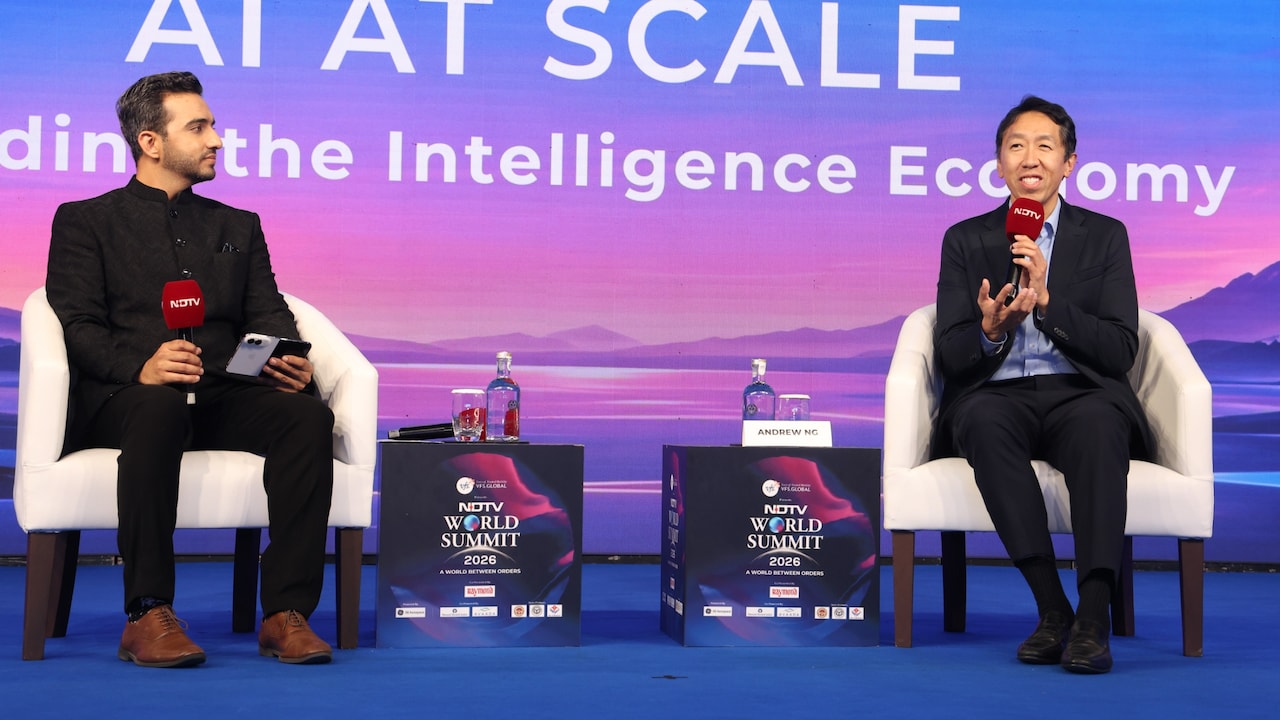
We have built machines that can think for us, write for us, and solve our equations before our pencils even hit the paper. But in our rush to make learning effortless, we may have engineered away the struggle that actually builds intelligence. When renowned computer scientist and AI pioneer Andrew Ng took the stage at the NDTV World Summit to warn that current AI chatbots are deeply flawed for genuine education, he was pointing at a quiet crisis hiding in plain sight.
Friction is not a defect in learning. Friction is the engine.
Consider how a muscle grows. Lift a weight that offers zero resistance, and the muscle remains unchanged. It requires tension, micro-tears, and the slow, burning ache of exertion to force adaptation. The brain operates under the exact same biological law. When a student stares at a blank page, panics slightly, forgets a formula, traces back their steps, hits a wall, and finally breaks through, neural pathways weld themselves together.
An instant answer bypasses the struggle entirely. It grants the illusion of understanding without the architecture to support it.
Step inside a modern study hall. The silence is different now. It is not the rustle of turning textbook pages or the frantic scratching of erasers correcting a false start. It is the rhythmic, mechanical clatter of keystrokes feeding prompts into a dialogue box.
Meet Maya, a hypothetical high school senior who relies on instant conversational models to draft her history essays and decode calculus problems. Maya is bright, hardworking, and deeply stressed. She wants efficiency. When her software hands her a breakdown of the French Revolution in three seconds flat, she reads it, feels a wave of relief, and copies the structural logic into her notes.
To an observer, Maya is productive. She finishes her homework in record time. But close the laptop and ask her to debate the underlying economic failures that triggered the Reign of Terror without looking at a screen. The details blur. The concepts slide off her mind like water off glass. Why? Because she never had to wrestle with the chaos of the raw history herself. The machine did the heavy lifting, which means the machine's brain got the workout, not hers.
Andrew Ng’s critique centers on this precise illusion. Current chatbots are prediction engines. They calculate the most probable next word based on massive datasets, optimized to give pleasing, coherent answers quickly. They are agreeable partners. They do not challenge a flawed premise with the rigorous skepticism of a seasoned teacher; they validate it, smooth it over, and hand it back wrapped in eloquent prose.
Education has always been an uncomfortable process. Real teaching involves a human mentor who can look into a student's eyes, spot the exact moment confusion clouds their expression, and ask a counter-question instead of giving a solution. A great teacher knows when to stay silent. A chatbot, programmed to be helpful and responsive, struggles with strategic silence. It fills every void with text.
The danger is not that students will cheat. Cheating is an old story. The deeper danger is that well-meaning, earnest students will genuinely believe they are learning while outsourcing their critical thinking to a server farm.
Think about the last time you navigated somewhere entirely new using a GPS with voice directions every single turn. You arrived at your destination, but could you retrace your steps unaided the next day? Probably not. You rented your navigation from a satellite. Now apply that exact dynamic to logic, synthesis, and creative problem-solving. If we rent our reasoning during our formative years, what happens when we face a crisis that requires us to own it?
We are training a generation to be exceptional editors of machine output rather than independent architects of thought.
This does not mean the technology belongs in the trash. Tools have always reshaped how we learn. The calculator did not destroy mathematics; it shifted the human focus from tedious arithmetic to higher-order geometry and algebra. The printing press did not ruin memory; it liberated human minds to analyze ideas rather than merely recite texts.
Artificial intelligence possesses that same earth-shaking potential, but only if we radically change how we deploy it in classrooms.
Imagine a flipped model. Instead of asking a chatbot for the answer to a physics problem, what if the chatbot's sole programming was to refuse the answer and instead act like a stubborn, curious Socrates? What if it asked guiding questions? What if it pointed out a contradiction in the student's logic and then stepped back, forcing the student to close the gap?
That is the missing link. We do not need conversational models that serve as effortless crutches. We need artificial friction. We need systems designed to slow down, to withhold the prize, and to demand that the human being on the other side of the screen do the hard, beautiful, irreplaceable work of figuring it out.
The blue light fades from the screen as the laptop lid snaps shut. The room goes dark. The assignment is submitted, but the real test is yet to come.
Somewhere out there, a complex world waits for minds that are sharp, resilient, and forged through genuine trial. The machine will always be ready with an answer. The real question is whether we will still remember how to ask the hard questions ourselves.