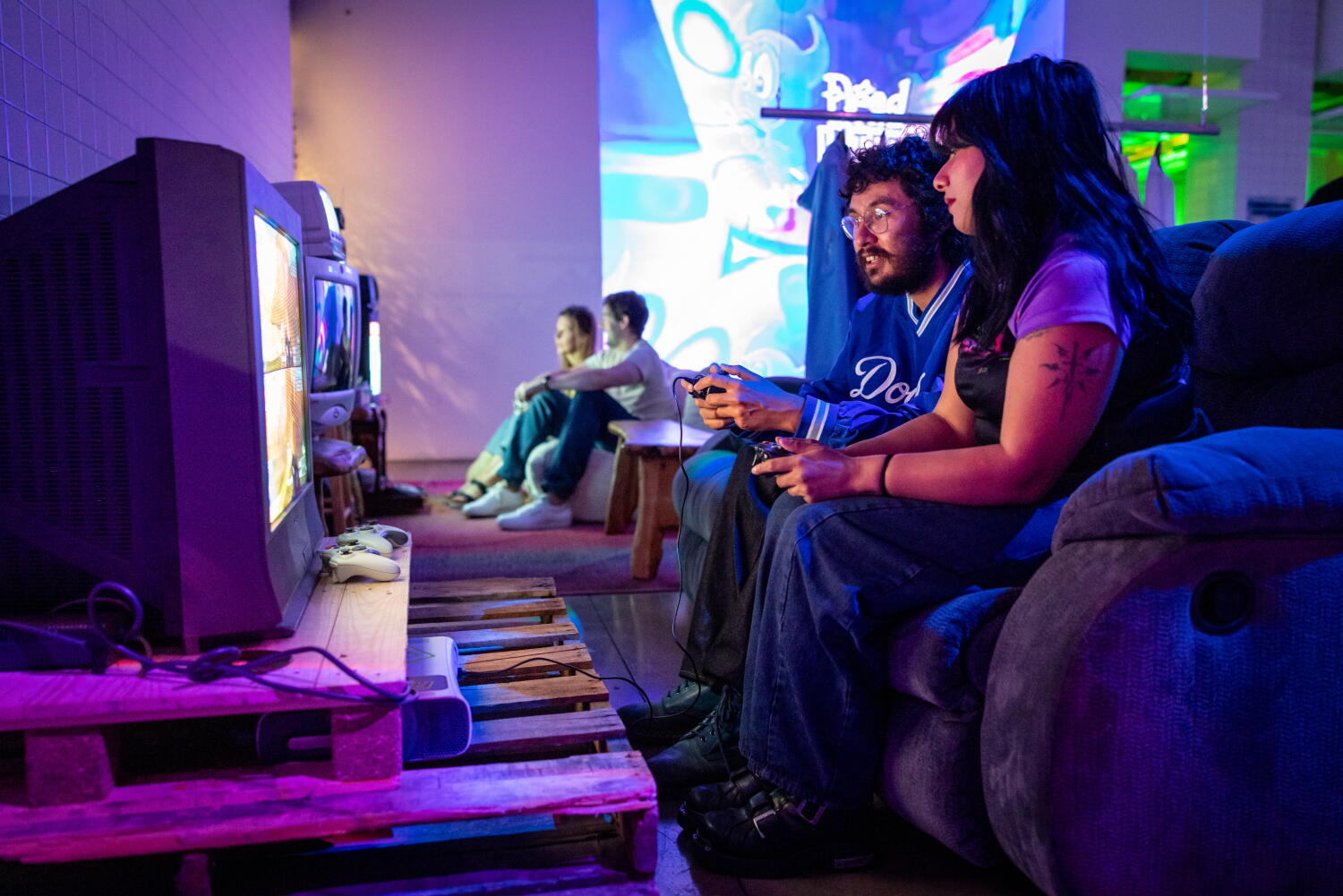
In a rented warehouse on the eastern edge of Los Angeles, a hundred people are huddled around glowing, candy-colored boxes of translucent plastic. They are not nostalgic hipsters staging an ironic photo shoot for social media. They are blinking away the blue glare of modern life, trading their surveillance-heavy, invisible cloud infrastructure for twenty-five-year-old cathode-ray tubes and mechanical keyboards that click with the satisfying weight of an industrial typewriter.
These gatherings featuring fleets of iMac G3s are spreading across urban centers because modern technology has broken its promise. We were told that hyper-connectivity would bind us together. Instead, it built walled gardens that monitor every keystroke while leaving us stranded in silent apartments staring at flat glass rectangles. When people pack into a room to play Marathon or browse long-dead web archives on a machine powered by a PowerPC G3 processor, they are engaging in a quiet, tactile rebellion. They are seeking refuge in an era when computers were physical objects you could own, open, fix, and touch without a corporate intermediary standing between you and the motherboard. Also making news recently: When Manchester Met the Machine.
The Architecture of Isolation
Silicon Valley sold an illusion of frictionless convenience. Every button became a software toggle. Every cord vanished into a monolithic wireless ether. Every application migrated to a subscription server thousands of miles away.
This transformation did more than streamline our workflows. It atomized human experience. Consider the trajectory of the personal computer over the last three decades. In 1998, buying a computer meant bringing home a massive, heavy sculpture that claimed physical space in your room. Setting it up required plugging cables into labeled ports. Turning it on involved a mechanical switch that pushed metal against metal. Further information regarding the matter are explored by Engadget.
That physical friction forced a certain intentionality. You sat at a desk. You used the machine with purpose. When you walked away, you were done.
Today's computing environment is an omnipresent hum. It follows you to your bed, sits in your pocket during dinner, and interrupts your thoughts with algorithmic notifications designed to monetize your anxiety. The modern operating system is a landlord that evicts you from your own hardware. You do not own your operating system; you rent permission to use it while your telemetry is harvested and sold to the highest bidder.
The revival of vintage hardware is a direct psychological response to this forced displacement. When a room full of people gathers around iMac G3s, bondi blue, lime, tangerine, and grape, they are touching monuments to an era when technology still possessed a sense of humor and a tangible identity.
When Hardware Had Personality
To understand why these machines draw crowds, look at what Apple was in 1998. The company was on the brink of bankruptcy. Steve Jobs had just returned, and he understood that personal computing had become beige, boring, and indistinguishable.
The iMac G3 changed the industrial design paradigm of the entire electronics industry. It turned the computer from a piece of office furniture into a consumer product with a soul. You could see right through the casing to the circuit boards inside. It demystified the machine just enough to make it approachable, yet retained enough mechanical complexity to feel substantial.
Compare that design philosophy with the current generation of laptops and phones. Modern devices are sealed aluminum slabs designed to discourage repair. Try opening an iPhone or a modern MacBook without specialized heat guns and proprietary suction cups. You cannot replace the battery. You cannot upgrade the RAM. If a component fails, the entire assembly goes into an electronic waste stream, replaced by a new unit engineered for obsolescence.
The iMac G3 represents the exact opposite philosophy. It was designed to be carried by a built-in handle. It invited curiosity. It sat on desks like a cheerful aquatic creature rather than a menacing corporate terminal.
At these Los Angeles gatherings, attendees trade stories of soldering new capacitors onto motherboards or hunting down obsolete IDE hard drives on secondary markets. This is not mere hoarding. It is the reclamation of mechanical agency. In a world where every consumer good is a black box controlled by remote firmware updates, fixing an old computer is an act of political defiance.
The Trap of the Subscription Economy
We have traded ownership for convenience, and the bill has finally arrived.
Thirty years ago, buying software meant owning a CD-ROM or a floppy disk. You installed it, and it ran on your machine indefinitely. If the company that made it went out of business, your software continued to function.
Today, almost every tool required to navigate daily life operates on a recurring rent model. Adobe, Microsoft, productivity suites, entertainment platforms, and even smart home appliances demand a perpetual tithe. Stop paying, and your tools vanish. Your documents become locked. Your smart thermostat turns into a paperweight.
Worse still is the absolute reliance on cloud storage. When files live on a remote server owned by a conglomerate, you are a tenant at will. Outages, policy changes, or sudden account bans can erase decades of personal history in an instant.
The retro tech underground rejects this dependency. An iMac G3 running Mac OS 9 does not require an internet connection to be useful. It does not check in with a mothership every morning to verify your subscription status. It does not update its user interface overnight to hide features you rely on. It is a closed, stable, deterministic system. You press a key, and the machine responds. There are no background telemetry syncs chewing up your bandwidth, no targeted advertisements injecting themselves into your workflow, and no artificial intelligence bots summarizing emails you never asked to receive.
Inside the Offline Sanctuary
The atmosphere at these events is striking for what is absent. There are no heads bowed over glowing screens scrolling through algorithmic feeds. People are talking to each other. They are looking over each other's shoulders to watch a game of classic arcade software render at thirty frames per second on a CRT monitor.
Loneliness is an engineered epidemic. Social media platforms optimize for engagement by maximizing outrage and isolation, keeping users glued to individual feeds rather than fostering genuine communal bonds. Physical proximity requires effort, travel, and shared vulnerability.
When participants sit shoulder-to-shoulder sharing a single power strip and configuring AppleTalk networks over antiquated Ethernet hubs, they are rebuilding community from the silicon up. They are solving problems collaboratively. If someone brings a spare mouse or a rare boot disk, it is handed across the table without transactions or digital currencies.
The machines act as social lubricants. It is easy to strike up a conversation when you are both staring at a translucent purple enclosure trying to figure out why an extension conflict is crashing the system. The shared friction of old technology creates a natural barrier against social friction.
Reclaiming the Physical Object
We spend our days interacting with ghosts. Pixels on glass lack weight, texture, and resistance. Typing on a glass tablet or a ultra-thin keyboard with zero travel distance is a sensory deprivation exercise.
Human neurology evolved to interact with the physical world. We understand weight, temperature, resistance, and geometry. The digital shift forced our brains to process abstract representations of objects rather than the objects themselves.
The iMac G3 and its contemporaries provide the sensory feedback our fingers and eyes crave. The satisfying clack of an Apple USB keyboard. The electrostatic hum of a CRT tube warming up. The distinct smell of warm plastic and dust that characterizes vintage electronics. These sensory cues anchor us in physical reality. They remind us that we exist in a specific room at a specific moment in time, rather than floating in an infinite, placeless digital void.
Critics dismiss these gatherings as nostalgic escapism. They argue that longing for 1998 technology is an exercise in regression, an unwillingness to engage with the modern challenges of artificial intelligence, climate change, and global connectivity.
That criticism misses the mark entirely. The people attending these events are not living in the past. They are using the past as a diagnostic tool to understand how badly the present has gone wrong. They are studying an earlier iteration of consumer technology to find the exact junction where convenience began to devour autonomy.
The rainbow of translucent machines humming in that Los Angeles warehouse is not a museum exhibit. It is a warning sign. It tells us that people are so desperate for ownership, privacy, and genuine human contact that they are willing to turn back the clock twenty-five years to find it.
Until modern technology re-centers human agency, privacy, and the right to repair over surveillance and subscription extraction, these underground gatherings will only grow. People will continue to dust off the plastic relics of the past, desperate for a machine they can actually call their own.