The smell of cordite and burning diesel does not wash out of high-visibility polyester. Ask anyone who has spent a Friday night scrubbing soot from the seams of a paramedic’s tunic, watching gray water swirl down a locker-room drain while their hands still hum with the residual vibration of a concussive blast.
We treat emergency responders like pieces of municipal furniture. They are painted in bright, reflective yellows and blues, engineered to be seen through fog, rain, and the red haze of panic. They arrive when a heart stops beating on a kitchen floor or when twisted metal traps a teenager against a steering column. The unspoken social contract—an agreement older than modern policing and older than the combustion engine—is simple. You do not shoot the medic. You do not burn the wagon that comes to pull your neighbor from the wreckage.
Yet, on a cold autumn evening, that contract disintegrated in a shower of sparks and shattering glass.
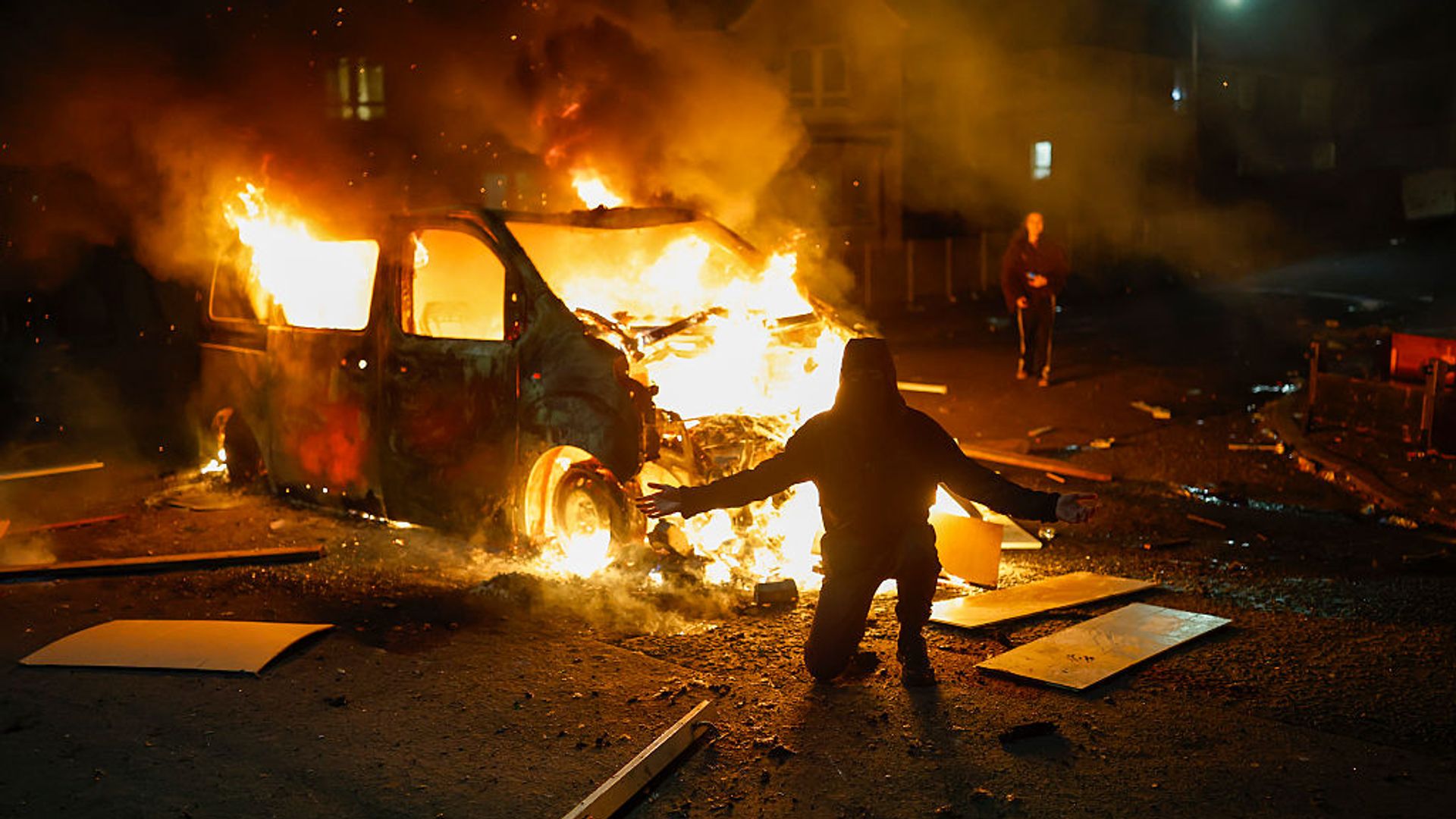
By morning, the official wire reports had already compressed the chaos into a tidy, digestible headline. Seven arrests. Paramedics attacked with fireworks. A police van set alight. It read like a weather report for a localized storm—brief, regrettable, and safely contained behind police tape. You read those twelve words over coffee, shake your head at the senselessness of it all, and turn the page.
But headlines are built to anesthetize. They strip away the heat, the noise, and the terrifying arithmetic of what happens when the people tasked with saving lives have to fight for their own.
The Anatomy of an Ambush
To understand what actually happens when an ambulance drives into a barrage of industrial-grade pyrotechnics, you have to step inside the cab. Let us construct a hypothetical crew, grounded entirely in the documented realities of urban emergency response. Call them Sarah and Marcus. Sarah has been on the road for nine years; Marcus is six months out of training, still learning how to sleep through the phantom beep of cardiac monitors.
At 11:14 PM, their terminal chimes. A routine dispatch. Someone is down near a housing estate, or perhaps a street corner has erupted into a spontaneous gathering that spilled over into injury. They activate the blues and twos. They are unarmed. Their inventory consists of saline bags, a defibrillator, trauma shears, and oxygen cylinders—pressurized steel canisters that turn into shrapnel if exposed to sufficient heat.
When they turn onto the street, there is no patient waiting on the curb. Instead, there is a silhouette against the sodium streetlights, holding a cardboard tube aimed directly at their windshield.
Fireworks are marketed as toys, celebratory bursts of color meant to mark a new year or a summer festival. In the hands of someone aiming horizontally across a narrow residential street, a commercial rocket or a Roman candle is an incendiary projectile. It travels at roughly sixty miles per hour, trailing magnesium sparks that burn at over a thousand degrees Celsius.
The first impact hits the reinforced glass inches from Marcus’s face. The sound inside a fiberglass ambulance box is deafening—a sharp, metallic crack that overwhelms the radio and leaves both medics temporarily blind from the flash. Instinct tells Sarah to hit the reverse gear, to retreat. Training tells her to look for the patient who might still be bleeding out behind the smoke.
While they hesitate in that agonizing three-second window between self-preservation and duty, a second volley strikes the side panels. Outside, a police carrier that arrived to clear a corridor for the medics is already surrounded. Someone has wedged a burning accelerant beneath the chassis, or hurled a lit flare through a smashed window. Within ninety seconds, the vehicle is a skeletal frame of blackening steel, sending plumes of toxic, rubber-scented smoke curling into the bedroom windows of families who had nothing to do with the riot outside.
Seven people were eventually led away in handcuffs that night. Seven names added to a court docket. If you look at the statistics gathered by ambulance trusts and policing federations over the past five years, those seven arrests are merely the visible tip of a massive, submerged iceberg of civic decay.
The Invisible Cost of a Diverted Siren
People often ask why a crowd would turn on the very people who have no power to arrest them, fine them, or judge them. Paramedics do not carry batons. They do not write citations. To understand this violence, you have to look at the psychology of the uniform.
To an angry crowd—whether fueled by alcohol, misplaced grievance, or the intoxicating anonymity of a mob—a uniform is a monolith. High-visibility yellow and tactical black blur together into a single symbol of authority. When the red mist descends, nuance is the first casualty. The person holding the firework does not see Sarah, who spent her afternoon comforting an eighty-year-old widower with a fractured hip. They see a flashing light, a siren, a boundary being imposed on their chaos.
I remember talking to a veteran paramedic a few years ago, a man whose voice had the gravel of three decades of night shifts. He told me that the hardest part of getting his ambulance pelted with bricks wasn't the fear in the moment. It was the shift in posture that followed. "You start looking at your hands differently," he said. "Instead of thinking about how to start an IV in a moving truck, you're checking the locks on the cab doors. You're profiling the shadows on the sidewalk before you even grab your jump bag."
That hesitation is lethal. We measure emergency response times in minutes and seconds because human biology is unforgiving. Brain cells begin to die four minutes after oxygen stops flowing. A severe arterial bleed can empty a human body in less than three.
When a crew is pinned down by fireworks, or when a police van is burning on the tarmac, the damage extends far beyond the scorched paint and the seven suspects sitting in holding cells. Every riot requires a perimeter. Every attacked ambulance requires a backup crew to extract the trapped medics, a hazardous-area response team to clear unexploded pyrotechnics, and a fleet mechanic to haul a damaged vehicle out of commission.
Consider what happens three miles away while that fire is burning.
Somewhere in a quiet cul-de-sac, a toddler is choking on a grape. Across town, a middle-aged father is experiencing the crushing, chest-tightening onset of a myocardial infarction. They dial the emergency number, expecting the cavalry. Instead, the dispatcher stares at a screen where half the available units in the sector are locked down behind a cordon, waiting for tactical support to quell a street battle.
The invisible victims of an attack on emergency workers never make the morning paper. Their names are not listed alongside the seven arrests. They are simply statistics buried in quarterly response-time audits—a four-minute delay here, a six-minute gap there—quietly determining who walks out of the hospital and who does not.
A Pattern We Refuse to Name
It is comforting to dismiss these nights as isolated anomalies, the work of a few reckless youths who had too much to drink and too much access to cheap explosives. It is comforting, and it is completely false.
Across major metropolitan areas, assaults on emergency personnel have climbed steadily over the last decade, spiking predictably around autumn holidays and summer heatwaves. Unions report that thousands of ambulance workers face physical violence, spitting, or projectile attacks every single year. Police vehicles, once treated with a grudging wariness, are increasingly viewed as trophies to be vandalized for social media clout.
Look at how modern street disturbances operate. Notice the phones held aloft just behind the front line of those throwing projectiles. The burning police van is no longer just an act of destruction; it is content. The shower of sparks bouncing off an ambulance windshield is framed for a vertical screen, engineered to gather views and digital validation before the smoke has even cleared.
We have built an ecosystem where outrage and spectacle are rewarded instantly, while the consequences are slow, bureaucratic, and invisible to the audience. The person who lights a fuse and aims it at a paramedic gets an immediate rush of adrenaline and notoriety. The paramedic who develops post-traumatic stress disorder six months later, waking up in a cold sweat every time a neighbor sets off a sparkler in the backyard, suffers in silence.
There is also the sheer physical vulnerability of the equipment itself. An ambulance is not an armored personnel carrier. Its walls are built of lightweight aluminum and composite plastics designed to maximize fuel efficiency and interior cabin space for medical gear. A commercial firework hitting the rear doors can easily breach the outer skin or ignite the oxygen lines running beneath the floor. When a police van is set alight, the heat does not just melt the tires; it incinerates radios, medical kits, ballistic shields, and thousands of dollars of taxpayer-funded infrastructure that will take months to replace.
In the meantime, the community that hosted the riot wakes up to fewer patrols, slower ambulance arrivals, and a lingering atmosphere of mutual suspicion.
The Fragile Line
So what happens after the handcuffs click shut on those seven suspects?
The legal machinery grinds forward. Prosecutors will sift through body-worn camera footage, CCTV feeds from nearby storefronts, and forensic swabs from charred clothing. Charges will be filed—arson, violent disorder, assaulting an emergency worker. Politicians will issue statements condemning the "mindless thuggery" and praising the "bravery of our front-line heroes."
And then, almost inevitably, the news cycle will move on.
The problem with praising responders as heroes is that it subtly excuses the abuse they endure. Heroes, in our mythology, are invulnerable. They wear capes; they absorb blows; they keep walking forward regardless of the cost.
Paramedics and police officers are not mythical figures. They are tired human beings working twelve-hour shifts on lukewarm coffee and fast food. They have mortgages, bad backs, aging parents, and children waiting for them to come home at seven in the morning. When you strip away the reflective tape and the Kevlar vests, they are just neighbors who agreed to run toward the screams while everyone else runs away.
I admit that it is hard to look at a burning police vehicle and feel anything other than frustration—or a cynical resignation that this is simply the price of modern city life. It is tempting to throw up our hands and assume that some corners of society have drifted beyond the reach of basic decency.
Yet, civilization is not maintained by laws alone; it is maintained by taboos. A taboo is an invisible fence that a community agrees never to cross, even in its darkest moments. The taboo against attacking healers and first responders is one of the foundational pillars of any functioning society. When that fence gets trampled, putting up stronger steel barriers on ambulances isn't the answer. You cannot armor-plate empathy. You cannot weld steel bars over a paramedic’s windows and still expect them to connect with a terrified child in the back of a truck.
The real test of a community is not how it behaves when the sun is shining and the streets are quiet. It is what happens at midnight, when the sirens wail, the smoke rises, and someone has to decide whether to clear a path for the ambulance—or light a match.
Next time a siren screams past your window in the dark, listen closely to the Doppler shift as it fades into the distance. Somewhere ahead of that sound, someone’s worst night is unfolding, and two strangers in yellow jackets are stepping out of a fiberglass box into the unknown, betting their lives that the rest of us still remember what side they are on.