Silence.
In the Australian bush, silence is never actually empty, because the wind scrapes through dry eucalyptus leaves like tearing paper, and somewhere high above the gray-green canopy, a kookaburra laughs at nothing at all, reminding you that the land does not care whether you exist. Recently making headlines recently: What Most People Get Wrong About Israel Katz Saying Strikes Need No Opposition Approval.
When a teenager vanishes into that vastness, the clock stops ticking in minutes and starts measuring life in degrees of temperature, millimeters of water, and the terrifying math of human endurance. Six days. One hundred and forty-four hours. To anyone sitting in a climate-controlled living room scrolling past a headline—A missing teen is found alive after 6 days in the Australian woodlands—those numbers look like a tidy miracle wrapped in digital newsprint. They read the blurb, feel a brief swell of relief, and swipe to the next tragedy or triumph.
They miss the entire war that happened inside those six days. Additional insights regarding the matter are explored by Reuters.
I have walked search lines through dense Australian scrub when the sun drops below the ridge and the temperature plummets twenty degrees in half an hour. I know the specific, hollow dread that settles into your ribs when your flashlight beam hits nothing but endless, identical trunks of stringybark and tangled banksia. You shout a name until your throat tastes like copper, and the bush swallows the sound whole, giving you back only the crunch of your own boots on dry leaf litter.
To understand what survival actually looks like out there, we need to step past the sterile police press releases and look at the invisible stakes.
The Architecture of Disorientation
Most people imagine getting lost as a cinematic moment—a dramatic wrong turn at a fork in the trail, a sudden realization accompanied by swelling orchestral music. Reality is far more insidious. In the Australian woodlands, disorientation happens by inches.
Consider a hypothetical scenario that mirrors hundreds of real search-and-rescue cases across Victoria, New South Wales, and Queensland. Picture a seventeen-year-old boy—let us call him Liam, though his name changes with every frantic emergency call—stepping twenty paces off a marked fire trail to get a better view of a rocky outcrop or to follow the flash of a wallaby through the ferns. He turns around. The trail is gone. Not hidden behind a wall, just visually dissolved into a uniform sea of gray bark, olive foliage, and dappled shadows.
Human beings possess a notorious neurological flaw when deprived of visual landmarks: we walk in circles. Researchers at the Max Planck Institute for Biological Cybernetics proved what bushmen have known for centuries—without a visible sun, moon, or distinct horizon line, subtle asymmetries in our stride and inner ear force us to veer continuously to one side. You think you are marching straight toward the highway you heard an hour ago. In truth, you are tightening a slow, exhausting noose around the exact patch of dirt you started from.
Panic arrives next, and panic is the deadliest predator in the scrub.
When adrenaline floods the bloodstream, your heart rate spikes, your breathing turns shallow, and your prefrontal cortex—the rational part of your brain responsible for planning and restraint—effectively goes offline. You start running. You scramble up steep, loose shale ridges only to find another identical gully on the other side. You burn through precious glycogen reserves and sweat out half a liter of water in forty minutes. By the time twilight bruises the sky purple, you are dehydrated, scraped raw by tea-tree branches, and miles further from the search perimeter than when you took that first careless step.
The Math of Survival
When emergency services launch a full-scale search in rugged woodland, they are fighting against the physiological limits of the human body. Survival instructors often cite the "Rule of Threes"—three minutes without air, three hours without shelter in harsh weather, three days without water, three weeks without food.
In the Australian bush, those margins shrink violently.
Even outside the blistering peak of summer, daytime temperatures under an unshaded canopy can push past thirty degrees Celsius, pulling moisture from your skin with every breath. At night, clear skies allow radiant heat to escape rapidly, dropping temperatures close to freezing. Hypothermia does not require snow; it only requires a tired, dehydrated body wearing a damp cotton t-shirt when the wind picks up at three in the morning.
How does a teenager bridge a six-day gap when standard biology says three days without water is fatal?
They do it by abandoning modern instincts and adopting the stubborn patience of the land itself. They stop moving during the heat of the day, wedging themselves beneath rock overhangs or burrowing into piles of dry bark and bracken to trap body heat against the night chill. They learn to read the landscape for moisture—licking morning dew off broad leaves, digging into damp creek beds where sediment holds a trickle of groundwater beneath the crust, or chewing on the tender bases of native grasses.
Hunger, strangely enough, becomes background noise after the first forty-eight hours. Once the body shifts into ketosis and begins metabolizing its own fat stores, the sharp pangs dull into a heavy, sluggish fog. Thirst never dulls. Thirst sharpens into a singular obsession that dominates every waking thought, making your tongue swell against your teeth and turning every rustle of wind into the hallucinated sound of running water.
Inside the Search Grid
While a missing teenager is fighting a microscopic battle for every drop of moisture and degree of warmth, an entirely different machine is grinding into motion miles away.
If you have never seen a modern woodland search operation from the inside, it looks less like a frantic dash and more like a chess match played across a topographical map. Incident commanders set up mobile headquarters at the nearest trailhead, surrounded by glowing laptops, radio repeaters, and whiteboards covered in grid coordinates. They apply behavioral profiling—statistical models built from thousands of past rescues—to predict where a lost adolescent is likely to go.
Teenagers behave differently in the bush than young children or elderly hikers. Small children tend to hide in tight, enclosed spaces like hollow logs and refuse to answer calls from strangers. Elderly hikers with cognitive decline often push straight ahead until they become wedged in dense undergrowth. Teenagers, driven by a mix of embarrassment, overconfidence, and raw physical energy, tend to climb high ground looking for mobile phone reception or drop down into gullies following water drainage lines.
Hundreds of people pour into the trees. State Emergency Service volunteers in bright orange overalls, police search-and-rescue squads, mounted units on horses that can navigate steep terrain faster than foot patrols, infrared-equipped helicopters sweeping overhead, and tracking dogs working scent cones carried by shifting thermal currents.
Yet the bush remains stubbornly opaque. From a helicopter two hundred feet up, a person curled under a fallen eucalyptus log wearing dark clothing is completely invisible. A foot searcher can walk within ten meters of someone who is too weak or hypothermic to shout and never see a flicker of movement through the scrub.
By day four, the atmosphere at the command post changes. Nobody says the worst out loud, because professionalism demands discipline, but you can hear it in the quieter tone of the radio chatter and see it in the way volunteers stare into their coffee cups during shift changes. Hope begins to fray at the edges. Families standing beside the incident tent start aging in real time, caught in a purgatory where every passing hour makes a happy ending statistically harder to defend.
The Turning Point
Day five bleeds into day six. At this stage, survival depends on small, seemingly insignificant decisions made days earlier.
Staying put. Conserving energy. Making yourself visible against the monotone palette of the forest—laying out a brightly colored backpack on a clear patch of rock, snapping branches to leave unnatural geometric shapes on the ground, or saving your voice until you hear the distinct, rhythmic crunch of boots rather than shouting blindly at the wind.
Consider what happens when those two worlds finally collide.
A line of searchers is pushing through a steep, overgrown gully—the kind of miserable terrain nobody wants to search because the lawyer vines tear at your clothes and every step risks a twisted ankle. Ahead of them, near a stagnant pool of rainwater trapped in a granite basin, something shifts. Not an animal. Animals move with fluid certainty; they dart or freeze cleanly. This movement is slow, deliberate, human.
A faint shout cuts through the hum of cicadas.
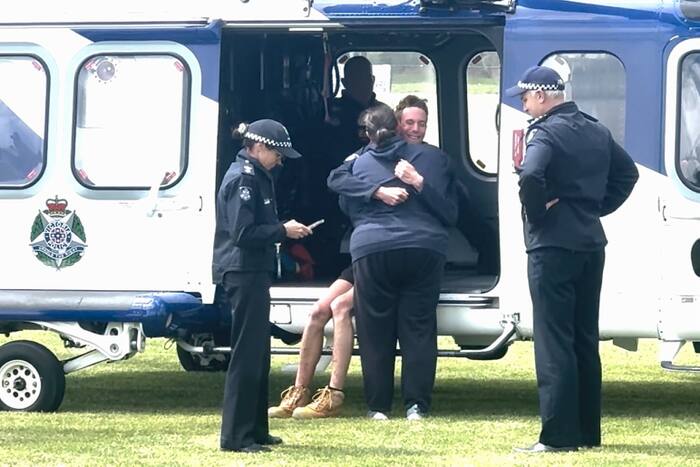
When rescuers reach a missing person on day six, the immediate reality is rarely the clean, triumphant embrace shown in movies. The teenager is usually sunburned, scratched from head to toe, shivering uncontrollably despite the midday warmth, and barely able to stand as orthostatic hypotension drops their blood pressure the moment they try to rise. Their voice is a dry rasp. Their eyes look sunken, wide with the shock of realizing that the endless, solitary loop of survival has finally broken.
Paramedics move in immediately—not with gallons of cold water, which would shock an empty stomach and trigger violent vomiting, but with measured sips of electrolyte solution, thermal foil blankets, and steady, grounding conversation to pull their mind back into the civilized world.
Why These Stories Grip Us
Why do millions of people stop scrolling when they read that a teenager walked out of the Australian woodlands alive after six days?
It isn't merely relief for a stranger's family, though that empathy is real and vital. It is because stories like this puncture the comfortable illusion of our modern lives. We spend our days insulated by concrete, GPS navigation, climate control, and instant communication, convincing ourselves that nature is a scenic backdrop we visit on weekends rather than an indifferent, ancient force that plays by uncompromising rules.
When a young person vanishes into the trees and emerges six days later, they carry back proof of something we quietly fear we have lost: raw, unfiltered human resilience. Without batteries, without maps, without a single piece of modern convenience, a teenager stripped down to nothing but instinct and stubborn will stared down one of the harshest environments on earth and refused to yield.
And there is another truth woven into that rescue—one that deserves just as much reverence. While that teenager was fighting to stay alive alone in the dark, hundreds of strangers stepped away from their own jobs, families, and warm beds to walk into the scrub until their boots wore thin, refusing to draw a line on a map and call it finished.
The helicopter lifts off from the clearing, kicking up a swirl of red dust and dry eucalyptus leaves. Within minutes, the rotor wash fades, the canopy settles back into its ancient rhythm, and the bush closes over the footprints as if nobody had ever been there at all—except for one young life walking out into the sunlight, carrying a silence they will never quite forget.


