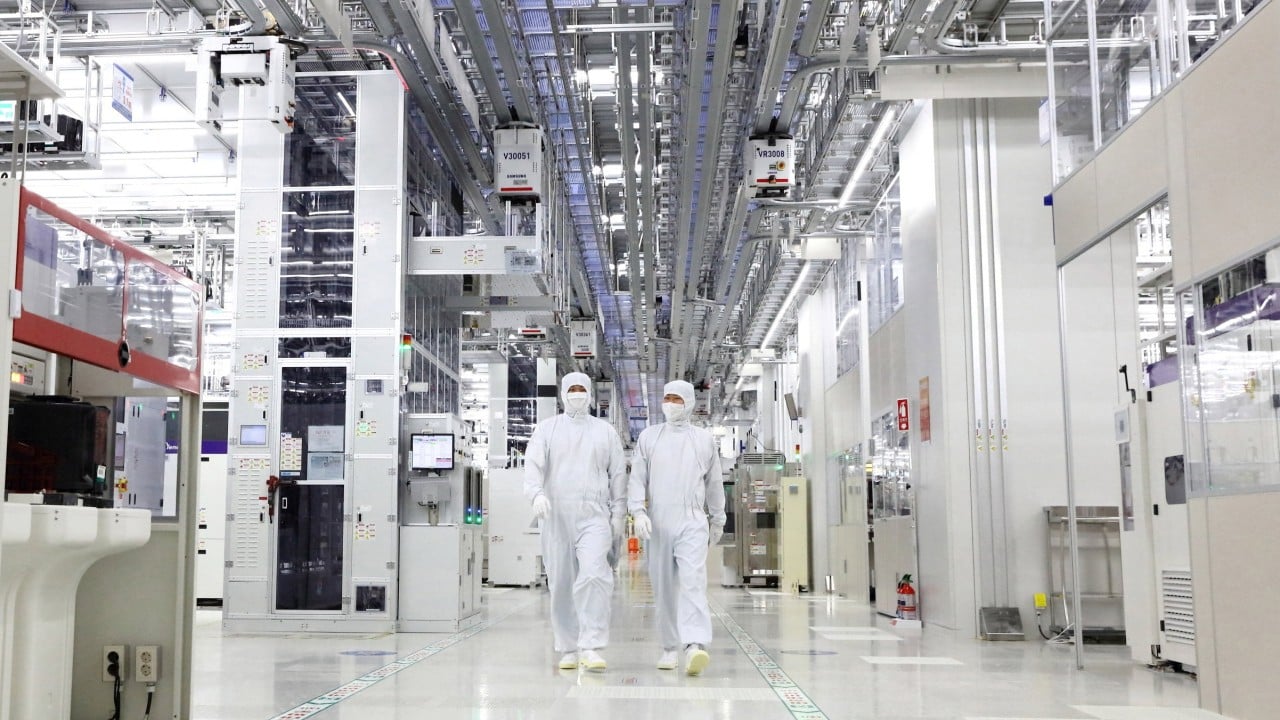
The tech press is swooning over South Korea’s plan to drop $600 billion on a massive semiconductor mega-cluster. Samsung and SK Hynix are treated like economic saviors, building a sprawling industrial empire outside Seoul to lock down global memory and foundry markets until 2047.
They are celebrating a catastrophic misallocation of capital.
This astronomical expenditure is not a masterstroke of geopolitical strategy. It is a panicked, defensive reaction to a cyclical peak, disguised as a long-term vision. By pouring over half a trillion dollars into physical infrastructure, South Korea is setting itself up for an unprecedented supply glut that could crush margins for a decade. The industry is repeating its oldest, most self-destructive habit: building massive capacity at the exact moment demand dynamics are shifting underneath its feet.
The Illusion of Eternal AI Demand
The entire justification for this $600 billion spending spree rests on a single, shaky premise. The assumption is that the world's appetite for High Bandwidth Memory and advanced logic nodes will expand exponentially, forever.
It will not.
Right now, hyperscalers like Microsoft, Alphabet, and Meta are buying chips at an unsustainable rate to build out infrastructure for artificial intelligence models whose monetization models remain unproven. I have watched tech giants blow billions on infrastructure booms before. The fiber-optic bubble of the late 1990s looked exactly like this. Companies laid millions of miles of glass under the assumption that internet traffic would require infinite bandwidth. When the reality of consumer adoption failed to match the capital expenditure models, the market collapsed, leaving a mountain of dark fiber and bankrupt telecom providers.
The semiconductor industry is building the exact same trap. High Bandwidth Memory, specifically HBM3E and HBM4, is notoriously difficult and expensive to manufacture. Yield rates are low, often hovering between 50% and 60% for advanced packaging. Samsung and SK Hynix assume they can brute-force these yields by throwing money at giant factories.
But what happens when hyperscalers realize that running trillion-parameter models costs more than the software revenue they generate? When the enterprise AI spending slows down from a frantic sprint to a cautious jog, South Korea will be left holding the bill for massive, underutilized fabs that cost billions a year just to keep the lights on.
The Mathematical Reality of the Capital Intensity Trap
Let us look at the brutal unit economics of modern semiconductor manufacturing. A single extreme ultraviolet lithography machine from ASML costs upwards of $200 million, and the newer High-NA EUV systems push past $350 million. To equip a modern fab capable of producing chips at the 3-nanometer or 2-nanometer level, you need dozens of these machines, alongside cleanrooms that consume more power than mid-sized cities.
When a company commits to a $600 billion roadmap, the depreciation costs alone become a corporate anchor.
| Metric | Traditional Manufacturing | Modern Mega-Fab Reality |
|---|---|---|
| Depreciation Period | 10–15 Years | 5–7 Years (Due to technological obsolescence) |
| Fixed Cost Overhead | 30% of total revenue | 65%–75% of total revenue |
| Breakeven Capacity Utilization | 70% | 90%+ |
If a fab's utilization rate drops even slightly due to a macroeconomic downturn, the fixed costs eat the company alive. Samsung’s semiconductor division already felt the sting of this during the recent memory downturn, posting record losses because they could not cut production fast enough to offset falling average selling prices.
Now, multiply that risk by $600 billion.
Imagine a scenario where global PC and smartphone demand remains flat, while the AI infrastructure buildout hits a plateau in 2028. Samsung and SK Hynix will be forced into a brutal price war, slashing the price of DRAM and NAND flash to fill their newly built factories. We have seen this movie before. In the 1980s and 1990s, Japanese memory makers overexpanded, ran into a wall of oversupply, and were subsequently hollowed out by South Korean competitors who undercut them on price. Now, China is rapidly building out its own domestic legacy and mid-tier memory capacity through state-backed firms like CXMT. South Korea is walking straight into the same meat grinder they used to conquer the market forty years ago.
The Centralization Gamble
Concentrating $600 billion of industrial capacity within a single geographic zone near Seoul is an operational nightmare masquerading as efficiency. The plan envisions 16 new fabs producing 7.7 million wafers per month by 2047.
Think about the sheer resource consumption required to sustain that level of output. A single advanced fab can consume up to 10 million gallons of ultra-pure water per day. The electrical grid infrastructure required to power 16 new mega-fabs is staggering. South Korea already struggles with grid modernization and reliance on fossil fuels. The country cannot simply manifest the gigawatts of clean energy required to run these facilities without massive political and environmental pushback.
Furthermore, this extreme geographic concentration introduces immense supply chain vulnerability. The industry spent the last five years talking about diversification, regionalization, and building resilience. The US passed the CHIPS Act to bring manufacturing back home. Europe tried the same. South Korea's response is to double down on putting all their eggs in one highly localized basket.
Geopolitical risks are not confined to the Taiwan Strait. South Korea sits directly adjacent to an unpredictable, nuclear-armed neighbor. It is prone to regional supply chain bottlenecks. A single localized power grid failure, an earthquake, or a cyberattack on the Seoul metropolitan infrastructure could instantly paralyze over half of the world's memory supply. Buyers are already nervous about TSMC’s concentration in Taiwan. By copying that exact model of extreme geographic density, South Korea is ignoring the structural diversification that global customers are actively demanding.
Bricks and Mortar Do Not Solve Yield Engineering
The mainstream financial media loves big numbers. A $600 billion headline sounds dominant. But money spent on pouring concrete and buying structural steel does not magically solve the underlying engineering crisis facing Samsung’s foundry business.
For years, Samsung has lagged behind TSMC in foundry yield rates for leading-edge nodes. Winning customers like Apple, Nvidia, and AMD requires more than just cleanroom space; it requires flawless execution in defect density reduction and operational consistency. When Samsung transitioned to the Gate-All-Around transistor architecture for its 3nm node, it struggled with low yields, pushing major fabless clients to remain locked into TSMC’s established FinFET and N3 variants.
Pouring money into a mega-cluster does not fix a fundamental engineering gap. You cannot buy your way to a stable 3nm or 2nm yield process just by scaling up the number of factories. It takes years of iterative learning, deep collaboration with customers, and a corporate culture that prioritizes precision over raw volume. TSMC succeeded because they spent decades mastering the unglamorous, highly specific art of pure-play foundry services. Samsung is still structured like an integrated device manufacturer, where the internal smartphone and consumer electronics divisions frequently conflict with the needs of external foundry clients. Building more factories in Gyeonggi Province does nothing to resolve that structural conflict of interest.
The Misguided Answer to the Wrong Question
Industry analysts constantly ask: "How can South Korea protect its market share against TSMC and Intel?"
That is the wrong question. The real question is: "Is physical manufacturing capacity the asset that will capture the highest profit margins in fifteen years?"
The answer is no. The value in the technology stack is moving rapidly up the chain to software, custom architecture, and algorithmic optimization. Nvidia does not own a single fab, yet it commands a trillion-dollar valuation and gross margins above 75%. They own the software ecosystem (CUDA) and the architectural design. The firms that build the physical chips are treated like high-tech utilities. They bear all the capital expenditure risk, suffer the cyclical downturns, and must constantly reinvest their profits just to stay on the treadmill of Moore's Law.
By allocating $600 billion to physical manufacturing, South Korea is solidifying its position as the world's heavy laborer. They are taking on trillions of wons in debt and financial risk to build low-margin commodity infrastructure, while American fabless firms design the chips and capture the lion’s share of the economic value.
If South Korea wanted to disrupt the status quo, they would not build another dozen fabs. They would invest that $600 billion into creating an independent software ecosystem, advanced chiplet design houses, and proprietary packaging architectures that break TSMC’s monopoly on advanced integration. Instead, they are playing a twentieth-century game of industrial scale in a twenty-first-century world governed by software.
The Looming Subsidy hangover
Let us be completely honest about why this plan is happening now. It is a political theater piece. Governments around the world are throwing hundreds of billions of dollars at semiconductor companies in a desperate bid to secure domestic manufacturing. The South Korean government is offering massive tax incentives and infrastructure support to keep Samsung and SK Hynix from moving their core investments to the United States or Europe under the pressure of the CHIPS Act.
But these subsidies distort the market. They shield corporate executives from the financial consequences of overexpansion. When a government subsidizes the cost of building a factory, it artificially lowers the barrier to entry, leading to an overproduction of chips that the market cannot absorb.
When the subsidy dust settles in the early 2030s, the global semiconductor industry will look entirely different, and not in a good way. The US will have its Arizona and Ohio fabs. Europe will have its German fabs. Japan will have its Kumamoto facilities. And South Korea will have its massive $600 billion mega-cluster.
Every single one of these regions will be capable of producing massive quantities of silicon. Yet, the global population is plateauing, smartphone replacement cycles are lengthening, and the initial gold rush of AI infrastructure will have concluded. The result will be a brutal, systemic margin compression across the entire industry. The companies that spent the most on physical expansion will fall the hardest.
Stop looking at the $600 billion figure as a sign of strength. It is a sign of a desperate industry that has run out of architectural ideas, turning instead to raw, uncalculated scale to solve its structural problems. When the next major downturn hits, this mega-cluster will not be an economic engine; it will be an expensive monument to corporate hubris.