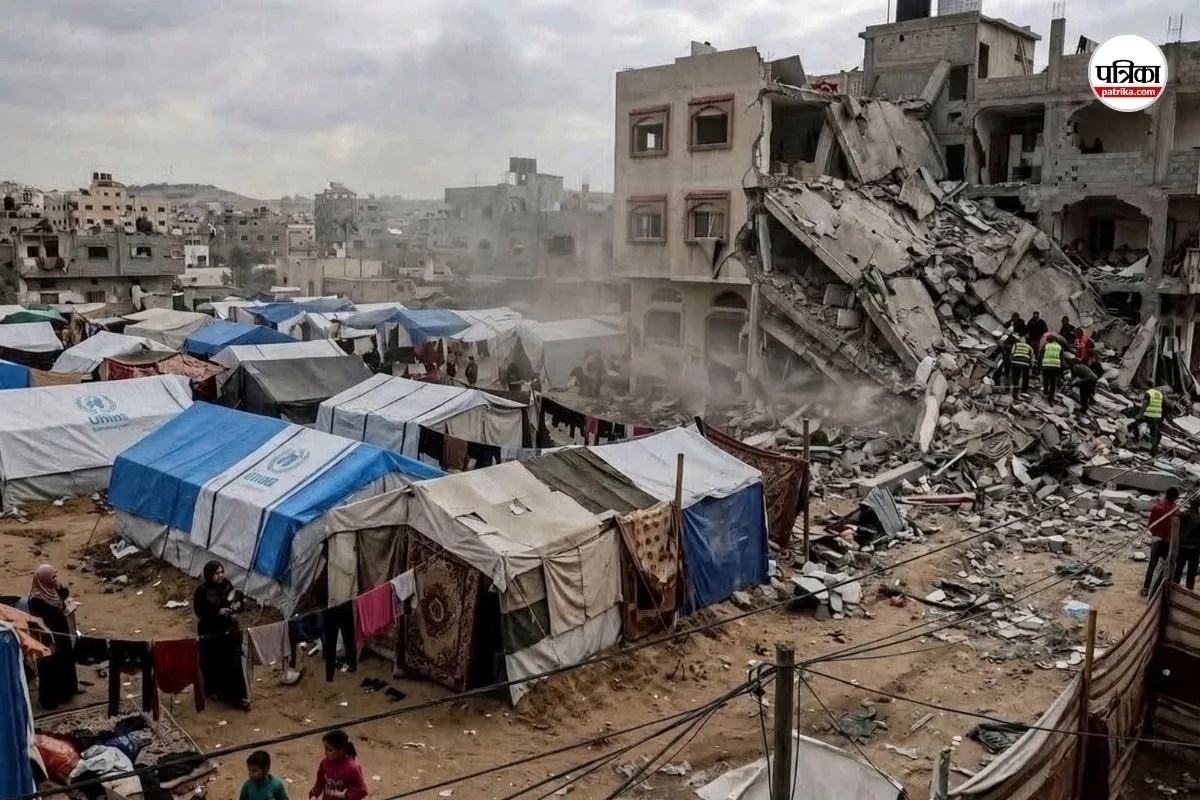
The rain in Gaza does not fall like water elsewhere. When the winter storms break over the strip, the drops do not nourish; they stalk. They hammer against the skeletal remains of concrete towers, finding every fracture left behind by months of bombardment, turning hairline cracks into bleeding chasms of vulnerability.
Imagine, if the word must be used not as a cliché but as a physical command, standing inside a room where three walls are gone and the fourth is leaning at an angry, terrifying angle. Now imagine the sky opening up.
Water pours over bare electrical wires, pools on rubble-strewn floors where children sleep under damp blankets, and most terrifyingly, seeps deep into the foundation blocks that have already been shaken to their molecular core. The earth beneath those foundations softens. The weight above remains too heavy. And then, the silence before the collapse.
On a recent rain-drenched day, that silence was shattered once again. The storm did not just bring discomfort; it brought death. Three more lives were claimed not by a falling shell, but by the very walls meant to shelter them, crashing down under the relentless, heavy gray skies. Three Palestinians, surviving the unlivable, crushed by the weight of their own collapsing homes while the storm raged overhead.
The arithmetic of survival in a conflict zone is rarely taught in textbooks. It is learned in milliseconds.
Consider what happens to a structure after an explosion. To the untrained eye, a building that still stands after an airstrike is a sign of resilience. It is a miracle that it didn't turn to dust. But structural engineers look at that same building and see a ticking clock. The steel rebar inside the concrete has been stretched past its yield point. The binding agents have micro-fractured. The load-bearing columns are hollowed out of integrity.
Then comes the water.
Water is heavy. A single cubic meter of water weighs one metric ton. When torrential rain pounds a damaged roof, hundreds of gallons pool in sagging ceilings and shattered upper floors, adding thousands of pounds of dead weight to structures that are already praying to gravity to hold them up. Furthermore, as water infiltrates the concrete, it causes the internal iron to rust and expand, a phenomenon known as spalling. The iron swells, cracking the surrounding concrete from the inside out.
The building does not need another missile to fall. It simply needs to get wet.
In the narrow, densely packed neighborhoods of Gaza, this turns every rainstorm into a game of psychological torture. Families who managed to salvage a single room from a multi-story family home now listen to the rain with a gripping, visceral dread. Every drip from the ceiling sounds like a footstep. Every groan of shifting timber or stressed concrete feels like an eviction notice from life itself.
"We used to love the rain," an older resident muttered, watching gray clouds roll in from the Mediterranean, carrying a chill that cuts straight through thin, salt-cured clothing. "It meant the olive harvest. It meant drinking tea by the window. Now, when the clouds turn dark, we look at our children and wonder which wall is going to give way first."
This is the invisible crisis. The headlines often capture the immediate flash of the explosion, the fiery bloom of an airstrike, the instant casualty count. Those are clean data points for news tickers. But the slow violence of environmental degradation—the pneumonia creeping into the chests of infants in flooded tents, the sudden midnight cave-in of a water-logged kitchen, the quiet suffocation of families buried under domestic debris—this is the violence that lingers in the dark.
There is no shelter infrastructure left to absorb the displaced. Schools, mosques, and hospitals—places traditionally turned into sanctuaries during crises—are either overcrowded beyond human imagination, structurally compromised themselves, or reduced to rubble. When a home collapses from rain damage, the family inside does not move to a safer house down the block. They move to the street. They move to makeshift plastic sheets held together by scavenged tape and sheer human stubbornness, facing winds that tear those shelters away as quickly as they are erected.
The ground turns to thick, sucking mud. Sanitation systems, shattered by months of neglect and destruction, overflow into the tent camps. Waterborne illnesses begin their silent march through populations already weakened by hunger and exhaustion. The rain washes garbage and sewage through the alleys where barefoot children try to navigate the day.
It is a cascading failure of human habitat.
We talk about humanitarian aid in terms of truckloads of flour, medical kits, and fuel canisters. And those are lifelines, desperately needed and criminally restricted. But how do you deliver structural integrity? How do you hand out dry foundations? How do you patch the sky when it decides to drown the people it has already burned?
History is filled with accounts of cities enduring sieges, but rarely in the modern era has a population been forced to endure a siege while living inside the progressive, unmitigated decay of their own built environment. Every storm writes a new chapter of vulnerability. Every drop of rain is a test of how much weight a human spirit can bear before the architecture of daily life gives out entirely.
The storm will pass, eventually. The clouds will clear, and the Mediterranean sun will bake the mud back into hard, dry dust. But the walls will remain wounded. The next cloud on the horizon will not be viewed as weather. It will be viewed as an adversary.
And until the fundamental right to a safe, stable roof over one's head is restored, the weather in Gaza will remain a weapon of mass displacement, proving that sometimes, the most dangerous thing in the world is simply a rainy day.