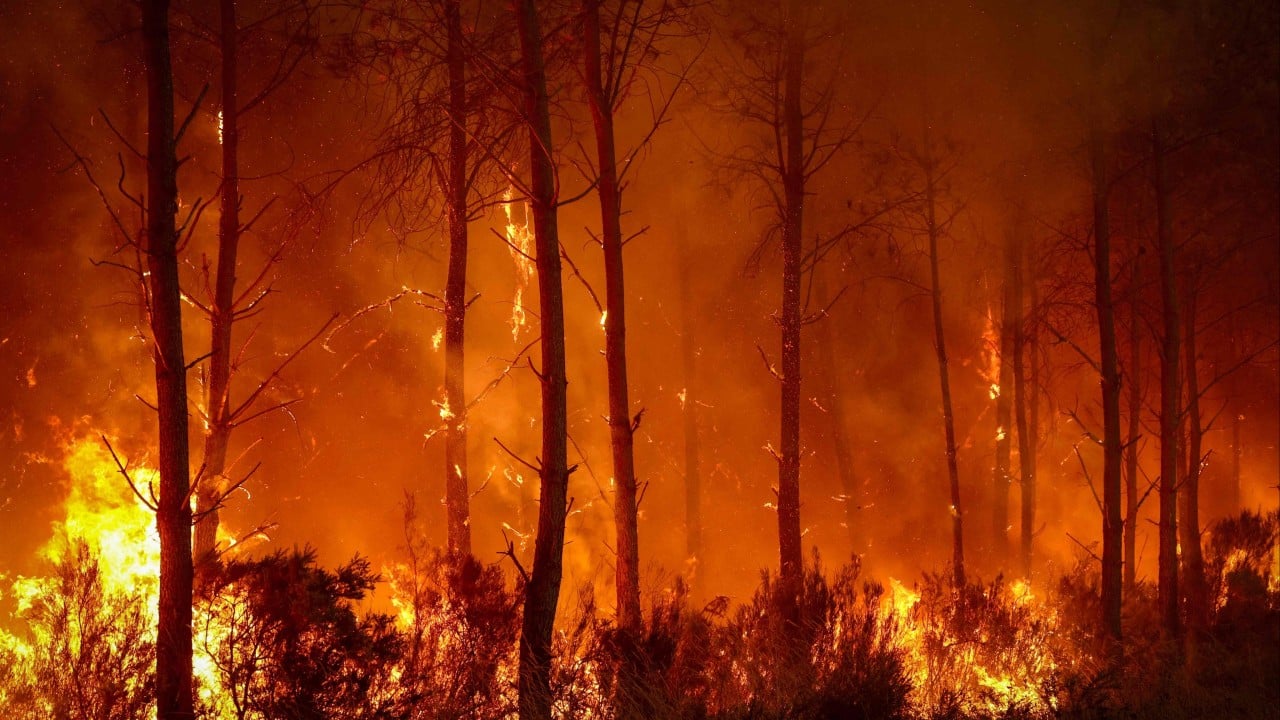
The air does not smell like smoke at first. It smells like old dust, dry pine needles, and something ancient and metallic, like pennies left in the sun. Then the light turns. The afternoon sun stops being yellow and flattens into a bruised, copper disk. Shadows sharpen. Birds go entirely quiet, not a chirp left in the canopy, as if they have collectively decided that the sky is no longer a safe place to exist.
Down in the valley, between the limestone cliffs of the French Midi and the sun-bleached hills of northern Spain, people step out onto their porches. They look up. They wet a finger, hold it to the wind, and feel the dry, furnace-like breath of the tramontane and the sirocco. They do not need to check their phones to know what is coming. They can feel it in the tightening of their chests. The dry season has teeth this year, and it is hungry.
France and Spain are racing. Not on a track of asphalt, but against an invisible, escalating countdown. A new heatwave is clawing its way up from North Africa, carrying temperatures that will turn brushwood into tinder and wind into an unpredictable weapon. Firefighters in red-and-white trucks are already repositioning, sleeping on cots in station houses with their boots untied, waiting for the tone to drop.
Consider what happens to a forest when it forgets what water feels like.
To understand the scale of the crisis, look at the soil. Down twelve inches, the earth is not just dry; it is hydrophobic. It has baked into a crust so hard that even the rare summer thunderstorm bounces off it, unable to sink in, running off into dry gullies instead of quenching the roots of the cork oaks and maritime pines. The trees are stressed. They are shutting down their own vascular systems, pulling back moisture, leaving brittle, resin-filled branches that snap like dry glass under the lightest pressure.
When a spark lands in this landscape—whether from a discarded cigarette, a stray exhaust pipe, or a dry lightning strike—it does not burn. It explodes.
I remember standing three miles away from a frontline containment line outside of Narbonne a few summers ago, watching a column of pyrocumulus cloud rise thousands of feet into the stratosphere. It generates its own weather. That is the terrifying part of modern wildfire behavior. It sucks in oxygen with the fury of a jet engine, creating fifty-mile-per-hour winds that hurl burning embers half a mile ahead of the main body. Fire doesn't crawl anymore. It jumps. It flies.
Governments call these events anomalies. They schedule press conferences, pledge millions in emergency response funds, and draft new evacuation protocols. But on the ground, the reality is starkly human. It is the vineyard owner who spends his nights walking his rows with a water tank strapped to a tractor, staring at hillsides that have been in his family for four generations. It is the mayor of a medieval stone village who has to make the agonizing decision of which neighborhoods to evacuate first when the wind shifts at two in the morning.
The race currently unfolding across the Pyrenean border is a masterclass in logistics under pressure. Spanish crews are clearing strategic firebreaks through the rugged terrain of Aragon and Catalonia, sawing through dense thickets before the mercury hits forty degrees Celsius. Across the border, French civil security units are pre-positioning water-dropping aircraft—the iconic yellow Canadairs—at strategic airbases along the Mediterranean coast, ready to skim the sea and haul tons of water onto burning ridges within minutes of a flare-up.
Yet, technology and machinery can only chase symptoms.
The root of the threat lies in a shifting climate that has rewritten the rules of the Mediterranean basin. Summers are longer. Winters are drier. The traditional window for controlled burns—those small, deliberate fires set in the cooler months to clear out dead undergrowth—has shrunk to a narrow, unpredictable window of a few damp weeks. When you stop fire from doing its natural, small-scale work for decades, you inadvertently build a massive, continent-spanning cache of fuel.
Every pinecone on the forest floor is a historical record of neglected management and rising temperatures.
As the new heatwave rolls in, shimmering over the asphalt of rural roads and turning the horizon into a wavy, distorted mirror, the frontline communities hold their breath. Evacuation bags sit by front doors in small villages whose names rarely make international news unless something is burning. Neighbors check on elderly residents who remember the fires of decades past, fires that were fierce, but nothing like the roaring, atmospheric monsters of the current decade.
The sun dips lower, bleeding a deep, angry crimson through the thickening haze.
The wind picks up again, rattling the shutters and carrying the faint, unmistakable scent of distant ash. Somewhere out in the dry hills, a thermal updraft begins to turn. The crews in the red trucks lace their boots. The planes on the tarmac sit fueled and waiting. And the land holds its breath, waiting to see which way the wind will blow.