The water in a British canal does not rush. It creeps. It is thick, brown, and ancient, constrained by brick walls built during an industrial boom that died long ago. On a narrowboat, you move at four miles per hour. Fast walkers can outpace you. Cyclists on the towpath leave you in the dust. But speed was never the point.
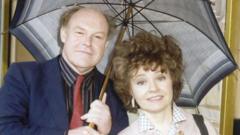
When the television cameras first climbed aboard a narrowboat named Avon to film what was pitched as a standard Sunday-night travelogue, nobody expected a masterpiece of human grief and devotion. The premise seemed simple, almost mundane. Two veteran British actors, Timothy West and Prunella Scales, would navigate the inland waterways of Britain, operating locks, drinking tea, and admiring the weeping willows. You might also find this related article interesting: The Anatomy of Genre Capture A Brutal Breakdown of the Dembow Copyright Ruling.
It looked like cozy television. It looked like escape.
But television is an accidental truth machine. What began as a series about geography quickly mutated into something entirely different. It became a public chronicle of a long, slow goodbye. As highlighted in latest reports by Rolling Stone, the implications are significant.
Beneath the scenic backdrops of the Kennet and Avon Canal or the floating bypasses of France lay an unscripted, raw reality. Prunella Scales, beloved by millions for her sharp-tongued portrayal of Sybil Fawlty in Fawlty Towers, was disappearing. Vascular dementia was quietly erasing her timeline.
The water kept moving. So did they.
The Anchor of the Present Moment
Dementia changes the architecture of time. For the person living with it, the past becomes a series of disconnected islands, and the future is an abstract concept that refuses to take shape. Only the present remains.
On a canal, the present moment requires absolute attention. You cannot drift off when you are steering a 20-ton steel shell through a brick bridgehole that offers only two inches of clearance on either side. You cannot forget where you are when you are winding a windlass to open a lock paddle, unleashing thousands of gallons of churning water.
Consider what happens when memory fails but muscle memory endures. Watch Prunella on the stern of the boat. Her hands find the tiller naturally. She knows the weight of it. She knows how a boat responds to a gentle push. For a few moments, the fog clears. The illness recedes into the background, defeated by the immediate necessity of the rudder.
This was the magic of their journeys. The canals did not cure the condition, but they provided a framework where the condition did not matter as much. The slow pace matched the forced slowness of their lives. On the water, there is no rush to get anywhere, because rushing is structurally impossible. If you hit a lock, you wait. If the wind blows you into the reeds, you push off with a pole.
It is a striking metaphor for navigating a terminal diagnosis. You do not fight the canal; you adapt to it.
The Geography of Partnership
Marriage is a shared language built over decades. It consists of inside jokes, unspoken signals, and mutual tolerance. When one partner begins to lose that shared vocabulary, the remaining partner must carry the weight of both sides of the conversation.
Timothy West became the keeper of their shared history.
In one fragment of film, they sit side by side in the cabin as the rain beats against the small windows. Timothy reminds Prunella of a play they performed together forty years earlier. He supplies the names of the theaters. He remembers the specific directors. He remembers her costumes. She listens, her eyes bright, nodding along to the story of her own life as if she is hearing a fascinating tale about a stranger.
"Did I really do that, Tim?" she asks.
"You did," he says softly. "And you were marvelous."
Love is often depicted as a lightning bolt. It is fireworks, grand gestures, and breathless confessions under the rain. That is a young person's myth. Real love, the kind that survives the brutal erosion of time, looks like a man gently guiding his wife’s hand toward a iron handrail because he knows her depth perception is fading. It looks like a woman trusting her husband completely as he leads her into the dark cavern of a canal tunnel.
They had been married for over half a century when they started filming. They knew every crease in each other's faces. The show offered no clinical advice. It provided no medical breakthroughs. Instead, it offered something far rarer: a blueprint for dignity in the face of inevitable decline.
The Invisible Stakes of Public Vulnerability
We live in a culture obsessed with presentation. We filter our photos, edit our thoughts, and hide our vulnerabilities behind a veneer of competence. Famous people do this more than anyone else. To admit weakness is to risk irrelevance.
Choosing to let the cameras roll as dementia took hold was an act of immense bravery.
There were moments of genuine frustration. There were times when Prunella looked lost, unsure of why she was standing on a muddy path in Wiltshire or who the people with microphones were. A lesser production would have edited those moments out to preserve the illusion of a cheerful holiday.
But the filmmakers kept them in. Because of that choice, millions of families watching at home saw their own struggles reflected on screen. They saw that it was acceptable to be tired. They saw that it was acceptable to grieve for someone who was still sitting right next to you.
The stakes were not about whether they would reach the next town before nightfall. The stakes were about preserving connection. Every successful lock negotiation was a tiny victory against the disease. Every shared laugh over a burnt piece of toast was a flag planted in defiance of oblivion.
The Turning of the Leaves
The seasons changed over the course of the series. The bright greens of spring canal banks gave way to the deep, heavy foliage of summer, and eventually to the stark, skeletal gray of winter.
The progression of the illness followed a similar trajectory. The gaps between the good days grew wider. The questions became more repetitive. Yet, the affection between the two travelers never wavered. If anything, it crystallized. Strip away the ability to recall what happened yesterday, strip away the accolades of a long acting career, and what is left?
What remained was a profound, instinctual attachment.
In the final episodes, the physical reality of aging caught up with the production. The heavy lock gates became too difficult to push. The steps down into the cabin grew too steep. The journeys had to end.
But the lesson of the waterways remained. The canals endure because they were built well, crafted by hand to withstand the passage of centuries. A deep human bond functions the exact same way. It is not built for speed; it is built for the long haul.
The boat eventually returned to its mooring. The engine was switched off. The water grew still, reflecting the gray English sky. Timothy and Prunella stepped off the steel deck and walked away, arms linked, moving slowly into the quiet afternoon.


