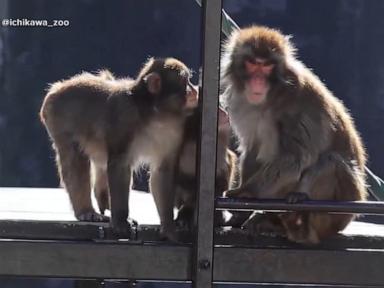
He weighed less than a bag of flour when they first brought him through the heavy steel doors, a shivering knot of gray fur and oversized ears whose fingers refused to uncurl from the fabric of a volunteer’s fleece.
Stop. Look closely at those hands.
In the frantic, high-definition blur of modern viral media, we are trained to consume animal rescue stories like sugar packets—a quick burst of sweetness, a double-tap on a glowing screen, a fleeting murmur of aww before the thumb flicks upward to the next catastrophe or celebrity scandal. Punch the monkey became one of those digital flashes. A tiny primate, orphaned and bewildered, captured on camera clinging to life and later emerging in a widely shared video update that promised a heartwarming resolution. Most people watched the clip for twelve seconds, smiled at his glossy eyes and clumsy first steps toward recovery, and moved on with their Tuesday.
They missed the entire point.
If you have ever sat on the cold concrete floor of a wildlife rehabilitation ward at three in the morning—listening to the hum of incubators and the shallow, terrified wheezing of an infant mammal that knows its mother is gone—you understand that survival is never cute. It is exhausting, precarious, and brutally slow. When Punch arrived in human care, he wasn't a charming internet mascot. He was a biological emergency wrapped in skin so thin you could trace the blue architecture of his veins beneath the wrist.
The Architecture of Abandonment
To understand why a thirty-second update on a single young monkey carries so much emotional voltage, you have to understand what happens to a primate nervous system when the primary bond is severed.
For an infant monkey, a mother is not merely a source of milk or warmth. She is gravity. She is the entire sensory universe. From the first second of breath, an infant primate’s survival depends on an ancient, involuntary reflex: the palmar grasp. Those miniature, leathery fingers lock onto maternal fur with enough tensile strength to support the baby's entire body weight while the mother leaps across high canopy branches.
When that fur vanishes—whether through habitat destruction, the illegal pet trade, or an accident in the wild—the infant does not simply feel sad. Its physiological regulation collapses. Heart rates spike into dangerous arrhythmias. Cortisol floods the bloodstream, stunting neural development and suppressing a fragile immune system. Left alone on a flat surface without something to cling to, an orphaned monkey will often thrash itself into exhaustion or slip into a silent, fatal shock.
Consider a hypothetical scenario to picture what that actually feels like. Imagine waking up tomorrow morning on a planet where the atmosphere has suddenly lost half its oxygen, every wall is made of slick, freezing glass, and giants speaking an incomprehensible language are gently trying to feed you liquid from a plastic tube while you have nothing—not a blanket, not a hand, not a thread—to hold onto. That is the exact sensory reality of an intake ward.
I remember the first time I assisted with an orphaned infant macaque years ago, long before smartphones turned every rehabilitation center into a potential broadcast studio. My job wasn't medical. My job was simply to be a warm, stationary post. For six hours straight, I sat cross-legged on a rubber mat while this two-pound creature buried his face into the crook of my elbow, his tiny fingernails digging into my shirt with a ferocity that left red crescents on my skin for days. If I shifted my weight by an inch, his entire body went rigid, a high-pitched trill of pure panic vibrating against my ribs. I walked out of that room with a cramp in my spine and a profound, unsettling realization: to love something back to life requires becoming an inanimate object first.
That is the invisible labor behind every "heartwarming update" you ever see online.
Why We Watch Through Glass
When the recent footage of Punch began circulating, the surface details were undeniably magnetic. There he was, noticeably plumper, his coat filling out with the healthy sheen that only comes from weeks of meticulously balanced formula and uninterrupted sleep. In the video, he wasn't cowering in the corner of an enclosure or clinging desperately to a rolled-up towel—the standard surrogate mothers used by wildlife staff to prevent human imprinting. Instead, he was exploring. He reached out with deliberate curiosity, testing his balance, interacting with his environment with the unmistakable spark of an animal that no longer believes every shadow is a predator.
Why did millions of strangers stop scrolling to watch him?
It is easy to dismiss viral animal content as cheap distraction, an emotional pacifier for an anxious public. Frankly, there are days when I wonder if our obsession with animal rescues is just a convenient way to feel compassionate without doing the hard work of helping our neighbors. That doubt sits heavy in the chest of anyone who works in conservation or rescue journalism. You see the donations pour in for one photogenic baby monkey while funding for the broader habitat protection laws—the unglamorous, bureaucratic trench work that prevents these orphans from being created in the first place—dries up in committee rooms.
Yet, watching the public reaction to Punch reveals something far more honest than mere escapism.
Modern life has become remarkably antiseptic and weirdly isolated. We spend our days manipulating glass rectangles, trading abstract emails, and navigating social interactions filtered through algorithms. We are starved for proof of tangible, unambiguous care. When you watch a tiny creature recover from trauma, you are witnessing a direct cause-and-effect chain that feels increasingly rare in human affairs: someone was broken, someone else stayed up through the night to mend them, and now the broken thing is whole enough to play.
Think of rehabilitation not as a miracle, but as a slow-motion bridge. On one side is acute trauma—the sudden severance from the wild, the sterile shock of captivity. On the other side is autonomy. Every syringe feeding, every temperature check, every carefully calibrated introduction to enrichment toys is another plank laid across that chasm. You cannot rush the construction, because if you step onto an unfinished bridge, the whole structure drops into the river.
The Quiet Discipline of Letting Go
The hardest part of Punch’s journey isn't the part that makes people smile on camera. It is what happens right after the camera turns off.
In ethical wildlife rehabilitation, success is measured by heartbreak. If a caregiver allows an orphaned primate to become permanently attached to human hands, that animal is ruined for the wild. It will never learn the complex, unforgiving grammar of troop hierarchy. It will not know how to read the warning bark of an elder male, which leaves carry toxins, or how to groom an ally to secure protection during lean seasons. A monkey that loves humans too much ends up trapped behind bars for thirty years, a permanent dependent unable to speak the language of its own species.
So the caretakers working with Punch have had to perform an extraordinary feat of emotional discipline. At the exact moment when the infant finally begins to trust them—when he stops trembling and starts looking at them with recognition and affection—they have to begin pulling away.
Let that sink in.
They must wear neutral expressions. They have to minimize vocalizing. They gradually replace their own warm shoulders with textured climbing frames, woven ropes, and eventually, the unpredictable, rough-and-tumble company of other young primates. It is a deliberate, methodical withdrawal of affection designed to push the animal toward its own kind.
Historically, wildlife facilities got this terribly wrong. Through the mid-twentieth century, well-meaning rescuers raised orphaned primates in human homes, dressing them in toddler clothes and feeding them at kitchen tables. Behavioral primatologists eventually documented the devastating fallout: severely neurotic adult animals unable to mate, unable to integrate into troops, and prone to self-harm when inevitably outgrowing their living-room cages. Modern sanctuary protocols were forged out of those failures. Today, every step forward in an update video like Punch’s represents hundreds of hours of restraint—caretakers biting their tongues and keeping their hands at their sides so a monkey can discover its own strength.
What the Camera Never Captures
Watch that update video again, if you come across it in your feed, and look past the obvious charm of a healthy baby monkey finding his footing.
Look at the background. Notice the carefully angled branches positioned just high enough to challenge his coordination without risking a dangerous fall. Notice the cleanliness of the enclosure—not sterile like a hospital, which would dull his immune system, but stocked with natural substrates that force his brain to map textures, smells, and spatial depth. Notice the calm, unhurried posture of the human hand entering the frame for a fraction of a second, steady and completely devoid of sudden movement.
Every single frame is a quiet argument against cynicism.
We live in a culture addicted to spectacle. We expect transformation to look like fireworks—dramatic speeches, overnight turnarounds, sweeping victories. Punch offers the exact opposite lesson. His recovery was built out of lukewarm formula measured to the milliliter, soiled towels swapped out at four in the morning, and the quiet patience of professionals who know their names will never appear in the headline.
There is no grand philosophical theorem needed to explain why this matters. A small life that was supposed to end in the dark didn't. Fingers that once locked onto cotton fabric in sheer terror are now opening, reaching outward, and testing the weight of a branch on their own terms.
Somewhere in a quiet enclosure right now, the lights have been dimmed for the night, and a small gray shape is curled tightly around a thick rope—breathing steadily, fast asleep, holding onto itself.