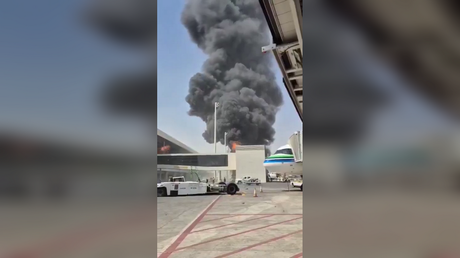
The coffee in the paper cup had gone cold hours ago, but Tariq still held it, wrapping his numb fingers around the wet cardboard as if it could anchor him to something solid. Outside the reinforced glass of the terminal observation deck, the tarmac of Abha International Airport shimmered under a harsh, bleached midday sun. It was supposed to be a normal Tuesday. Passengers in crisp business suits rolled their carry-ons toward Gate 4. Families with tired toddlers stood in line for boarding passes, murmuring about baggage allowances and duty-free chocolate.
Then came the sound. Read more on a related issue: this related article.
It wasn't the familiar, comforting whine of a Boeing turbine spinning up for takeoff. It was a sharp, tearing hiss—a metallic scream that scraped against the sky before the concourse windows began to violently shudder.
Sirens woke the concrete. Red emergency lights bled across the pristine marble floors, turning the departure lounge into a stage set for a disaster movie. But this wasn't a film. This was the raw, jagged edge of a shadow war that had finally crossed the invisible line from distant border skirmishes into the quiet, everyday spaces where civilians pour their morning coffee. More reporting by The Guardian explores comparable views on the subject.
For years, the conflict in Yemen had been an abstraction for most travelers passing through the southern hubs of the Arabian Peninsula. It was a headline swallowed by the morning commute, a geopolitical chess match played out in mountain passes and dry riverbeds hundreds of miles away. But geography is a stubborn thing, and when unmanned delta-wing drones dipped low beneath the radar horizon, bearing explosive payloads with calculated trajectories, that distance evaporated in a fraction of a second.
Consider what happens to a city's heartbeat when the sky becomes a question mark.
Abha and Jizan are not front-line fortresses in the traditional sense. They are commercial waypoints, agricultural market towns, and regional transit arteries where salesmen, teachers, and mechanics cross paths every day. When the Houthis issued their stark, ultimatum-laden final warning demanding an immediate halt to coalition air operations, few ordinary citizens expected the threat to materialize as jagged shrapnel tearing through civilian hangars and parking lots.
Warnings in modern asymmetric warfare are rarely gentle. They are broadcast through state television tickers and translated into chilling bullet points on social media feeds, usually accompanied by grainy thermal-imaging footage of launch rails tilting upward into the dark. Yet, the translation between a political decree issued in Sanaa and the screaming metal of an interception over an airport terminal is vast. It is the distance between a diplomat’s desk and a child diving under a plastic airport chair.
The tactical reality of these strikes reveals a grim evolution in regional mechanics. Armed with heavily modified delta-wing loitering munitions—often assembled from smuggled foreign components and guided by commercial GPS systems—insurgent forces found a low-cost workaround to sophisticated air defense batteries. You do not need an expensive supersonic fighter jet to paralyze a regional economy; you only need a swarm of fiberglass-and-motor-engine projectiles cheap enough to throw at the wall until something cracks.
Each interception leaves a signature white scar across the blue air, a puffy ring of cotton where a Patriot missile met its target five thousand feet above the runway. But gravity is democratic. Even when intercepted, the falling debris—shards of carbon fiber, burning fuel cells, and razor-sharp guidance fins—rains down on housing estates, car dealerships, and empty taxi stands.
Tariq remembers the smell most of all. It wasn't the sulfur of a movie explosion. It smelled like burning electrical wire and scorched rubber, mixed with the sharp, sickening tang of aviation fuel leaking from a punctured wing. It lingers in the back of the throat long after the smoke clears, a chemical reminder that the roof over our heads is remarkably thin.
The political fallout rippled outward long before the smoke settled on the tarmac. International carriers paused their routes. Insurance premiums for regional cargo flights spiked overnight, sending invisible shockwaves through supply chains that fed local supermarkets and medical clinics. A single explosion at a regional hub doesn't just disrupt travel schedules; it rewrites the psychological baseline of an entire population. It forces a weary populace to look upward with a new kind of vigilance, measuring the safety of an afternoon stroll against the unpredictable arc of a drone engine overhead.
History is full of these bitter pivots. Moments where the abstract calculus of war collides with the mundane routines of ordinary people who simply wanted to catch a flight home for dinner. The strike on the southern airports was framed by combatants as a strategic necessity, a lever to force diplomatic concessions at the negotiating table. But the leverage was bought with the panic of passengers clutching their passports in stairwells and the sleepless nights of mechanics sweeping glass off the runway before dawn.
The horizon remains hazy over the mountains. Flights have resumed, and the terminal glass has long since been replaced, swept clean of the morning's debris. But the air feels heavier now. Every time a twin-engine jet banks sharply toward the runway, the people waiting below do not just hear the engines. They listen to the silence underneath them, wondering how long it will hold before the sky speaks again.