The coffee in the paper cup went cold hours ago, but nobody on the fourth floor of the apartment block near the Dnipro river is drinking it anyway.
Outside, the autumn wind carries the dry, rattling scent of fallen leaves and something sharper—something metallic that stays at the back of the throat long after the windows are shut. Inside, the light is the grey, flat hue of a television screen flickering in an unlit room. On that screen, the ticker keeps moving. Numbers. Percentages. Districts reporting. Parliamentary elections under a sky that has forgotten how to be quiet. If you liked this article, you should look at: this related article.
Then the sirens start. Not the distant, mournful wail that urban populations learn to tune out like traffic noise, but the sharp, rising shriek that tightens the skin across the back of the neck.
Everyone in the room knows what comes next. It is not an abstract political maneuver discussed in wood-paneled chambers thousands of miles away. It is an escalation, cold and deliberate, dropped from the dark. For another angle on this event, see the latest coverage from The Washington Post.
The Calculus of Retaliation
Politics is usually measured in handshakes, press releases, and fractional shifts in public opinion. But in Kyiv, the currency of politics has been reduced to milliseconds and decibels.
During the recent legislative elections, while citizens stood in queues outside schools and community centers waiting to cast ballots, something else fell from the sky. Drones. Small, buzzing, mechanical hornets loaded with high explosives, sent to disrupt the democratic ritual of a nation refusing to stop breathing. The air defenses caught many of them, turning the night sky into a jagged display of orange sparks and concussive thunder.
To the outside world, it was another headline scrolling past on a morning commute. To the state apparatus in Moscow, it was an irritant that demanded a ledger balanced in blood and masonry.
The announcement came with the chilling predictability of winter. Russia stated its intention: attacks on the capital would intensify. Not taper off. Not pause for negotiation. Intensify.
Consider what that means on the ground.
An escalation in a city of millions is not a military statistic. It is the rhythmic shudder of windowpanes three miles away from an impact site. It is the school principal checking the basement drainage system for the fourth time that week. It is the pharmacy shelf where the iodine tablets sit right next to the aspirin, both of them bought with a quiet, practiced fatalism that defies easy categorization.
Living in the Crosshairs of Democracy
To understand why a legislative election triggers an intensification of airstrikes, you have to look past the tactical maps and examine the psychology of defiance.
Elections during wartime are an absurdity to anyone who views survival purely in biological terms. Why queue up? Why debate party platforms? Why cast a ballot when the power grid is fragile and the airspace is contested?
Because voting is an act of punctuation. It is a way of saying: We are still here. This timeline still belongs to us.
When citizens marked their ballots against the backdrop of drone incursions, they were engaging in an act that autocracy finds uniquely intolerable. An active parliament, freely chosen even while air raid shelters echo with children's voices, is a living refutation of the narrative that a nation can be bombed into political submission.
That is why the response is designed to be disproportionate. The intensification of strikes on Kyiv is not merely about destroying transformers or shattering concrete panels; it is an attempt to break the cognitive continuity of ordinary life. If you can make a trip to the bakery feel like a lottery with death, people stop going to the bakery. If you can make an election night feel like an execution, people stop voting.
Except, historically, they rarely do.
The Architecture of Resilience
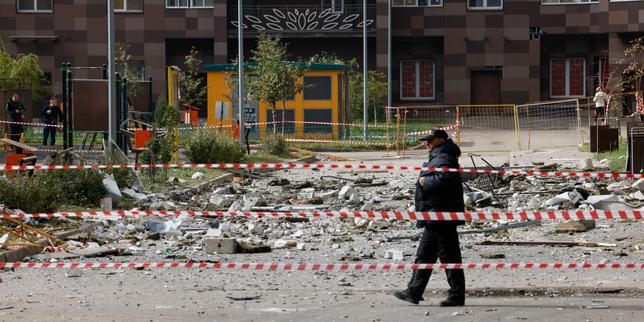
Walk down a residential street in Kyiv on the morning after a heavy night of interceptions. The cleanup crews are already there.
This is the part that telemetry data and military briefings miss: the sound of brooms sweeping up safety glass. It is a remarkably mundane sound for a war zone. Orange-vested municipal workers shovel shattered storefronts into metal bins while delivery cyclists pedal past them, weaving around fresh craters with the practiced indifference of bicycle couriers worldwide.
Human beings possess an almost terrifying capacity to normalize the abnormal.
In a hypothetical scenario where an outsider is dropped directly into this reality, the panic is overwhelming. The sirens sound like the end of the world. The concussions in the distance feel like they are shaking the floorboards beneath your teeth. But for the people who have lived through years of this kinetic chess match, the reaction is measured down to the second.
Three rings on the phone from a relative in Lviv: Are you in the corridor?
A text message back: Yes. Bring tea.
Ten minutes of silence broken only by the muffled thump of air defense batteries doing their grim work three neighborhoods over.
Then the all-clear.
And the city exhales, resets, and goes back to work.
Beyond the Horizon
The threat from Moscow remains absolute. The official statements do not leave room for diplomatic ambiguity. The drones will come heavier, the targets will be probed for weakness, and the psychological pressure on the capital will be cranked another notch higher.
Yet, sitting in that fourth-floor apartment as the grey evening descends, looking out over the sprawling, darkening grid of a city refusing to turn on its outdoor lights, a different truth emerges.
You cannot bomb a concept out of existence with high explosives. You can crater a street, you can plunge a neighborhood into darkness, and you can force thousands down into the concrete womb of the metro stations for hours at a time. But every time the smoke clears and the brooms come out to sweep the glass, the underlying architecture of the society remains intact.
The ballot boxes have been sealed. The votes are counted. And high above the Dnipro, the stars are still there, half-obscured by the thin, drifting grey haze of a city that has decided, quite simply, to endure.