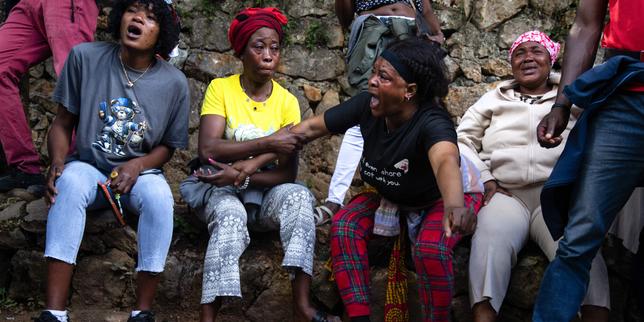
Morning does not arrive gently in the lower districts of Port-au-Prince. It arrives with a sudden, tearing sound. A sharp crack of automatic gunfire pierces the heavy, humid air before the sun has even cleared the corrugated iron roofs.
For most people living outside the island nation, numbers on a screen represent tragedy. Forty dead. The statistic flashes across a morning broadcast, a brief disruption between weather reports and international finance updates, easily scrolled past and just as easily forgotten. But numbers do not capture the weight of empty chairs at a breakfast table. They do not smell of cordite, dust, and copper.
Consider a hypothetical mother, let us call her Marie, waking up to that exact sound. She does not reach for her phone to check the breaking news. She reaches for her youngest child, pulling the sleeping boy onto the floor beneath the window sill, away from the glass. She knows the arithmetic of survival here. She does not need a news alert to tell her that the border between safety and catastrophe has dissolved once again.
Violence in Haiti has evolved past simple street crime. It has mutated into a sprawling, suffocating system of control. Gang coalitions, operating with impunity in the vacuum left by collapsed political institutions, treat entire neighborhoods as territories to be conquered, depopulated, or bled dry. When an assault happens near the capital, leaving at least forty souls dead in its wake, it is not an isolated riot. It is a calculated escalation in a war of attrition against ordinary human existence.
Silence.
That is what lingers after the smoke clears. The silence of deserted market stalls where vegetables rot in the heat because no vendor dares walk the roads. The silence of shuttered clinics where doctors have fled because medicine has become a target.
(Note: While Marie is a composite portrait, the terror she navigates is documented daily by humanitarian groups tracking the displacement of tens of thousands of families across the metropolitan zone.)
To understand why forty lives can be extinguished in a single coordinated raid without immediate intervention, one must look beyond the immediate tactical failure of local security forces. The state is fractured. Police stations, besieged and under-resourced, often find themselves outgunned by militias wielding military-grade weapons smuggled across porous maritime borders. When the shield breaks, the people are left exposed to the storm.
History whispers a warning here, though few in the international community seem willing to listen. Haiti’s current crisis is not an anomaly born in a vacuum. It is the accumulated weight of decades of institutional erosion, external meddling, abandoned political promises, and economic strangulation. When governance fails completely, the vacuum is invariably filled by those who measure power in calibers and coercion.
Yet, resilience persists in the most stubborn, beautiful ways.
Walk through the quieter alleys of the capital on an afternoon when the gunfire pauses, and you will see it. Neighbors sharing clean water from a single functioning tank. Teachers holding impromptu classes under the shade of a mango tree because the school building is occupied or damaged. People refusing to let their humanity be reduced to casualty reports. They are rebuilding the social fabric thread by thread, even as invisible hands tear it apart again.
The world watches from a safe distance, offering statements of deep concern and piecemeal aid that too often get lost in bureaucratic bottlenecks or intercepted before reaching those who need them most. Condolences are cheap. Effective solidarity requires a fundamental reckoning with the root causes of the terror. It requires cutting off the illicit financial and arms flows that keep the armed groups operational. It requires listening to local civil society leaders who have laid out clear, homegrown paths toward stability, rather than imposing top-down solutions that have failed time and time again.
Forty people died near the capital. Tomorrow, the headlines will shift. Another crisis will demand the world's fickle attention. But Marie will still be on the floor beneath her window, listening to the wind rustle through the zinc sheets, waiting for a dawn that brings peace instead of smoke.
The sun dips below the horizon, painting the Caribbean sky in violent shades of burnt orange and bruised purple, casting long, dark shadows over the silent streets where the names of the fallen are already turning into memory.