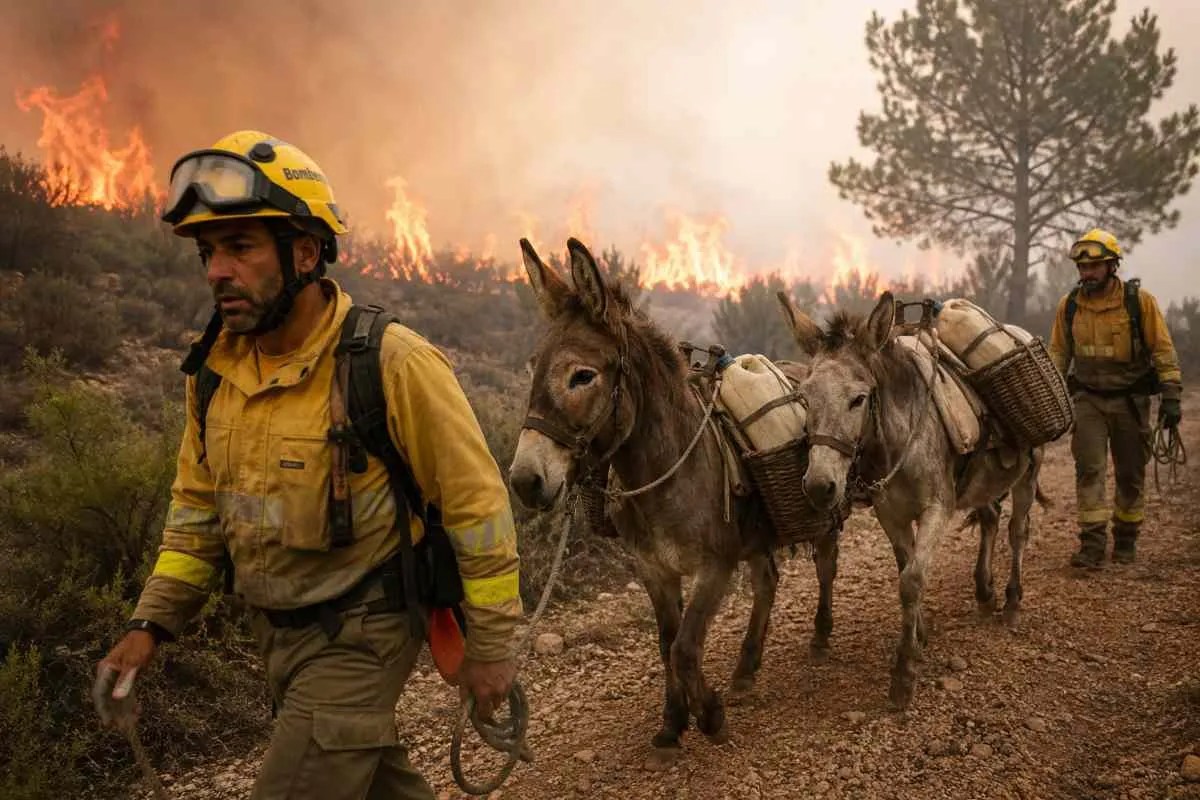
Ash does not fall like snow. Snow has a gentle, tumbling weight, a quiet way of settling into the crevices of a windowsill. Ash is jagged. It is the ghost of a pine needle, the skeleton of a centuries-old oak, charred and weightless, riding the hot thermals miles away from the mouth of the beast.
When the air turns the color of a bruised peach, you stop looking at your phone. You stop refreshing the weather apps. You simply step outside, draw a breath that tastes like a campfire built out of wet plastic and ancient resin, and you know.
The forest has woken up angry.
Consider what happens next. A quarter of a million human beings—mothers with toddlers clutching frayed stuffed animals, old men clutching metal boxes of faded photographs, teenagers staring blankly at backpacks packed with clothes they will never wear—are handed a single instruction. Leave.
Leave the kitchen table where you ate breakfast twenty minutes ago. Leave the lavender bushes you planted in the spring. Leave the front door unlocked because locking it feels absurd when the roof might not be there by midnight.
Bordeaux was supposed to be safe. Bordeaux was the city of stone, of orderly rows of limestone facades, of damp vineyard cellars where deep, quiet bottles of red wine age in the dark, untouched by the frantic rhythms of the modern world. But the pine forests of the Gironde, stretching out toward the Atlantic like a green ocean of their own, became a tinderbox.
Years of quiet heat built up in the soil. The rain forgot how to fall. The ground cracked, thirsty and brittle, sucking the remaining moisture from the roots of the maritime pines until every needle became a fuse.
Listen. Can you hear it?
It is not the sound of a crackling campfire. It is a freight train moving at full speed through a tunnel made of dry leaves. It is a roar that vibrates in your chest cavity, drowning out the sirens, drowning out the frantic shouts of neighbors, drowning out the very thoughts in your head. Fire on this scale does not merely burn. It consumes oxygen with such violent greed that it creates its own weather system. It breeds its own winds, whipping embers a mile ahead of the front line, turning every backyard fence and wooden shed into a rolling lottery of destruction.
Statistics are cold things. They are designed to keep us at a comfortable distance from tragedy. We read that 250,000 people were displaced, and our brains categorize it as a data point, a headline to scroll past while waiting for a train. But numbers do not bleed. Numbers do not choke on the particulate matter settling heavily over the southwestern coast of France.
Imagine a hypothetical resident, let us call him Jean-Luc, though his name could just as easily be Sarah or Mateo. Jean-Luc has farmed grapes in the shadow of the pine belt for forty years. He knows the wind patterns better than he knows his own children's birthdays. When the local authorities knocked on his door, he scoffed. He had seen small fires before. He had grabbed his garden hose, sprayed the perimeter, watched the orange glow retreat.
But this fire laughed at the garden hose.
When Jean-Luc finally turned his small truck down the evacuation route, creeping bumper-to-bumper through a choking corridor of twilight-sky, he looked in his rearview mirror. The sky behind him was no longer blue, nor grey, nor black. It was the color of a deep, roaring furnace door flung wide open in a pitch-black room.
The social fabric of a region frays in real-time under that kind of light. Gas stations run dry. Highway lanes merge into bottlenecks of stressed metal and blaring horns. Strangers share water bottles through rolled-down windows, their eyes bloodshot from smoke and exhaustion, bound together by a sudden, terrifying equality. In the face of a wall of fire, bank accounts do not matter. Job titles do not matter. Only the distance between you and the Atlantic coast matters.
Firefighters fought with a desperate, exhausted heroism along the perimeter lines, carving firebreaks into the earth with heavy machinery, pouring thousands of gallons of water into a furnace that hissed and swallowed it whole. But human hands have limits. When the wind shifts, plans dissolve. You fall back. You give up another mile of pine, another hundred years of history, another village built of stone and timber, all to buy enough time for the living to escape.
The evacuation of a quarter of a million souls is a logistical nightmare, yes, but it is fundamentally a human rupture. It is the abrupt severance of a life built over generations.
We live in an era where we treat the planet as an infinite resource, a backdrop for our expansion, a machine that will endlessly absorb our exhaust and our carelessness. We build our homes closer to the trees, we pave over the wetlands, we let the summers stretch longer and hotter into the autumn, and then we act surprised when the balance sheet comes due. The wildfire season in Europe is no longer an anomaly. It is the new baseline. A warning written in soaring temperatures and falling ash.
Look closely at the horizon.
The flames will eventually be beaten back. The smoke will clear, revealing a scorched earth where emerald forests used to stand, leaving behind hillsides that look like charcoal drawings of themselves. The displaced will return, some to rebuilt homes, others to empty concrete slabs where memories used to live. They will plant new vines. They will rebuild the fences.
But the air will taste different. The horizon will look emptier. And every time the wind picks up from the east, carrying the dry heat of the interior toward the sea, a quarter of a million people will pause, look up at the sky, and listen for the roar of the train.