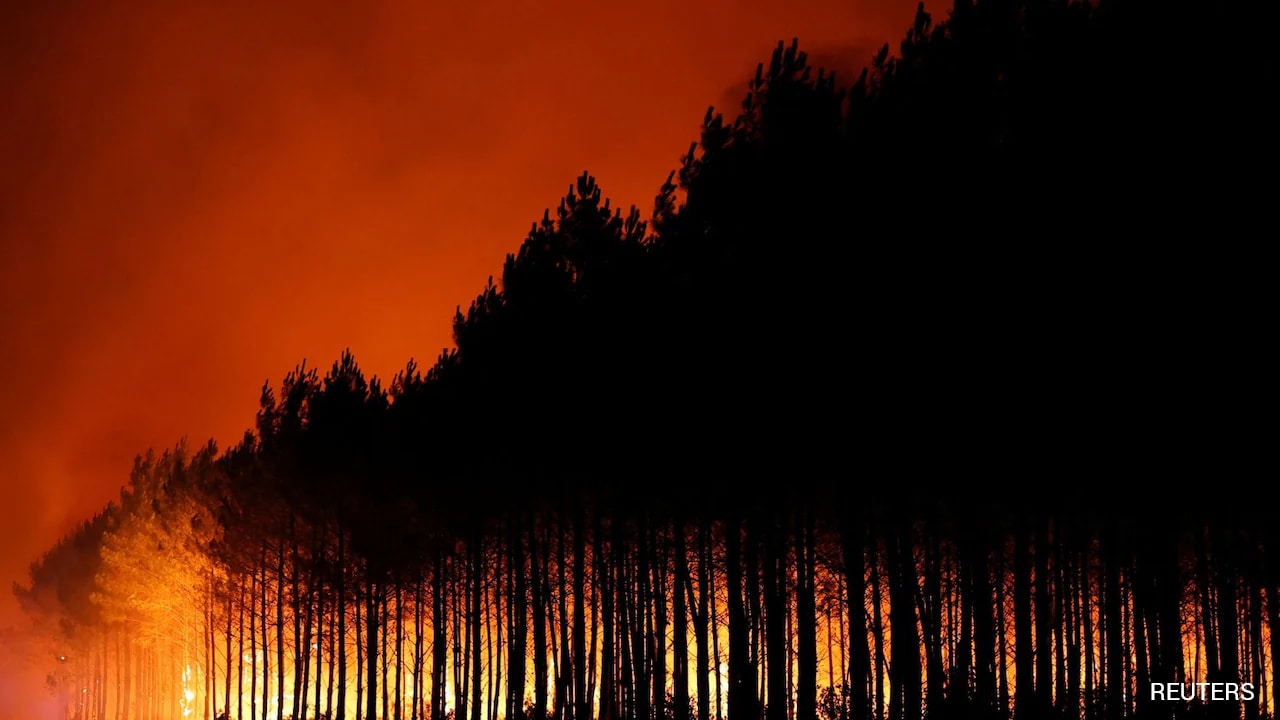
Ash does not fall like snow. Snow drifts, catching the light, whispering of winter holidays and quiet mornings. Ash drops heavy. It smells of burned plastic, of ancient pine resin, of things that were once someone’s living room.
The sky above the pine forests of southwestern France did not turn blue that Tuesday. It turned the color of an old bruise.
Across the border in Spain, the thermometers had long since stopped feeling like numbers on a screen. They were physical weights pressing down on the asphalt, bending the rails, baking the soil until it cracked open in jagged, hungry mouths. When the spark caught—whether from a discarded bottle acting as a lens or the sheer, breathless furnace of a July heatwave—it did not need an invitation. It found fuel waiting. Decades of dry underbrush. Centuries of quiet woods.
Heat.
That was the constant.
Imagine standing on your porch, watching a column of black smoke climb three miles into the stratosphere. You do not think about hectares or mitigation strategies. You think about your grandfather’s pocket watch in the top drawer. You think about the cat hiding under the bed who refuses to understand that time has run out.
Three hundred thousand people.
Say the number out loud. It sounds clean. Clinical. A statistic to be scrolled past on a morning commute while sipping lukewarm coffee. But strip away the anonymity of the aggregate, and you find a mother in Bordeaux loading three changes of clothes and a photo album into the boot of a station wagon. You find a vineyard owner in Catalonia watching fifty years of sun and soil turn into an impenetrable wall of orange.
Evacuation is not an orderly queue. It is a crawl of brake lights stretching into the midnight dust. It is the sudden, terrifying realization that the road you have driven a thousand times to get to the coast is now a corridor between two walls of flame.
Fire moves. This is the horror of it. People talk about wildfires as if they are static disasters, like earthquakes that strike and leave behind their wreckage to be counted. Fire is alive. It breathes. It creates its own weather. A crown fire races through the tops of pine trees faster than a horse can gallop, driven by the superheated air it generates itself. It throws embers half a mile ahead of the main front, planting new fires like cruel seeds in the dark.
Firefighters know this better than anyone. They stand behind lines of wet earth and dropped foam, watching the wind shift an inch to the left.
One degree.
That is all it takes. One shift in the jet stream, one sudden gust off the Atlantic, and the safe zone becomes the danger zone.
We have engineered our modern lives around the illusion of containment. We believe our concrete dividers, our paved highways, our municipal water systems can keep the wild things at bay. We build homes at the edge of the woods because we love the green, because we crave the quiet. But the green is changing. The old rhythms of summer rain followed by autumn damp have broken.
What happens when the buffer zones disappear?
Look at the statistics coming out of the Mediterranean basin this season. Record-shattering temperatures. Months without a drop of meaningful moisture. The soil is not just dry; it is desiccated. It is tinder waiting for a match. When scientists talk about megafires, they use words like resilience and adaptation. They draw charts showing exponential curves.
The people on the road do not need a chart. They feel the heat through the floorboards of their cars.
By the time the convoys reached the emergency shelters in regional sports halls and makeshift fairgrounds, the adrenaline had given way to a profound, hollow exhaustion. Cots were unfolded. Bottled water was handed out by volunteers whose own homes might be next. In the corners of gymnasiums, children slept on jackets, their faces illuminated by the blue glow of phones checking for news that hadn't arrived yet.
Has the fire reached our street?
That is the question suspended in the air. A question without an answer, hanging over thousands of families who left their front doors unlocked, believing they would be back in an hour.
The smoke travels further than the flames. It drifts across borders, turning the sun a dull, coppery red over cities hundreds of miles away. People in distant capitals cough slightly as they step out of office buildings, wondering why their eyes smart. They look up at the strange, filtered light, briefly inconvenienced by the atmosphere.
They do not smell the pine. They do not hear the roar of a thousand acres of forest collapsing inward like a burning cathedral.
The wind keeps blowing. The heat stays trapped in the valley.
Somewhere near the border, a lone water-bomber banks steeply over a ridge, its belly doors snapping open to release a heavy grey arc of red retardant into the teeth of the blaze. It is a tiny drop against an ocean of heat. Yet it turns, circles, and comes back for more.