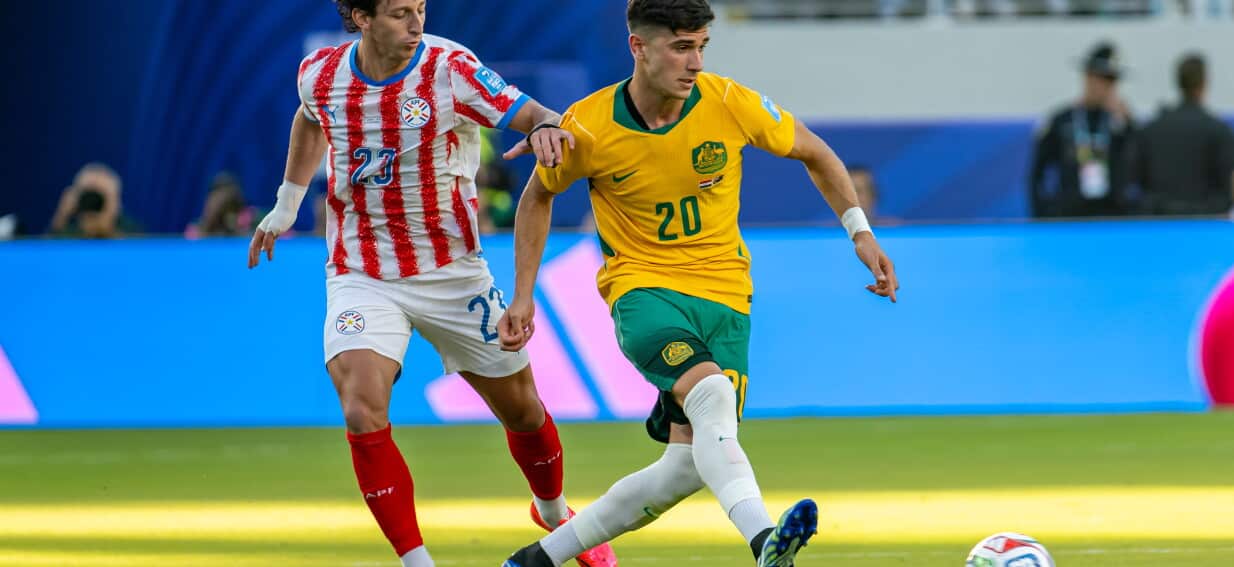
Mainstream sports media is currently congratulating itself on a lie. The headlines are predictably breathless: "Socceroos stop the nation." They point to the TV ratings for the Australia versus Paraguay World Cup match, pop champagne corks, and declare that football has finally, permanently arrived in the cultural mainstream.
It is a comforting narrative. It is also entirely wrong.
As someone who has spent two decades analyzing sports media rights, broadcast metrics, and commercial sponsorships, I have watched this exact cycle play out half a dozen times. A major international tournament rolls around, casual fans tune in out of a sense of national duty, ratings spike, and pundits declare a "new era" for the round-ball game. Then, the tournament ends, the circus leaves town, and domestic metrics plunge straight back into freezing territory.
We need to stop confusing nationalistic event-tourism with genuine sport consumption. The raw data from the Paraguay match does not prove football is taking over Australia. It proves that Australians love free-to-air drama, a green-and-gold jersey, and the fear of missing out.
The Mirage of the One-Off Spike
The core flaw in the current celebratory analysis is a failure to differentiate between a structural shift in audience behavior and a temporary, event-driven anomaly.
When a World Cup match draws millions of viewers, networks and sporting bodies treat those viewers as newly converted lifelong fans. They are not. They are cultural tourists.
Look at the structural mechanics of sports broadcasting. True sporting health is measured by sustained engagement—the week-in, week-out willingness of an audience to invest time and money into a product. While the national team can command massive eyeballs during a high-stakes knockout game, the domestic A-League struggles to draw fractions of those numbers.
Imagine a retail store that tracks its health solely by the foot traffic it receives on Boxing Day. If a store is empty for eleven months of the year but packed on December 26th, you do not have a booming business; you have a systemic operational problem masked by a single calendar event.
This is the blind spot of Australian football administration. The gap between international event ratings and domestic league reality is wider in football than in any other major Australian sport. The National Rugby League (NRL) and the Australian Football League (AFL) do not need the World Cup to stop the nation. They do it every single weekend for seven months of the year.
The Problem With Free-to-Air Metrics
We also have to dismantle how these "record-breaking" numbers are calculated and spun.
- The Reach vs. Average Audience Trap: Networks love to throw around "total reach" figures. Reach simply means someone clicked on the channel for a few consecutive minutes while looking for something else. The true metric of value is the average audience across the entire broadcast, which paints a far more modest picture.
- The Single-Screen Bias: A massive chunk of the viewership for international qualifiers and tournament matches comes from public venues, live sites, and clubs. Traditional ratings boxes heavily distort how these communal viewing experiences translate into actual, monetizable digital assets.
- The Time-Zone Factor: When an event occurs in a favorable domestic prime-time slot against weak counter-programming, a ratings bump is inevitable. It reflects scheduling convenience, not a deep-seated passion for the tactical nuances of a mid-block defense.
Why Major Brands Are Quietly Backing Away
While sports editors write glowing pieces about record audiences, corporate sponsorship executives are looking at the data with cold eyes.
I have sat in boardrooms where major FMCG (Fast-Moving Consumer Goods) brands and banking giants review their sports portfolios. They are increasingly realizing that buying into the Socceroos' peak moments is an incredibly expensive exercise with a terrible depreciating value.
The cost of alignment with a national team during a World Cup cycle is exorbitant. Yet, the tail of that investment is non-existent. A brand pays premium rates to appear on screen during the Paraguay match. The morning after, that audience disperses. It does not transfer its loyalty to the local club matches the following weekend.
In contrast, an investment in the AFL or NRL offers constant, repetitive brand exposure over 24 weeks plus finals. It embeds a brand into the weekly routine of the consumer. It provides regional activation, grassroots integration, and continuous digital touchpoints.
Football in Australia has failed to build a bridge between the peak emotional highs of the national team and the daily reality of the local game. Until that bridge exists, high ratings for a single match are nothing more than a vanity metric.
The Flawed Questions Media Economists Keep Asking
If you look at the industry panels and public discussions surrounding sports media rights, the premise of the conversation is fundamentally broken.
People Also Ask: "When will football overtake the AFL and NRL?"
This question has been asked for forty years, and the premise is completely flawed because it assumes sports growth is a zero-sum game played on a linear television grid.
Football does not need to "overtake" traditional Australian codes to be successful, nor is it on a trajectory to do so. The AFL and NRL possess deep, multi-generational, localized monopolies on corporate hospitality, stadium infrastructure, and media complicity. They are civic institutions disguised as sports leagues.
The Socceroos can draw five million viewers for a sudden-death match, but that does not strip a single member from Collingwood or the Brisbane Broncos. The audience for a major international match is additive—it pulls in people who do not otherwise watch sports. It is an entertainment audience, not a sporting audience.
People Also Ask: "How can the game monetize these World Cup ratings?"
The brutal truth is: they cannot. At least not under the current structural framework.
Monetization requires a direct funnel. When a user watches a match on a free-to-air network or a free streaming platform, the governing body does not capture that user's data in a meaningful, actionable way. The network monetizes the immediate ad spots, the viewers turn off their TVs, and the sporting organization is left with nothing but a nice press release to show their government funding partners.
To convert attention into cash, you need friction. You need to compel the viewer to buy a ticket, purchase merchandise, or sign up for a digital membership. The current setup offers zero friction. It is a premium product given away for free to an audience that has shown no inclination to pay for the everyday version of the sport.
The High Cost of Chasing Glitz
There is a dark side to chasing these massive tournament spikes. It distorts the allocation of capital within the sport.
When an organization becomes addicted to the validation of big TV ratings, it starts directing its limited resources toward elite high-performance programs and major international bid campaigns at the expense of the boring, unglamorous foundational work.
- Neglecting the Grassroots Infrastructure: Suburbs are overflowing with kids playing football, yet the facilities are crumbling, pitches are unplayable in winter, and local club fees are prohibitively expensive.
- The Domestic League Starvation Diet: The national domestic league is left to wither on paywalls and secondary streaming networks, starved of marketing investment because the governing body is busy funding international travel and elite camps for national squads.
- The Player Drain: Without a financially viable domestic ecosystem, young talent is forced overseas too early, fracturing the connection between local fans and the stars of the game.
I admit the alternative is a tough sell. Focusing on structural reform, fixing community club economics, and building a sustainable domestic broadcast model doesn't generate flashy front-page headlines. It doesn't allow executives to rub shoulders with FIFA dignitaries in VIP lounges. But it is the only way to build a real sporting economy.
Stop Celebrating the Anomaly
The data from the Paraguay match is an outlier, not a trendline.
When you strip away the hype, the flags, and the manufactured media hysteria, you are left with a simple truth: Australian sports fans love a big event, and they love winning. They will turn up for the spectacle, yell at the screen, and then return to their regular programming.
Stop using international anomalies to justify systemic complacency. Stop telling us the sport has arrived when the foundation is still shaking. The ratings aren't a sign of victory; they are a stark reminder of a massive, unexploited audience that the sport's custodians still have absolutely no idea how to keep.