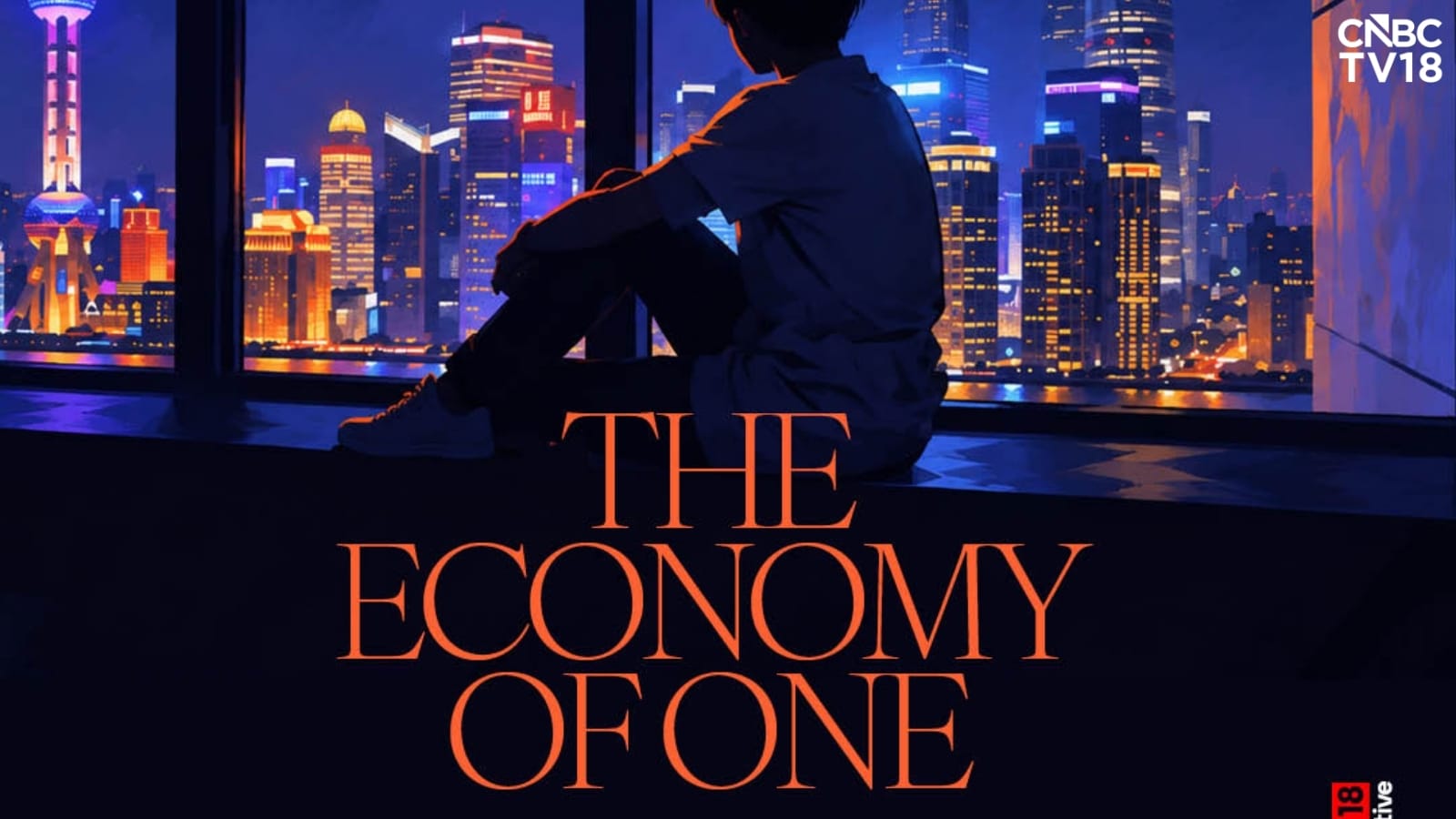
The kettle boils in an empty kitchen.
In Tokyo, a television murmurs to a room where the only resident is a man who finished his corporate shift forty minutes ago. He does not take off his suit jacket immediately. He stands by the window, watching the neon veins of Shinjuku pulse against the dark. Nobody is waiting for him. Nobody is asking about his day. The silence isn't heavy; it is simply total. Recently making waves recently: The Wedding at the Edge of Time.
Across the East China Sea, in a high-rise apartment in Seoul, a woman arranges a single plate of handcrafted dumplings. She photographs them with precision, posts the image to an audience of thousands who know her only as a digital moniker, and then she eats in quiet satisfaction. She does not share rent. She does not negotiate over television channels. Her choices belong entirely, ruthlessly to her.
This is the economy of one. More details regarding the matter are detailed by ELLE.
For generations, the societal blueprint was standardized around the cluster. We built cities, suburbs, schools, and tax codes on the assumption that humans naturally default to pairs and packs. Nuclear families, multi-generational households, dormitories, marriage certificates—these were the structural pillars of commerce. Every product from soup cans to station wagons was scaled for the collective.
That architecture is quietly fracturing.
From Seoul to Taipei, Tokyo to Singapore, a massive demographic realignment is taking place. Millions of adults are choosing to live alone. This is not merely a transient phase of youth or a temporary byproduct of late-night career building. It is a permanent lifestyle choice, an irreversible shift in how human beings inhabit space, spend money, and seek meaning.
To understand the sheer magnitude of this movement, look at the cold numbers, though they fail to capture the heartbeat behind them. In South Korea, single-person households now account for over thirty percent of all homes. Japan stares down a future where nearly half of its population will live unpartnered. In urban centers across Asia, the studio apartment has replaced the sprawling family estate as the primary unit of residential desire.
Yet, numbers are bloodless things. They do not tell you about the midnight grocery run.
Consider Mei. She is a thirty-two-year-old graphic designer living in Taipei. Mei is not lonely, though people who do not live like her often assume she must be. She has friends, projects, a vibrant social life, and a cat named Oolong. But her apartment is her sanctuary. When Mei goes to the supermarket, she faces a paradox that economists are scrambling to decode. Almost everything is packaged for the mythical family of four. Giant bags of rice, family-sized cuts of meat, industrial tubs of detergent.
For years, the market punished the solo dweller. You either wasted food, wasted money, or compromised on variety.
Then, capitalism did what capitalism always does: it adapted.
Entrepreneurs woke up to the sound of single-person wallets opening. Entire industries began to re-engineer themselves around the independent consumer. Miniaturization became an art form. Single-serve rice cookers that occupy no more counter space than a toaster began flying off shelves. Restaurants introduced solo-dining booths—curtained cubbies where a person can eat a steaming bowl of ramen in absolute, uninterrupted peace, free from the social performativity of dining out. Karaoke boxes engineered specifically for one person became lucrative hotbeds for urban venting.
The economy of one has birthed a massive, specialized ecosystem.
Subscription boxes tailored to individual tastes, pet care products designed for owners who treat animals as primary family members, smart-home security systems built for peace of mind rather than shared surveillance. Even the real estate market warped to accommodate the trend. Developers stopped building sprawling three-bedroom compounds in favor of micro-apartments outfitted with high-end, space-saving technology.
Business models that once relied on shared households are being forced to reinvent their value propositions. When you live alone, your discretionary spending shifts dramatically. You invest more in experiences, personal wellness, self-education, and convenience. Time becomes your most precious currency because you are the sole manager of your domestic labor. If the dishes need washing, nobody else is stepping in to save the day. If the bills mount, the weight rests on one pair of shoulders.
This brings us to the invisible friction point of the solo lifestyle.
Independence is intoxicating, but it comes with a quiet, persistent tax. It is the cost of absolute self-reliance.
When you live alone, illness hits differently. There is no one to fetch cough syrup, no one to notice if your fever spikes in the dead of night. Care takes on an entirely different meaning. In societies where filial piety and multi-generational support were once the bedrock of social security, governments and private sectors are now scrambling to figure out how to care for an aging population that has spent decades living apart.
Robotic companions, AI-driven wellness checks, and neighborhood micro-communities are beginning to fill the void. Convenience stores in Tokyo and Seoul are transforming into community nodes, places where older solo dwellers can interact with human beings outside their front doors. The challenge of the coming decades will not be economic growth in the traditional sense; it will be the invention of new architectures for human connection that do not require cohabitation.
We are watching a profound psychological transformation unfold in real time.
For centuries, identity was largely forged in relation to others—as a spouse, a parent, a provider within a household. Strip away those traditional containers, and what remains?
An individual forced to confront their own company.
Some find terror in that mirror. They rattle against the silence, seeking constant distraction in the endless scroll of screens or the perpetual hum of the city. But many others find something unexpected: clarity.
When your living space reflects only your own aesthetic, when your refrigerator contains only what you love, when your time is entirely uncompromised by the endless negotiations of shared living, you begin to inhabit your own skin differently. You become an architect of self.
The economy of one is not a symptom of societal decay, nor is it a cold, dystopian isolation pod. It is an experiment in radical autonomy. It tells us that modern human beings are willing to trade the safety of traditional structures for the fierce, sometimes lonely freedom of self-determination.
The kettle finishes boiling. The water cools in the cup. The city outside continues its relentless, dazzling roar. In a million small apartments across the continent, lights flick on one by one—each a universe unto itself, entirely self-contained, charting a course through the dark.