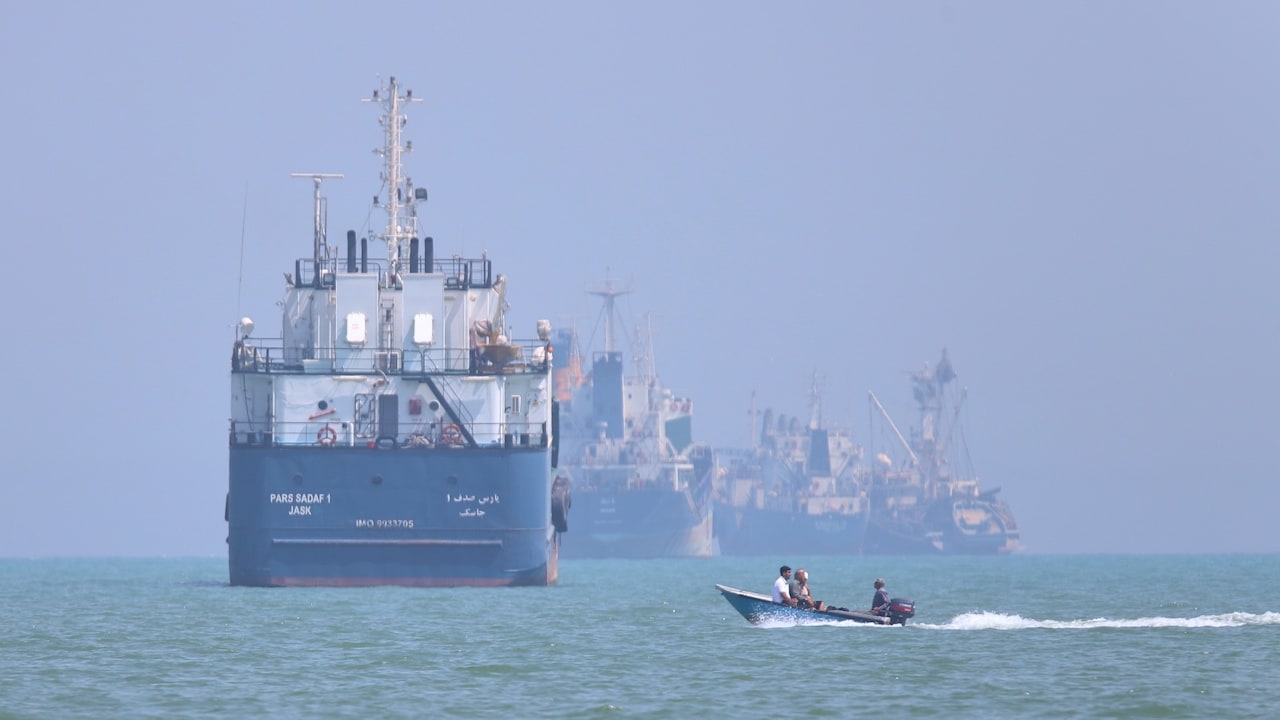
The sea does not care about communiques. From the deck of a weathered fiberglass skiff idling seventy miles off the coast of Funafuti, the horizon looks impossibly vast, a flat brushstroke of sapphire meeting an empty vault of blue. To a fisherman hauling in a sparse morning catch, the ocean is a provider, a hazard, a home. It is not a theater of geopolitics.
Yet, thousands of miles away, metal tubes screaming through the upper atmosphere had just rewritten the math of that quiet horizon.
When the People's Liberation Army Navy launched an intercontinental ballistic missile deep into the international waters of the Pacific Ocean, it was not merely an exercise in telemetry. It was a message written in fire across the sky. The missile splashed down into a watery grave, but the ripples reached every corner of the Pacific Islands Forum. Leaders who had gathered to discuss rising sea tides, tuna stocks, and the quiet erosion of their ancestral shores suddenly found themselves blinking against the sudden, harsh glare of great power competition.
They sat around polished tables in air-conditioned halls, but the room felt suddenly small.
Consider the anatomy of a failure to agree. To an outsider scrolling through wire service headlines, a lack of a unanimous condemnation looks like weakness. It looks like fracture. It looks like an opening for the world’s heavyweights to divide and conquer. But spent time talking to the delegates who sat through those closed-door sessions, and a more complicated truth emerges. This was not an endorsement of distant missile tests. It was the terrifying calculus of survival for nations whose economies are tied inextricably to the very superpowers now glaring at each other across the international dateline.
When you live in a house made of coral sand and tin, you do not easily pick a fight with the neighbor who owns the hardware store, the shipping lanes, and the checkbook.
The missile test itself was a rare public display. Beijing rarely tests ICBMs into the open ocean; usually, those trajectories are lofted high into domestic airspace or kept within controlled corridors. Dropping a live-fire weapon thousands of miles across international paths was a flexing of technological muscle. It signaled range. It signaled accuracy. And, crucially, it signaled an indifference to the anxieties of the small island nations over whose watery backyards that metal flew.
Silence fell over parts of the room. Not because the leaders weren't afraid, but because fear takes many forms.
For some, the primary existential threat is not a missile landing in the deep ocean trench three thousand meters down. The primary existential threat is the water lapping at the threshold of their primary school. When a nation’s landmass is barely two meters above high tide, climate change is not a policy debate. It is a slow-moving invasion. In that context, negotiating millions in climate adaptation funding from Beijing while simultaneously signing security frameworks with traditional Western partners becomes a dizzying high-wire act.
Diplomacy in the Pacific has never been simple. It is a mosaic of ancient navigational ties, colonial histories, and modern economic desperation.
Let us use a hypothetical scenario to ground the weight of these choices. Imagine a village elder in a remote atoll, a woman who remembers when the coconut palms grew fifty yards further from the salt- bitten shore. Her grandson looks at a smartphone screen, watching grainy footage of a rocket streaking through the dark. To him, the world is shrinking, filled with terrifying engines built by distant empires. To her, the breadfruit harvest failing because of saltwater intrusion is an immediate catastrophe. When the leaders fly home from the summit without a unified condemnation text in hand, they are carrying the heavy, splintered burden of trying to keep both realities from crushing their people.
Unanimity is a luxury of the powerful. For the fragmented archipelagos of Oceania, consensus is forged slowly, often painfully, out of disparate needs.
Some member states have deep security and historic ties to Canberra, Wellington, and Washington. For them, a ballistic missile landing in the Pacific is a direct affront to regional stability and an alarming escalation. They wanted a sharp, ringing condemnation. They wanted the communique to echo with moral clarity.
Others have grown weary of lectures from capitals that contributed the most to the carbon choking their reefs while offering the least in immediate aid. They look at infrastructure loans, port developments, and cargo ships arriving with medical supplies. They ask a blunt, pragmatic question: Which threat arrives first, the rocket or the flood?
This divergence is not moral cowardice. It is the defensive crouch of the vulnerable.
History is littered with small nations crushed beneath the boots of giants who were merely settling scores. The Pacific Islands know this history intimately. Their islands were chewed up as airstrips and nuclear testing grounds during the twentieth century by powers that promised protection while leaving behind radioactive craters and generational trauma. They learned early that when elephants fight, the grass beneath them gets trampled.
So when the draft resolution failed to achieve unanimous backing, the news cycle moved on. Pundits parsed the diplomatic failure. Analysts drew maps of influence zones and sphere metrics.
They missed the point.
The real story was never about whether a joint statement could be wrung out of an exhausted delegation at midnight. The real story is the impossible tightrope walk of the twenty-first century, where nations with populations smaller than a medium-sized suburb find themselves cast as the chessboard for a cold war they never voted to join.
The skiff cuts back toward the lagoon, the outboard motor humming a steady, monotonous drone against the vastness of the water. The sun dips low, bleeding bruised purples and burnt oranges across the clouds. Beneath the surface, the tide continues its slow, relentless climb. Somewhere in the deep, undisturbed dark, a piece of metal rests on the ocean floor, forgotten by the news cycle, but heavy in the minds of everyone who calls this great water home.