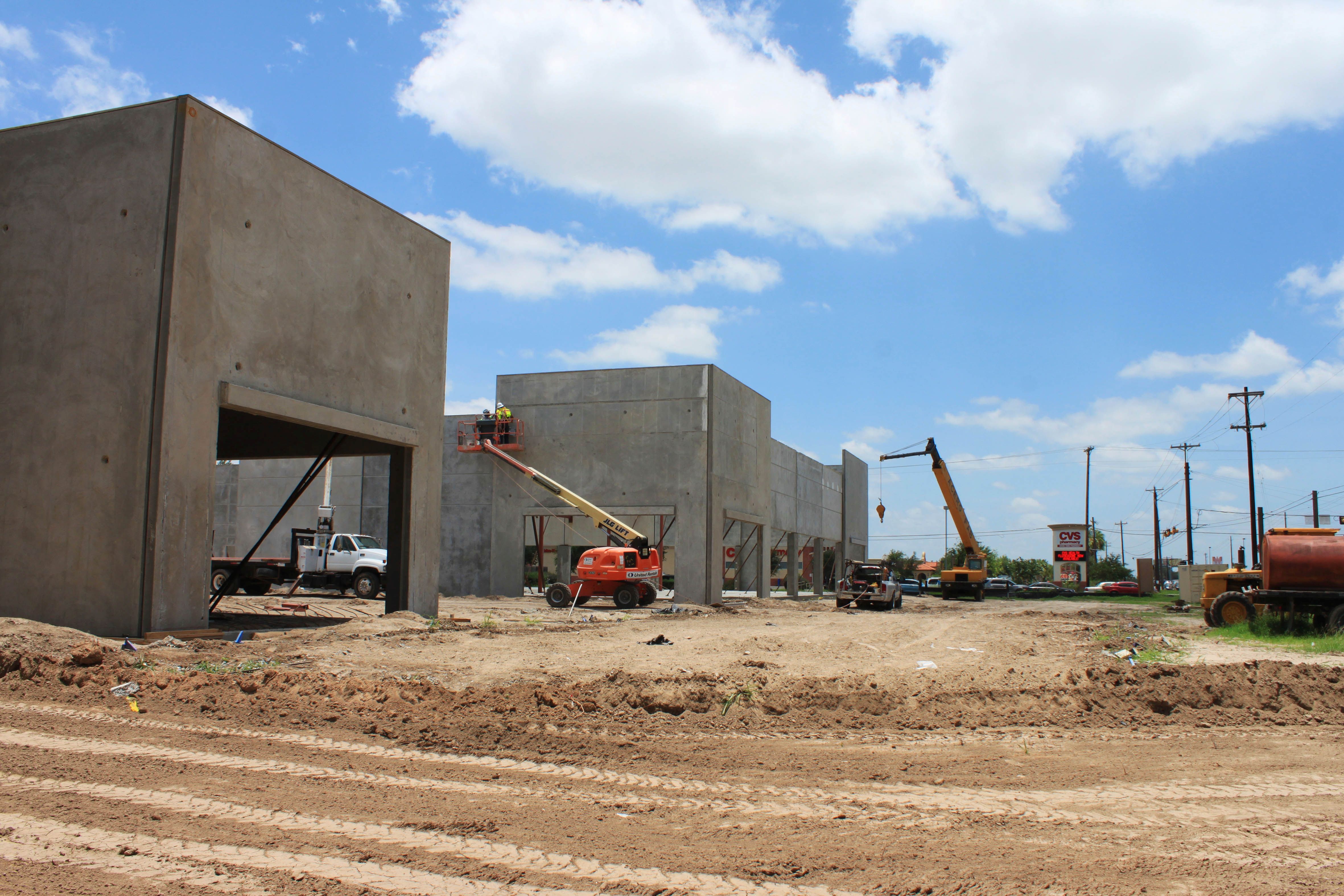
The rhythm of the Rio Grande Valley has changed. It is no longer the steady thrum of nail guns and the beep of reversing heavy machinery that defines the morning air in Pharr and McAllen. Instead, it is a heavy, watchful silence. President Trump’s intensified ICE operations have done more than just remove individuals; they have functionally decapitated the labor supply of the South Texas construction industry, leaving half-finished residential skeletons to rot under the Gulf sun.
Within the first 100 words of any honest assessment, the reality is clear: the aggressive surge in worksite enforcement has triggered a 5% drop in regional construction jobs and a nearly 40% slowdown in project completion rates. This isn’t a temporary market correction. It is a fundamental breakdown of the "blue-collar" machinery that allows Texas to grow. While the administration frames these raids as a restoration of the rule of law, the immediate economic consequence is a housing market in a state of cardiac arrest.
The Math of an Empty Job Site
For decades, the Texas miracle was built on a handshake and a surplus of motivated, albeit often undocumented, labor. Data from the American Immigration Council confirms that prior to this latest enforcement push, nearly 40% of the Texas construction workforce was foreign-born. In the trades that actually get a house dried in—roofing, drywall, and painting—that number frequently pushed past 60%.
When ICE vans appear at the perimeter of a subdivision, the effect is instantaneous and viral. It is not just the 9,100 people detained in South Texas over the last year who are missing from the line. It is the tens of thousands of others—some with legal residency or mixed-status families—who have simply stopped showing up. Fear is a highly effective de-motivator.
A standard 2,100-square-foot home that once took four months to build now drags into its ninth or tenth month. This isn't just an inconvenience for the homebuyer. It is a catastrophic drain on the contractor's cash flow. Interest on construction loans doesn't stop ticking because a framing crew vanished overnight.
The Myth of the American Replacement
The central argument for these raids is the "replacement theory" of labor: remove the undocumented worker, and a sidelined American citizen will step into the boots. On the ground in South Texas, this theory is failing its first real-world stress test.
Trade associations and veteran builders report that for every two positions vacated by enforcement or fear, only one is being filled by a local applicant. The "skills gap" isn't a buzzword here; it’s a physical wall. You cannot take a retail worker and expect them to hang drywall with the speed and precision required to keep a project profitable on day one.
Furthermore, the domestic workforce is aging out. The average age of a master plumber or electrician in Texas is climbing every year. Without the "helper" class—the entry-level laborers who handle the heavy lifting, the digging, and the hauling—the highly skilled, American-born tradesmen find themselves doing $15-an-hour grunt work. This lowers their overall productivity and, ironically, reduces the number of high-paying jobs available.
Financial Contagion in the Supply Chain
The pain doesn't stop at the silt fence of a construction site. It moves upstream. Isaac Smith, co-owner of Matt’s Building Materials, has seen double-digit declines in sales since the operations intensified. When the saws stop humming, the lumber stays on the rack.
We are seeing the beginning of a genuine financial contagion.
- Credit Crises: Contractors are increasingly defaulting on their lines of credit at local hardware stores because they can't hit the milestones required to draw the next round of bank funding.
- Lending Pullbacks: Regional banks in South Texas have reported a 30% drop in new construction loans. Lenders are risk-averse by nature; they aren't interested in financing a project that might lose its entire workforce on a Tuesday morning.
- Insurance Spikes: As projects sit idle, they become liabilities for theft, weather damage, and vandalism, driving up premiums for an already squeezed industry.
The Invisible Infrastructure Toll
While the headlines focus on residential suburban sprawl, the "Smart Wall" and other federal infrastructure projects are competing for the same dwindling pool of legal labor. The administration is essentially bidding against its own enforcement policy. By pouring $46.5 billion into border infrastructure, the federal government is sucking up the remaining "clean" labor, leaving private residential builders to fight over the scraps.
This creates a perverse incentive structure. Small-scale builders are forced to choose between bankruptcy or "low-road" employment practices—misclassifying workers or paying under the table to stay under the radar. These practices don't just hurt the workers; they rob the state of billions in payroll taxes and create an uneven playing field for the few companies trying to do things by the book.
The Regressive Cost of "Cheaper Rents"
The administration’s rhetoric suggests that mass removals will lead to cheaper rents by reducing demand. This ignores the basic physics of supply. If you remove 10% of the renters but stop 40% of the new housing supply from being built, the price doesn't go down. It goes up.
Economics isn't a zero-sum game played with a static number of houses. It is a dynamic system. In South Texas, the cost of a new build is rising not just because of labor shortages, but because of 25% jumps in domestic steel prices and 50% tariffs on imports. When you combine a labor vacuum with an equipment tax, you get the current reality: a housing market that is becoming inaccessible to the very "working-class" people the policy claims to protect.
The "brutal truth" of the South Texas construction crisis is that there is no plan for the day after. There is no federal vocational program ready to deploy half a million tradespeople. There is no guest-worker visa reform on the immediate horizon that matches the scale of the need. There is only the raid, the empty site, and the mounting interest on a loan for a house that might never be finished.
Would you like me to analyze how these labor shortages are specifically impacting the "Smart Wall" federal contracts compared to private residential projects?


