Everybody is cheering for the giant metal chopsticks.
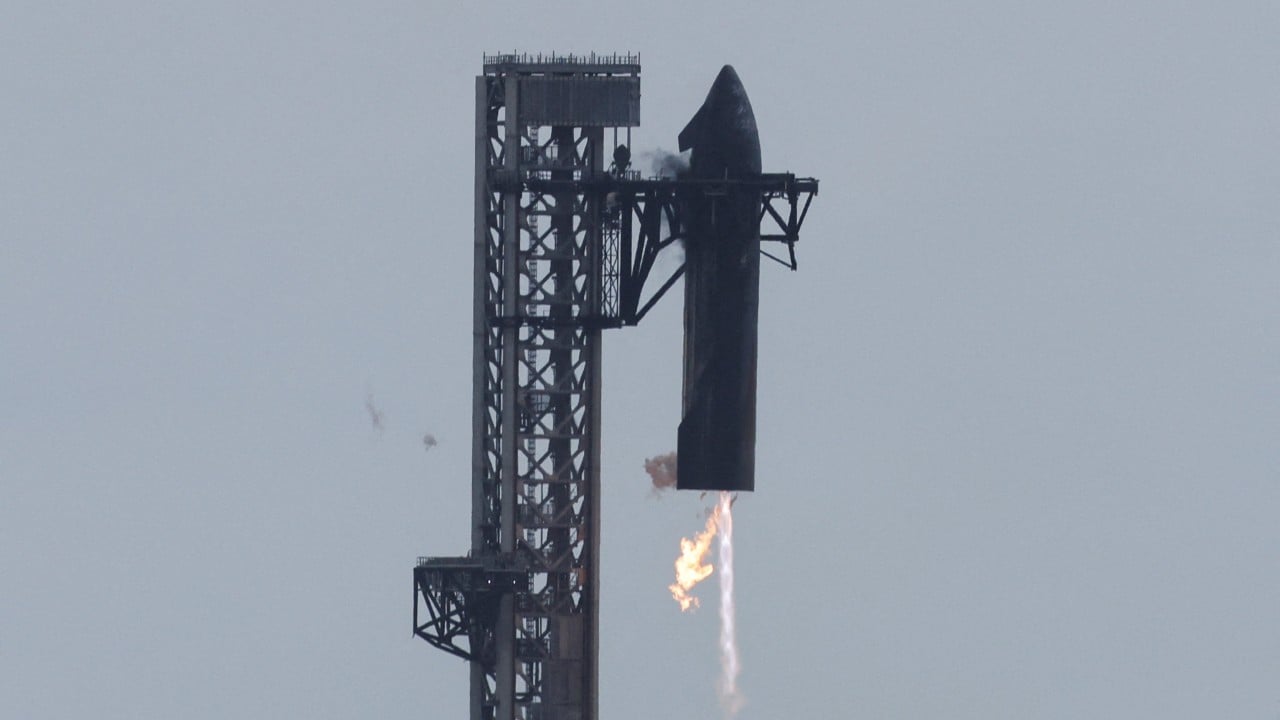
Watch any mainstream tech broadcast covering SpaceX's mid-air catch of the Super Heavy booster, and you will hear the exact same breathless script. They call it a miracle of modern aerospace. They call it the death of traditional rocketry. They treat a 232-foot stainless steel cylinder slamming into a pair of mechanical arms on a launch tower as the undisputed blueprint for humanity's multi-planetary future. Recently making news in this space: NASA’s Voyager 1 Is Crossing the Light-Day Threshold—And Dying Slowly in the Dark.
They are completely missing the forest for the flaming, methane-fueled trees.
First, let us fix a glaring error that lazy headlines keep repeating. SpaceX did not catch the Starship spacecraft with those giant mechanical arms during the historic Flight 5 test in October 2024; they caught the Super Heavy booster. Starship is the upper stage. Super Heavy is the massive first stage that gets it off the pad. Getting the basic anatomy of the vehicle wrong is bad enough, but missing the actual engineering and economic trade-offs of the "Mechazilla" catch system is far worse. Additional insights regarding the matter are covered by MIT Technology Review.
The industry consensus is that eliminating landing legs to save mass is pure brilliance. Look closer at the physics, the risk profile, and the balance sheet, and a very different picture emerges. Catching a rocket with its own launch tower is not an automatic slam dunk. It is an extraordinarily fragile single point of failure that trades modest payload gains for catastrophic operational risk.
The Landing Leg Fallacy
To understand why SpaceX built the Mechazilla arms, you have to understand the tyrannical math of the Tsiolkovsky rocket equation. Every kilogram of dry mass you carry to orbit—or even partway to orbit—steals directly from the payload you can deliver.
Traditional orbital boosters, like SpaceX's own Falcon 9 or Blue Origin's New Glenn, carry deployable landing legs. Those legs require hydraulic actuators, carbon-fiber struts, heat shielding, and structural reinforcement in the airframe to absorb the shock of touchdown. On a vehicle the size of Super Heavy, engineers estimate that a robust set of landing legs would weigh anywhere from 15 to 25 metric tons.
By moving the landing hardware off the rocket and onto the ground, SpaceX stripped that dead weight from the vehicle. On paper, this looks like an undeniable win. More payload to orbit. Simpler airframe. Faster turnaround because the booster lands right back on the launch mount, ready to be restacked.
Here is what the cheerleaders ignore: you did not eliminate the mass; you just relocated the risk.
I have watched aerospace programs burn through hundreds of millions of dollars chasing theoretical mass fractions while ignoring operational bottlenecks. When you put landing legs on a rocket and land it on a concrete pad or an autonomous drone ship three miles away, a landing failure destroys a booster. That hurts, and it costs money, but your launch pad remains intact. You roll out the next booster, bolt it down, and keep flying.
When you use the launch tower to catch the booster, the launch pad is the catch net.
Single Point of Failure on Steroids
Let us run through a realistic scenario. Imagine a wind shear anomaly, a sticky hydraulic valve in one of the Raptor engines, or a degraded guidance sensor during the final three seconds of the landing burn.
Super Heavy is coming down at subsonic speeds, weighing roughly 200 to 250 metric tons with residual propellant. Its 33 Raptor engines have throttled down to just three center engines for the final hover-slam. There is zero margin for a sideways drift of more than a couple of meters. If the booster clips the chopsticks, or if one of the load-bearing catch pins shears off upon impact, you do not just lose a rocket. You detonate a partially fueled bomb directly inside your orbital launch mount.
A Stage 0 explosion—aerospace shorthand for destroying the ground support infrastructure—does not set your launch manifest back by two weeks. It sets you back by six to twelve months.
- Orbital Launch Mount (OLM): The massive steel table with its 20 hold-down clamps and quick-disconnect propellant lines gets mangled or melted.
- Deluge System: The water-cooled steel flame deflector plate beneath the mount suffers structural warping.
- Tower Electronics and Hydraulics: Every sensor, umbilical, and winch motor on the 480-foot integration tower gets cooked by a fireball of liquid methane and liquid oxygen.
Compare that to Falcon 9. When a Falcon 9 booster tips over on Of Course I Still Love You out in the Atlantic Ocean, SpaceX sweeps the scrap metal off the deck, repairs a few scorched cables, and launches another Falcon 9 from Cape Canaveral 48 hours later. By fusing the landing zone with the launch mount, SpaceX created a massive operational bottleneck. To mitigate this, they have to build multiple redundant towers at Boca Chica and Kennedy Space Center, driving up capital expenditure to protect against a single botched catch.
The Myth of the One-Hour Turnaround
SpaceX executives frequently pitch the tower catch as the key to airline-like operations. The vision goes like this: catch the booster, lower it straight onto the orbital launch mount, slap a fresh Starship upper stage on top, pump in 4,600 metric tons of cryogens, and launch again within hours.
Anyone who has actually worked on cryogenic launch vehicles knows this timeline is pure fantasy for the foreseeable future.
Even when a booster lands gently in the chopsticks, it has just survived hypersonic re-entry and the violent acoustic vibration of 33 engines firing at full thrust. Before you refill that tank with sub-cooled liquid oxygen and methane, you have to deal with cold hard reality:
- Thermal Soak-Back: Heat from the engine bay radiates upward into the propellant tanks and avionics after shutdown, requiring careful thermal management and purging.
- Non-Destructive Evaluation (NDE): Engineers must inspect welds, composite overwrapped pressure vessels (COPVs), and engine turbopumps for micro-fractures caused by acoustic fatigue.
- Heat Shield Tiles (For the Ship): While Super Heavy does not carry ceramic thermal protection tiles, the Starship upper stage does. Catching the ship—which SpaceX also plans to do with the exact same tower arms—introduces the nightmare of inspecting and replacing cracked or missing silica tiles while the vehicle hangs suspended 400 feet in the air.
Catching the booster saves you the time it takes to fold up landing legs and truck a rocket five miles down Highway 4. That saves maybe 24 to 48 hours of ground logistics. In the grand scheme of vehicle refurbishment, transport time is a rounding error compared to propulsion inspection and regulatory clearance.
Answering the Questions Nobody Bothered to Ask
When the video of the Mechazilla catch went viral, search engines flooded with basic questions from the public. Most outlets answered them with PR talking points. Here are the unfiltered truths behind what people are actually searching for.
Did SpaceX actually catch the Starship spacecraft?
No. They caught the Super Heavy booster (Booster 12). The Starship upper stage (Ship 30) performed a controlled soft splashdown in the Indian Ocean during that same flight. Catching the actual Starship spacecraft is vastly harder because it re-enters from orbital velocity—roughly 28,000 kilometers per hour—experiencing plasma temperatures exceeding 1,400 degrees Celsius. Any warping of its stainless steel hull or damage to its aerodynamic flaps during re-entry could throw off its alignment with the tower arms.
Why doesn't SpaceX just use a parachute or land in the ocean?
Parachutes are dead weight and useless for precision landing. Once a booster is the size of a 20-story building, you would need parachutes the size of football fields, and you would still be at the mercy of upper-level winds. Ocean splashdowns, meanwhile, destroy the engines. Saltwater intrusion into the intricate plumbing of a staged-combustion Raptor engine turns a reusable asset into an expensive museum piece. Propulsive landing is mandatory; the debate is strictly about where and how it touches down.
How much money does catching the booster actually save?
Right now, zero. SpaceX has spent billions developing Starbase, building the integration towers, designing the hydraulic catch mechanisms, and iterating through prototypes. The economic payoff only materializes if SpaceX achieves a launch cadence measured in hundreds of flights per year—specifically to deploy the next-generation Starlink constellation and refuel lunar landers in orbit. Until flight rates scale exponentially, the fixed infrastructure costs completely swamp the marginal mass savings of ditching landing legs.
Where the Contrarians Get It Wrong (And SpaceX Gets It Right)
I am not claiming the Mechazilla catch is a failure. To dismiss the engineering execution of Flight 5 would be intellectual dishonesty.
What SpaceX accomplished in October 2024 is an extraordinary triumph of closed-loop guidance, navigation, and control (GNC). Guiding a 20-story empty metal tube through the atmosphere, lighting 13 engines to kill horizontal velocity, transitioning to three engines, and arresting its vertical descent to zero millimeters per second right between two moving steel arms requires software precision that rivals anything in aerospace history.
Furthermore, if your sole objective is orbital propellant depot architecture—the specific mission profile NASA is paying SpaceX to execute for the Artemis moon landings—then mass fraction is king. Because Starship has to be refueled in low Earth orbit by up to a dozen tanker flights just to reach the lunar surface, shaving 20 tons of landing legs off the vehicle directly reduces the total number of tanker launches required per moon mission. In that specific narrow context, the insane complexity of the tower catch makes mathematical sense.
What Aerospace Competitors Should Actually Do
If you are running a competing launch provider—whether you are at Rocket Lab, Blue Origin, or a European space startup—do not fall into the trap of copying SpaceX's chopsticks.
Copying a market leader's most extreme architectural choice without having their capital reserves or vertical integration is suicide. Instead, focus on the fundamentals that actually drive launch economics:
- Decouple the Landing Zone from the Launch Pad: Land downrange on a barge or on a dedicated concrete landing zone a safe distance from your ground support equipment. Accept the 5% to 8% payload penalty of landing legs in exchange for 100% protection of your launch pad.
- Optimize Stage Separation Velocity: If you want to recover your first stage without insane thermal loads, stage earlier. Let the upper stage do more of the heavy lifting so the booster returns at lower velocities, reducing structural wear and refurbishment time.
- Prioritize Engine Life Over Dry Mass: A rocket that carries two tons less payload to orbit but flies 50 times without a teardown will beat a hyper-optimized rocket that requires two weeks of engine swaps after every flight.
SpaceX thrives on extreme vertical integration and a willingness to blow up hardware in public until the math works. They have the cash flow from Starlink to survive a catastrophic tower strike. Almost nobody else on Earth does.
The Real Bottleneck Isn't Gravity
The aerospace media loves a good spectacle, and watching giant mechanical arms snatch a falling skyscraper out of the sky is peak cinema. It makes for incredible slow-motion replays and breathless commentary about the dawn of a new space age.
Do not confuse a brilliant engineering stunt with a solved business model.
Catching Super Heavy proved that SpaceX's guidance algorithms can thread a needle in a hurricane. It did not prove that you can inspect, certify, restack, and relaunch an orbital-class super-heavy rocket every two hours without eventually turning your multi-hundred-million-dollar launch tower into a crater. Until SpaceX demonstrates fifty consecutive catches without a single scratch to Stage 0, those giant metal chopsticks remain the most expensive, high-stakes gamble in the history of spaceflight.