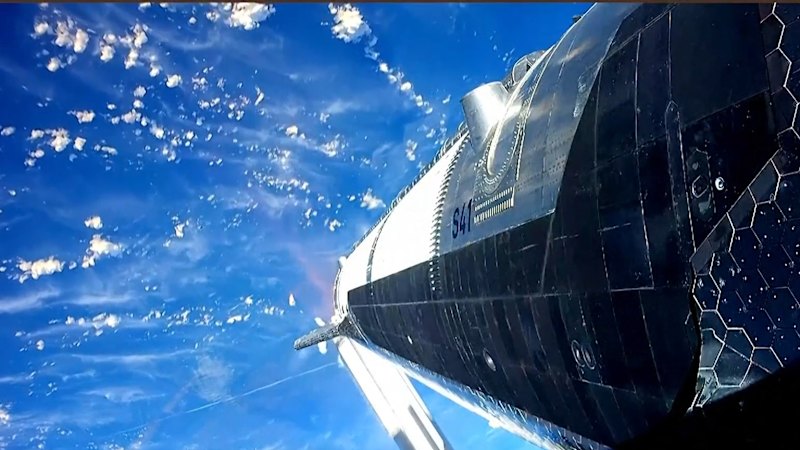
Rockets blow up. That is the baseline assumption of aerospace engineering. When you strap millions of pounds of liquid methane and oxygen to a steel tube and ignite it, things tend to go sideways. SpaceX built an entire philosophy around this chaos, blowing up prototypes on concrete pads just to see where the welds failed. But during its third major integrated test flight, the giant Starship system pushed past mere destruction and ran straight into a terrifying reality. It reached orbital velocity, crossed the planet, and survived a catastrophic mid-flight engine failure that would have instantly doomed any traditional spacecraft.
People still talk about the dramatic breakup during reentry, missing the actual milestone. The vehicle didn't fail because it fell apart over the Indian Ocean. It succeeded because it dragged its broken body halfway around the world after an engine detonated during the climb. Also making news in this space: Inside the Hidden Engine Failures Threatening SpaceX Orbital Missions.
If you want to understand where commercial spaceflight is heading right now, you have to look past the fiery telemetry feeds and understand what redundancy actually means under extreme stress.
The Anatomy of a Near-Disaster
Most orbital-class rockets are fragile things. Lose a single critical engine on a Saturn V or a Space Shuttle, and the flight controllers face an immediate emergency abort scenario. The margins are thin. The computer calculates whether the remaining thrust can drag the payload to safety, or whether the crew has to punch out. Additional details into this topic are covered by ZDNet.
Starship operates differently. The Super Heavy booster houses thirty-three Raptor engines, while the upper-stage ship carries six more. That level of engine count introduces a massive statistical probability of failure. SpaceX doesn't try to stop engines from dying. They design the vehicle to shrug when they do.
During that landmark flight, telemetry showed Raptor engines dropping offline earlier than planned. One specific raptor engine suffered an anomaly that caused a rapid unscheduled disassembly of its internal components. On any other rocket, shrapnel from that explosion would have severed fuel lines, triggered a chain reaction, and wiped out the entire aft section.
Instead, the flight computer instantly rerouted propellant, adjusted vector controls across the remaining cluster, and kept the stack climbing. The sheer brute force of scale saved the day. When you have dozens of engines, losing one isn't a catastrophe. It is just a math problem.
Why Orbital Insertion Matters More Than the Splashdown
The internet loves a good fiery explosion. When the live stream cut out as the ship tumbled backward through the upper atmosphere, critics jumped online to declare the mission a failure. They missed the entire point of the test.
Reaching orbit isn't about landing gently on a pad. Landing is a solved engineering problem, even if it looks hard. The hard part is achieving the specific velocity vector required to stay in freefall around the Earth without burning up on the way out.
Starship hit that mark. For the first time, a fully integrated, rapidly reusable heavy-lift architecture proved it could carry a payload into space, coast through the vacuum, and execute orbital maneuvers. The plasma buildup that blinded the Starboard cameras during reentry wasn't a malfunction. It was the brutal confirmation that the thermal protection system was doing its job against thousands of degrees of friction.
The heat shield tiles on Starship are controversial. They fall off. They crack. Engineers are wrestling with materials science problems that defeated NASA's shuttle program decades ago. But seeing the vehicle maintain structural integrity while its flaps fought supersonic plasma streams proved the aerodynamic design actually works.
The Economics of Surviving Failure
Look at traditional aerospace contracting. If an engine blows up on a legacy rocket, you spend eighteen months in congressional hearings, audit every bolt in the factory, and add twelve layers of redundant safety paperwork. The cost per launch stays locked in the billions.
SpaceX treats a lost engine like a line of software debugging code. They lose a ship, pull the telemetry logs, tweak the Raptor combustion chamber pressure thresholds in a software patch, and roll the next hull out to the pad two weeks later.
That velocity of iteration changes the entire financial equation of space exploration. If you can lose engines, lose tiles, lose a flap actuator, and still complete 80 percent of your flight profile, you aren't building a fragile glass cannon. You are building a truck.
Trucks get dented. Trucks blow tires on the highway. But they keep moving cargo from point A to point B.
What Comes Next for the Super Heavy Fleet
The regulatory hurdles are brutal. Environmental groups, federal agencies, and local zoning boards scrutinize every launch profile. Every time a Raptor engine hiccups over the ocean, the paperwork pile gets taller.
Yet, the engineering momentum is unstoppable. The next iterations of Starship feature upgraded heat shield configurations, electric thrust vector control instead of hydraulics, and second-generation Raptor engines designed specifically to handle higher chamber pressures without cracking.
When you look at the architecture required to build a permanent base on the Moon or land the first crews on Mars, perfection is a luxury you cannot afford. You need a vehicle that can take a beating, shed dead weight, and keep flying anyway. Starship proved it can take that beating and keep going. The era of fragile spaceflight is officially over.