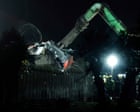
Spain has officially entered a national mourning period following a deadly train crash that has once again shaken the country's transport sector and forced uncomfortable questions about rail infrastructure to the front of public debate. Flags hang at half-mast across municipal buildings, minute-long silences echo through public squares, and government officials offer solemn condolences to grieving families. Yet beneath the ritualized sorrow lies a recurring pattern of systemic friction, aging track technology, and the political realities of operating one of Europe's most ambitious railway networks.
For decades, Spain has marketed its rail system as an international triumph of modern engineering. The Alta Velocidad Española (AVE) network regularly draws praise from transport economists for connecting major urban centers with speed and punctuality. When a fatal derailment or collision occurs, the contrast between that gleaming public image and the mangled steel on the tracks feels jarring. Public grief is immediate and genuine, but experienced transport analysts recognize that national mourning periods often serve a secondary, unspoken function in European politics. They pause the news cycle, defer technical accountability, and frame a preventable engineering or operational failure as an unpredictable tragedy.
The Architecture of a Rail Disaster
To understand why trains still crash in a country boasting thousands of kilometers of modern track, you have to look away from the flagship high-speed corridors and examine the conventional rail network. Spain operates a bifurcated system. On one side sits the sleek, standard-gauge high-speed lines built largely over the last thirty years. On the other sits a sprawling, older Iberian-gauge network that carries regional commuters, freight, and medium-distance passengers through rugged terrain, tight curves, and aging signaling zones.
Rail disasters rarely stem from a single broken bolt or one distracted driver. Investigators across the European Union Agency for Railways consistently point to the Swiss Cheese Model of accident causation, where multiple latent failures align at the exact wrong moment. A driver misses a braking point, an automated warning system is either absent or switched off due to track maintenance, and a curve designed in the nineteenth century leaves zero margin for excess speed.
Consider a hypothetical example of how this plays out on a typical regional line. A train approaches a section of track undergoing routine electrical upgrades. Because workers are modifying the signaling relays, the automated speed-enforcement beacon is temporarily bypassed, transferring full responsibility for speed regulation back to the human operator inside the cab. If that driver suffers a momentary lapse in attention, or misreads a poorly illuminated trackside marker during heavy rain, there is no electronic safety net left to catch the mistake. The physics of several hundred tons of steel moving at over a hundred kilometers per hour takes over instantly.
The Signaling Gap Nobody Wants to Fund
The technical divide between Spain's premier lines and its secondary routes comes down to one critical acronym, ERTMS (European Rail Traffic Management System). ERTMS is the gold standard of continental rail safety. It establishes continuous digital communication between the track and the train's onboard computer, automatically applying the emergency brakes if a train exceeds the safe speed limit for an upcoming curve or approaches an occupied block of track.
Installing ERTMS across an entire national network is astronomically expensive and logistically brutal. Consequently, vast stretches of Spanish track still rely on ASFA (Anuncio de Señales y Frenado Automático), a legacy signaling system developed in the 1970s. While ASFA has been upgraded several times into digital iterations, it fundamentally operates on discrete trackside beacons rather than continuous supervision. In plain terms, ASFA checks what a train is doing at specific checkpoints, whereas ERTMS watches the train every single second.
| Safety Feature | Legacy ASFA System | Modern ERTMS Level 2 |
|---|---|---|
| Supervision Type | Intermittent via trackside beacons | Continuous via radio block centers |
| Speed Curve Control | Limited to specific signal thresholds | Real-time dynamic braking curves |
| Human Error Mitigation | Relies heavily on driver reaction after alerts | Overrides driver immediately upon violation |
| Deployment Status | Dominant on regional and older routes | Concentrated on high-speed corridors |
Every time a fatal crash occurs on a line governed by older signaling protocols, union representatives and safety advocates point directly to this disparity. Upgrading secondary routes lacks the political glamour of cutting the ribbon on a new high-speed line linking Madrid to a provincial capital. Politicians win elections by promising faster transit times between major cities, not by allocating hundreds of millions of euros to replace invisible trackside electronics on commuter lines that already exist.
When Infrastructure Meets Extreme Weather
Beyond the hardware gap lies an environmental reality that railway engineers are struggling to outrun. The Iberian Peninsula sits on the front lines of European climate volatility. Prolonged droughts bake the soil beneath rail beds into hard, brittle clay, only for torrential autumn storms—known locally as DANA events—to dump months of rainfall within hours.
Water is the natural enemy of railway geometry. When flash flooding washes away the crushed stone ballast supporting the sleepers, the track can shift by mere centimeters. To the naked eye, the rails look intact. To a passenger train traveling at speed, a subtle washout or a mudslide spilling onto the right-of-way acts like a concrete wall.
Maintenance crews employed by Adif (Administrador de Infraestructuras Ferroviarias), the state-owned infrastructure manager, face an uphill battle monitoring thousands of kilometers of track running through mountainous passes and coastal floodplains. Acoustic sensors, weather stations, and track-geometry inspection trains provide immense amounts of data, yet physical track inspections remain irreplaceable. Budget constraints and staffing bottlenecks over the past fifteen years have repeatedly forced railway operators to prioritize reactive repairs over preventative overhauls.
The Anatomy of Official Mourning
When the sirens fade and the casualty figures stabilize, the Spanish state moves into a familiar institutional choreography. Regional presidents and national ministers visit the crash site wearing somber expressions. Royal condolences are issued. A three-day mourning period is declared, suspending political campaigning and legislative sparring.
This pause is culturally expected in Spain, a country with deep communal traditions surrounding collective grief. However, veteran observers of Spanish public administration recognize the political utility of the mourning window. While flags are lowered, the immediate pressure to name responsible officials or release internal maintenance logs evaporates. Journalists who push aggressively for technical answers during those first seventy-two hours risk appearing callous or disrespectful toward the victims.
By the time the official mourning ends, the initial shock has dulled. The investigation is handed over to the CIAF (Comisión de Investigación de Accidentes Ferroviarios), Spain's railway accident investigation body. Historically, the CIAF has faced sharp criticism from European oversight bodies and victims' associations for lacking true structural independence from the Ministry of Transport—the very ministry that oversees both the track manager Adif and the state rail operator Renfe.
After the catastrophic 2013 Angrois derailment near Santiago de Compostela, which killed 80 people, the European Railway Agency explicitly faulted Spain's initial official inquiry for focusing almost exclusively on the train driver's human error while downplaying the absence of automated braking systems on a dangerous curve. It took years of relentless legal battles by survivors and families to force a broader examination of institutional accountability.
Human Error Is an Easy Scapegoat
In the immediate aftermath of any major transport accident, leaks from early police or judicial inquiries almost always zero in on the person at the controls. Did the driver miss a red signal? Was the train traveling above the posted limit? Was a mobile phone in use?
Focusing on the human operator offers a neat, psychologically comforting narrative. If a single employee broke a rule, the system itself remains fundamentally sound. The public can continue buying tickets, politicians can avoid massive emergency infrastructure appropriations, and corporate executives keep their jobs.
Seasoned safety investigators reject this framing entirely. Human beings are fallible; we get tired, we lose focus, and we misjudge distances. Designing a mass-transit system that depends on flawless human performance every hour of every day is an engineering failure by definition. Modern rail safety exists specifically to ensure that when a human inevitably makes a mistake, the machinery intervenes before metal leaves the rails.
What Happens After the Flags Go Back Up
The families burying their loved ones this week do not need poetic tributes from parliamentary podiums. They need verifiable answers regarding maintenance schedules, signaling active status, and weather-monitoring protocols on the exact stretch of track where their lives were shattered.
Spain possesses the engineering talent and operational experience to run one of the safest railway networks on earth. Achieving that standard requires shifting capital away from vanity transit expansions and pouring it into the unglamorous work of modernizing legacy lines, separating accident investigators completely from transport ministries, and building physical resilience against extreme weather. Until the state treats every regional commuter track with the same rigorous safety redundancy as its flagship high-speed routes, Spain's mourning periods will remain a tragic matter of when, not if.