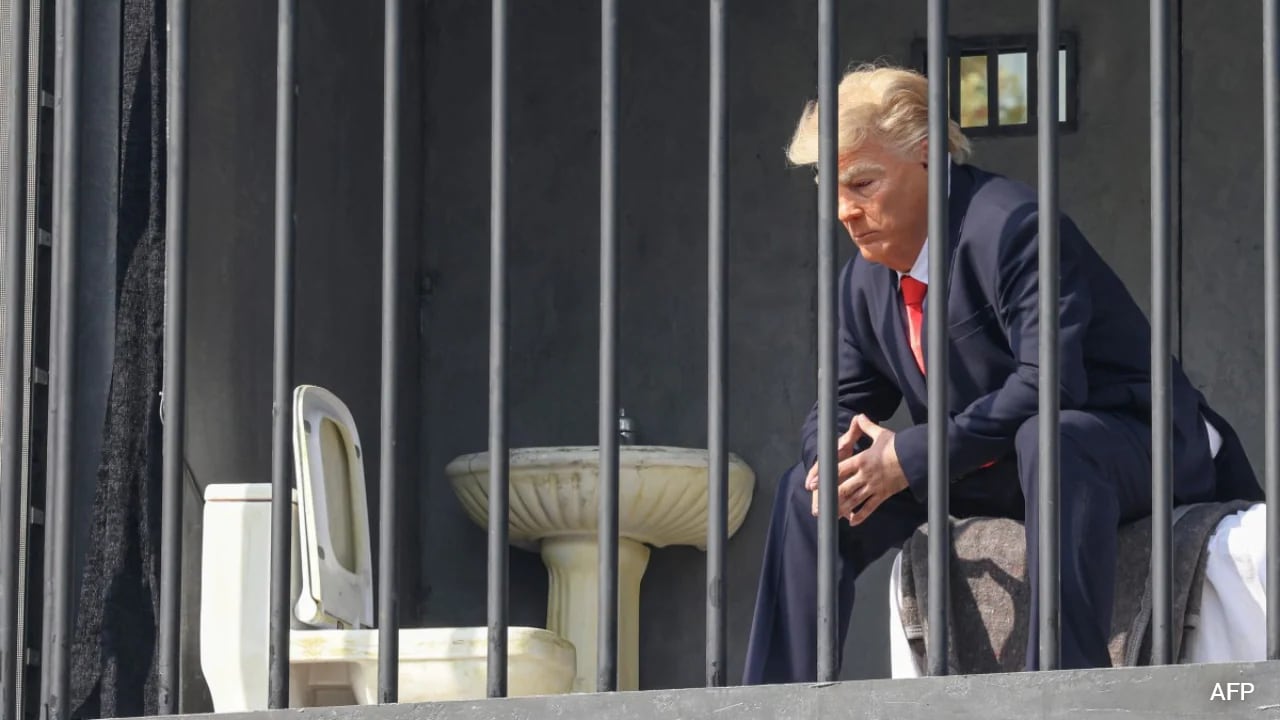
State-sponsored street theater in Tehran functions as a calibrated communication tool designed to manage domestic morale while signaling resolve to foreign adversaries. When Iranian state media and international outlets report on public installations depicting former U.S. President Donald Trump behind bars—frequently staged during anniversaries such as the 1979 U.S. Embassy takeover or Quds Day—superficial coverage frames the event purely as anti-American fervor. That framing misses the operational mechanics of authoritarian signaling. Rather than spontaneous grassroots outrage, these displays represent a structured information operation built to solve three simultaneous problems for the Islamic Republic: domestic legitimacy erosion, asymmetric deterrence signaling, and elite cohesion maintenance.
The Architecture of State-Orchestrated Mobilization
To understand why crowds gather around anti-U.S. installations in Tehran, analysts must separate organic public sentiment from state-engineered logistics. In closed or semi-closed political systems, crowd size is rarely a clean metric of ideological consensus. Instead, it is an output of institutional mobilization capacity.
State agencies, primarily the Islamic Revolutionary Guard Corps (IRGC), the Basij paramilitary organization, and the Islamic Development Coordination Council, control the physical and logistical infrastructure of major demonstrations. These bodies execute a repeatable operational sequence:
- Symbolic Fabrication: State-affiliated artists and municipal contractors construct high-visibility props—such as mock prison cells, effigies, or replicas of captured military hardware—engineered specifically for visual legibility on broadcast television and social media feeds.
- Institutional Transport and Incentives: Public sector employees, students from state-aligned universities, and Basij members are routinely organized via institutional channels, often provided with bussing, stipends, or administrative leave to ensure baseline attendance density.
- Media Amplification: State broadcasters (IRIB) and semi-official news agencies (Fars, Tasnim) capture tightly framed wide-angle shots to project mass uniformity, which international wire services subsequently syndicate globally.
International reporting often treats the resulting crowd photos as a direct referendum on foreign policy. In reality, the visual spectacle is a supply-side production. The regime manufactures the stage, populates the foreground with reliable organizational cadres, and relies on external media ecosystems to distribute the imagery at zero marginal cost.
Deconstructing the "Trump Behind Bars" Motif
The specific choice to depict Donald Trump behind bars—rather than generic anti-imperialist slogans—reflects a targeted shift in Tehran's psychological operations. Following the 2018 U.S. withdrawal from the Joint Comprehensive Plan of Action (JCPOA), the reimposition of "maximum pressure" sanctions, and the January 2020 assassination of Quds Force commander Qasem Soleimani, Tehran's strategic communications pivoted from abstract anti-Americanism to personalized judicial and retaliatory framing.
According to statements by Iranian judicial officials and IRGC commanders, the Islamic Republic has issued formal domestic arrest warrants and requested Interpol red notices against Trump and dozens of former U.S. officials over the Soleimani strike. While international legal experts note that Interpol's constitution strictly prohibits interventions of a political or military character—rendering those requests legally inert—the domestic utility remains high.
Displaying a Trump effigy in a prison cell serves two distinct messaging functions:
- Substitution for Kinetic Escalation: Direct military confrontation with the United States carries existential risk for Tehran's leadership. By staging symbolic "imprisonment" and promising judicial accountability, the state offers its hardline constituency a visible proxy for retaliation without crossing conventional military red lines that would trigger overwhelming U.S. counterstrikes.
- Exploitation of U.S. Domestic Polarization: Tehran's information strategists closely monitor American domestic politics. Visuals of a former U.S. president in a prison cell are engineered to resonate within polarized Western media environments, amplifying narratives of American political instability and institutional decline.
The Three-Audience Communication Model
Every major political spectacle in Tehran is designed to transmit distinct signals to three separate audiences simultaneously. Evaluating the effectiveness of the display requires measuring its impact across each target group rather than treating the event as a monolith.
1. The Domestic Core (Regime Loyalists and Security Apparatus)
The primary audience is internal. Amid chronic inflation, currency devaluation, and recurring waves of domestic protest, the leadership must continuously reassure its security forces and ideological base that the state remains strong, defiant, and unbowed by external pressure. High-production street displays reinforce internal cohesion by demonstrating that the state still commands the public square in central Tehran.
2. The Domestic Periphery (Skeptical and Apolitical Citizens)
For the broader Iranian public—many of whom attribute economic hardship to state mismanagement and regional overreach—the installations function as a subtle warning. By monopolizing major urban arteries with state-backed crowds and security personnel, the government signals its capacity for rapid mobilization and territorial control, raising the perceived cost of counter-protests.
3. External Adversaries and Regional Proxies
To Washington and regional allies, the imagery communicates ideological rigidity and non-capitulation. Simultaneously, for Tehran's regional network—including Hezbollah, the Houthis, and Iraqi militias—the broadcasts serve as proof of continued Iranian commitment to confronting U.S. influence, reinforcing Tehran's status as the ideological anchor of the "Axis of Resistance."
Methodological Blind Spots in Western Media Coverage
Standard journalistic coverage of Tehran's anti-U.S. rallies suffers from predictable analytical distortions that obscure the actual political dynamics on the ground.
First, visual framing bias inflates perceived consensus. A tightly cropped photograph of several hundred demonstrators surrounding a mock prison cell creates an illusion of city-wide mobilization. Without aerial baselines or independent polling—both of which are unavailable or restricted inside Iran—crowd size estimates provided by state organizers cannot be independently verified and should never be treated as empirical data.
Second, rhetorical literalism misinterprets the intent of state slogans. Western observers frequently read chants and installations as immediate precursors to kinetic action or absolute barriers to diplomatic engagement. Historically, however, the Islamic Republic has maintained a strict operational separation between public street theater and backchannel diplomacy. Intense anti-U.S. demonstrations have routinely coincided with indirect negotiations over prisoner swaps, nuclear parameters, and regional de-escalation.
Third, ignoring opportunity costs conceals internal friction. Every state-funded spectacle requires financial outlay, municipal coordination, and security deployment during periods of severe economic strain. Within Iran, critics—often speaking through coded commentary on social media or reformist-leaning outlets—frequently contrast the resources spent on ideological installations with deteriorating infrastructure, air pollution, and stagnant wages.
Strategic Limitations of Symbolic Deterrence
While state-orchestrated displays generate immediate media visibility, their strategic utility faces diminishing returns over time.
- Audience Habituation: Repeated reliance on identical visual tropes—burning flags, mock coffins, and caged effigies—blunts emotional impact both domestically and internationally. What once generated shock value in global news cycles increasingly registers as routine political background noise.
- Credibility Gaps: When symbolic threats of judicial or military retribution remain unfulfilled over multi-year timelines, hardline supporters risk disillusionment. If the gap between fierce street rhetoric and cautious operational reality widens too far, the regime risks eroding its own credibility among the exact constituency the displays were meant to pacify.
- Asymmetric Counter-Messaging: In an era of pervasive smartphone penetration, state-controlled visuals compete directly with user-generated footage showing empty side streets, indifferent commuters, or quiet acts of dissent, undermining the state's monopoly over the visual narrative.
Operational Assessment for Analysts and Policymakers
Intelligence analysts, foreign policy practitioners, and media editors evaluating anti-U.S. spectacles in Tehran must decouple street-level theatrics from actual shifts in Iranian strategic posture. Treat public installations not as leading indicators of military escalation, but as lagging indicators of domestic political pressure. When economic stress rises or diplomatic isolation deepens, the volume and theatricality of state-sponsored displays predictably increase to compensate for material vulnerabilities. Monitoring changes in Iranian force posture, naval deployments in the Persian Gulf, and nuclear enrichment telemetry provides actionable intelligence; reacting to street theater in Tehran only validates the regime's low-cost information operation.