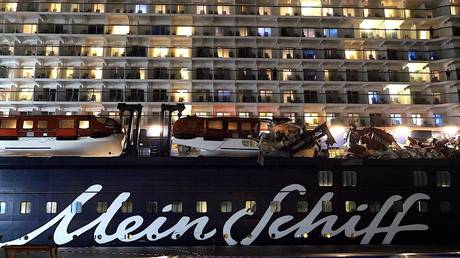
When a cruise liner collides with a container ship in German waters, the viral video clip captures the crunch of tearing steel, but it completely misses the systemic failure behind the impact. Maritime collisions in northern Germany are rarely freak accidents caused by a single distracted helmsman. They are the predictable byproduct of squeezing massive, modern vessels into some of the busiest, narrowest shipping corridors in Europe—specifically the Kiel Canal, the Elbe River estuary, and the congested approaches to the Port of Hamburg.
Look closely at the footage of any major hull-to-hull contact in this region. You will see two floating behemoths operating with razor-thin margins for error. On one side sits a modern cruise ship, towering twelve decks high, catching crosswinds like a massive sail. On the other sits a container feeder or ultra-large carrier, riding heavy in the water with immense forward momentum that takes miles to arrest. When wind, tide, and mechanical timing collide in a restricted fairway, physics wins every single time.
The Geography of a Bottleneck
To understand why a cruise liner hits a container ship in Germany, you have to look at a nautical chart of the North Sea and Baltic approaches. Germany’s northern coastline relies on a handful of vital arteries to move global trade and hundreds of thousands of vacationers.
The Kiel Canal (Nord-Ostsee-Kanal) is the busiest artificial waterway in the world. Stretching nearly 100 kilometers from Brunsbüttel on the North Sea to Kiel-Holtenau on the Baltic, it saves ships roughly 250 nautical miles of rough open-water transit around the Jutland Peninsula. Every year, tens of thousands of commercial vessels squeeze through this trench. The canal has been widened over the decades, yet modern shipbuilding has consistently outpaced civil engineering.
Then there is the Elbe River, the lifeline connecting the Port of Hamburg to the open sea. Navigating the Elbe requires a grueling, multi-hour pilotage run through shifting sandbars, fierce tidal currents, and blinding North Sea squalls. Cruise ships heading to Hamburg’s terminals share this exact channel with feeder vessels rushing to meet strict port-call windows.
There is no shoulder to pull onto. A vessel drafting twelve meters cannot simply steer out of the dredged channel to avoid an erratic oncoming ship without running hard aground on a mudflat—an outcome that can snap a hull in half as the tide drops.
The Physics of Floating Skyscrapers
Modern naval architecture has made maritime collisions in tight quarters far more likely, even as bridge electronics have become more sophisticated.
Consider the sheer windage of a contemporary cruise liner. Unlike a low-slung tanker, a passenger vessel features a towering superstructure designed to maximize balcony cabins and top-deck amenities. In a sudden 35-knot squall off Cuxhaven or inside the locks at Brunsbüttel, that flat wall of steel and glass acts like a giant spinnaker. At slow maneuvering speeds—precisely when a ship is entering a lock or passing another vessel—the ship’s rudder loses hydrodynamic authority. Without high water flow over the rudder blades, the captain relies entirely on bow and stern thrusters to fight the wind. If a gust exceeds the thruster rating, the ship drifts sideways. There is nothing the bridge team can do to stop it immediately.
Container ships suffer from the opposite problem. They possess massive displacement and staggering inertia. A fully loaded container vessel moving at twelve knots carries hundreds of thousands of tons of kinetic energy. You do not brake a container ship; you plan its deceleration miles in advance.
The Hydrodynamic Trap
When two large ships pass each other in a narrow German canal or dredged river channel, they trigger a dangerous fluid-dynamics phenomenon known as bank suction and ship-to-ship interaction.
As a massive hull pushes forward through shallow water, it displaces thousands of tons of liquid. That water has to rush backward through the narrow gap between the two passing ships. According to Bernoulli’s principle, as the velocity of the water increases between the hulls, the water pressure drops. The resulting low-pressure zone literally sucks the two vessels toward each other.
At the exact same time, the bow wave of one ship pushes against the stern of the other, creating a violent rotational force—a yaw—that can twist a ship’s bow directly into the path of oncoming traffic. Experienced Elbe and Kiel Canal pilots anticipate this pull and apply counter-rudder before the interaction even peaks. If a helmsman overcorrects, or if a steering gear pump suffers a momentary hydraulic lag during that critical five-second window, steel meets steel.
The Human Element Under Commercial Pressure
Mainstream news coverage of a ship collision almost always defaults to investigating "human error." That phrase is a convenient scapegoat for shipping executives and insurers, masking the intense commercial pressures placed on bridge crews.
Both the cruise industry and the container shipping sector operate on punishing schedules. A container feeder delayed by two hours misses its crane slot in Hamburg or Bremerhaven, triggering cascading supply chain penalties that cost tens of thousands of dollars per hour. Cruise lines face a different, equally unforgiving clock. Thousands of passengers have booked flights, shore excursions, and rail connections tied to a 7:00 AM gangway drop.
This economic reality creates subtle pressure on captains and local maritime pilots to push forward in marginal weather. Fog rolling off the Elbe, freezing rain in the Kiel Canal, or gale-force crosswinds might warrant dropping anchor and waiting six hours. Yet waiting breaks the schedule.
Fatigue and Bridge Resource Management
When vessels transit congested European coastal waters, the workload on the bridge spikes dramatically. Short-sea container ships often run with minimal crew manning to cut operational overhead. Officers rotate through grueling watch schedules while simultaneously managing port paperwork, cargo stability calculations, and constant VHF radio chatter in both English and German.
To mitigate these risks, German maritime authorities mandate the use of certified harbor and canal pilots (Lotsen) for vessels exceeding specific length and draft thresholds. These pilots possess encyclopedic local knowledge of every eddy, buoy, and blind bend in the river.
However, bringing a pilot onto the bridge introduces a complex social dynamic. The pilot acts as an advisor with local expertise, yet the ship’s captain retains ultimate legal command of the vessel. In the high-stress seconds before an impact, clear communication can fracture. Cultural barriers, ambiguous helm orders, or hesitation by a junior officer to challenge a senior pilot’s judgment have played documented roles in dozens of European maritime inquiries.
The Blind Spots of Modern Bridge Technology
If you step onto the bridge of a modern cruise ship or container carrier today, it looks less like a traditional wheelhouse and more like the flight deck of a commercial airliner. ECDIS (Electronic Chart Display and Information Systems), AIS (Automatic Identification System), and high-definition ARPA radar track every moving target within dozens of miles.
Why, then, do multi-million-dollar ships still hit each other in broad daylight or clear radar conditions?
Automation complacency is a documented hazard in modern seafaring. When officers spend hours staring at glowing vector lines on an ECDIS screen, they can lose their visceral sense of the ship's physical movement through the water. AIS transponders broadcast a vessel's position, speed, and heading, but the data is only as reliable as the sensors feeding it, and it suffers from transmission latency. During a rapid turn in a narrow channel, a digital vector line on a screen can lag behind the actual swing of a 300-meter bow.
Furthermore, radar struggles in tight river bends and around massive steel infrastructure like the Kiel Canal locks. Bridge structures, cranes, and shore facilities create radar clutter and false echoes, forcing navigators to rely on visual bearings—which disappear the moment a squall hits.
What Happens After the Impact
When a viral video shows a cruise liner scraping or striking a container ship, the immediate public reaction centers on passenger safety. Fortunately, modern passenger vessels are built to strict SOLAS (Safety of Life at Sea) standards, featuring double-bottom hulls, watertight subdivisions, and high freeboards. In low-speed canal or harbor collisions, the damage is usually concentrated above the waterline—crushed lifeboats, torn balcony railings, and buckled hull plating—rather than catastrophic flooding.
The real fallout is financial, legal, and environmental.
- Immediate Detention: The German Federal Bureau of Maritime Casualty Investigation (BSU) and the Water Police (Wasserschutzpolizei) immediately detain both vessels. No one leaves port until voyage data recorders—the maritime equivalent of black boxes—are seized, breathalyzer tests are administered to all bridge personnel, and class surveyors inspect the structural integrity of the hulls.
- General Average and Cargo Claims: If the container ship suffers structural breach or takes on water, the vessel owner may declare General Average—an ancient maritime law principle requiring every party with cargo on board to share proportionally in the financial loss. Untangling the insurance claims between a cruise conglomerate’s Protection and Indemnity (P&I) club and hundreds of cargo insurers takes years of litigation in maritime courts.
- Bunker Fuel Risks: Even a minor hull puncture near a fuel tank threatens the fragile ecosystems of the Wadden Sea National Park or the Kiel Canal. Spill response tugs must immediately deploy containment booms around the damaged vessels before a single drop of heavy fuel oil or marine gas oil reaches the shoreline.
The Uncomfortable Reality of Mega-Ships
Port authorities in Hamburg, Kiel, and Bremerhaven have invested hundreds of millions of euros into dredging deeper channels, upgrading Vessel Traffic Services (VTS) radar networks, and expanding lock chambers. These upgrades help, yet they do not solve the fundamental geometric problem.
Naval architects continue to design wider, taller, and longer ships because economies of scale dictate maritime profitability. Meanwhile, the geographic boundaries of the Elbe River and the Kiel Canal remain largely fixed by nature and urban development. Every time a 330-meter cruise ship passes a 200-meter container feeder in a channel barely wide enough for both, the margin between a routine transit and an international headline shrinks to a matter of meters.
Until shipping schedules prioritize weather windows over strict arrival times—and until port infrastructure catches up to the sheer physical scale of twenty-first-century hulls—cameras along the German coast will keep capturing the inevitable sound of tearing steel.


