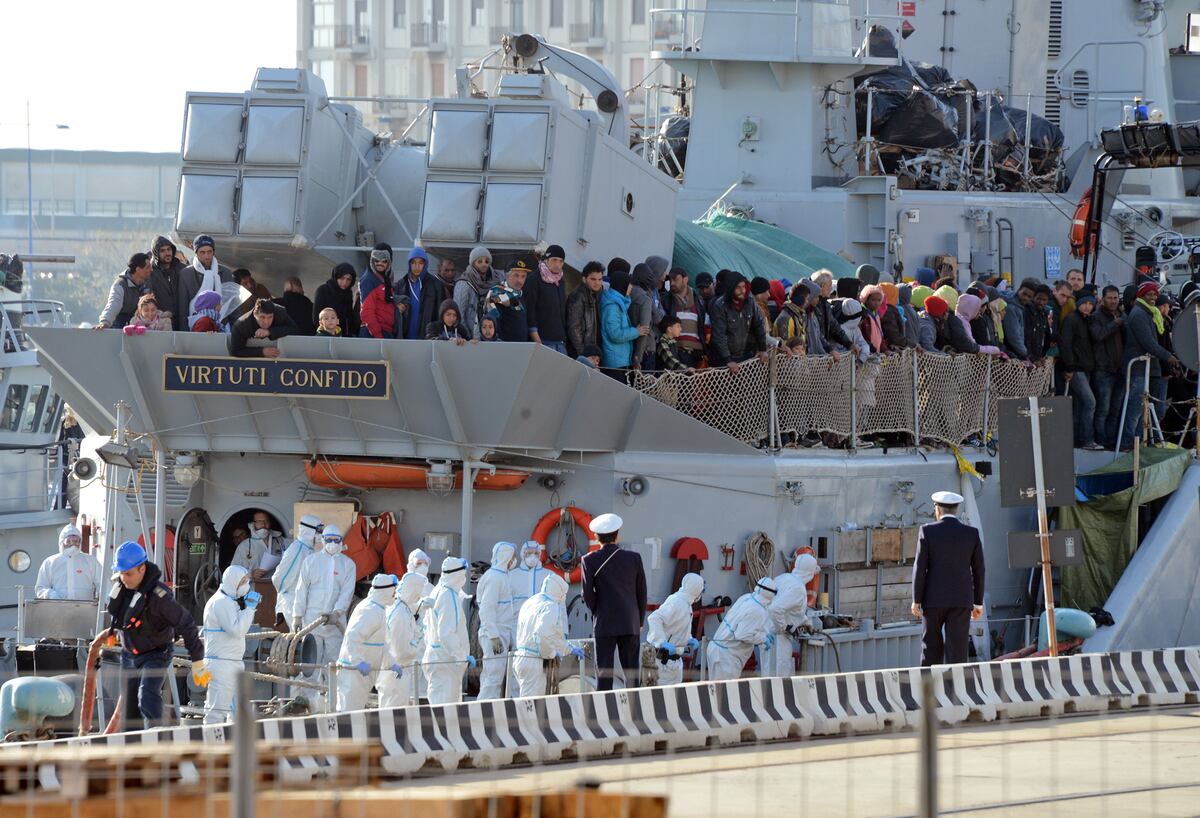
The salt spray off the Persian Gulf doesn't just sting the eyes; it eats away at everything it touches. On the deck of a massive U.S. destroyer, the air is thick with the scent of diesel and brine. For the sailors stationed there, the mission is a monotonous, high-stakes game of observation. They are the physical manifestation of a "maritime blockade"—a term that sounds clinical in a briefing room but feels like a heavy, invisible wall when you are staring through binoculars at a distant Iranian tanker.
This wall of steel has a singular purpose: to squeeze.
But while the ships sit in the water, heavy and unmoving, something else is shifting in the air. Thousands of miles away, the rhetoric is changing. Donald Trump has signaled that the door to the negotiating room, long since bolted shut, might be creaking open again. It is a jarring juxtaposition. On one hand, the U.S. is tightening the noose around the Iranian economy; on the other, there is the sudden, erratic promise of a handshake.
The Weight of the Empty Tanker
To understand why this matters, you have to look past the hull of the warships and into the ghost ports of the Iranian coast.
Imagine a crane operator in Bandar Abbas. For years, his life was defined by the rhythmic clang of shipping containers and the deep, vibrating hum of engines. Today, the silence is his primary companion. When a country’s ability to move its primary resource—oil—is physically obstructed by a naval presence, the ripple effect isn't just a line on a stock market graph. It is the price of bread in a Tehran bakery. It is the inability of a father to find imported medicine for a sick child because the currency has become little more than colorful paper.
The blockade is a blunt instrument. It is designed to create a level of domestic discomfort so profound that the leadership feels the floorboards rotting beneath their feet. By intercepting or discouraging the flow of goods, the U.S. is attempting to drain the coffers of the Islamic Revolutionary Guard Corps.
But pressure without an exit ramp is just a prelude to an explosion.
The strategy currently in play is one of maximum leverage. The blockade provides the "bad cop" energy, a constant reminder of what happens when the global community decides to turn off the lights. Yet, the recent hints from the Trump administration suggest a pivot toward the "good cop" phase. It is a high-wire act. If you offer the talk too early, you look weak. If you maintain the blockade too long without an olive branch, you invite a desperate, cornered strike.
The Language of the Deal
Trump has always operated on a philosophy of personal chemistry over bureaucratic process. He views the previous Iran nuclear deal not as a failed policy, but as a bad bargain struck by people who didn't know how to haggle. To him, the blockade is the pre-meeting posturing. It is the act of walking into a room and making sure everyone knows you own the air conditioning.
"We’ll see what happens with Iran," he says, with the casual tone of a man discussing a real estate acquisition.
However, the Iranians are not just another group of developers. They are heirs to a civilization that measures time in millennia, not election cycles. For them, the blockade is a humiliation that must be endured or circumvented. They have become masters of the "shadow fleet"—old, rusted tankers that turn off their transponders and slip through the cracks of the blockade like ghosts in the night.
Consider the "ship-to-ship" transfer. In the middle of the dark ocean, two vessels pull alongside one another. Hoses are connected. Oil is pumped from a sanctioned Iranian ship to a "clean" vessel with a different flag. It is a dangerous, oily dance performed under the cover of darkness. This is the cat-and-mouse game that the U.S. Navy is tasked with stopping. Every time a shadow tanker slips through, the blockade loses a bit of its psychological power. Every time it is caught, the tension in the region ratchets up another notch.
The Invisible Stakes
Why do we care about a few ships in a distant gulf?
Because the global economy is a circulatory system, and the Strait of Hormuz is the carotid artery. If that artery is constricted—either by a blockade or by a retaliatory strike from an Iranian fast-boat—the pulse of the world slows down. A spike in oil prices doesn't just affect the person filling up their SUV in Ohio. It affects the cost of shipping grain to Africa. It affects the stability of European governments.
The stakes are not just geopolitical; they are visceral.
There is a specific kind of dread that comes with maritime tension. Unlike land borders, where fences and walls provide a clear sense of "us" and "them," the sea is fluid. A misunderstanding between a U.S. drone and an Iranian patrol boat can escalate from a radio warning to a missile launch in less time than it takes to read this paragraph.
The blockade is a physical pressure cooker. The talk of resumed negotiations is the hand on the release valve.
The Art of the Pivot
Critics argue that you cannot trust a regime that continues to fund proxy wars across the Middle East. Supporters of the current approach argue that the blockade is the only thing that brought them to the table in the first place. The truth is likely found in the messy middle.
The Iranian leadership is currently facing a pincer movement. Internally, they deal with a restless, young population that is tired of being isolated from the world. Externally, they face a ring of steel that prevents them from funding the very systems that keep them in power.
Trump’s hint that talks could resume this week is a calculated gamble. He is betting that the Iranian leadership is finally hungry enough—literally and figuratively—to trade their nuclear ambitions for a return to the global market.
But what does a "new deal" look like?
It won't be the old one. It will likely be something more transactional, something that can be branded as a total victory for the "America First" doctrine. It will involve more than just centrifuges; it will have to address ballistic missiles and regional influence. For the U.S., the blockade is the ultimate bargaining chip. "We will move our ships," the message goes, "when you move your stance."
The Human Cost of Hesitation
While the politicians weigh their options and the admirals study their charts, the people on the ground continue to live in the "in-between."
In a small port town in Iran, a fisherman watches the horizon. He sees the silhouettes of the great gray ships. He knows that his livelihood is tied to decisions made in offices he will never see, by men who speak a language he doesn't understand. He represents the millions of people who are the collateral damage of economic warfare.
The blockade is a silent war. No bombs are falling, but the destruction is real. It is the slow decay of infrastructure, the vanishing of savings, and the hardening of hearts.
Then there are the sailors on those U.S. ships. They are mostly in their early twenties. They spend their days maintaining equipment and their nights thinking about home. They are the ones who will have to pull the trigger if the "talks" fail and the "blockade" turns into a "conflict." They are the physical edge of American foreign policy, sharpened by the sun and the salt.
The Uncertain Horizon
Negotiations are often described as a chess match, but that's too clean an analogy. Chess has rules. This is more like a game of poker played in a room filled with gasoline. One wrong move, one sudden flare of temper, and the whole thing goes up.
The news that talks might resume is a glimmer of light, but it is a flickering one. The U.S. maritime blockade continues because, in the world of high-stakes diplomacy, you don't put down your weapon until you see the other person's hands are empty.
We are currently in the breathless moment before the first word is spoken. The ships are still there. The oil is still stuck. The people are still waiting.
There is a specific kind of silence that happens just before a storm breaks or a peace is brokered. It is a heavy, expectant quiet. As the sun sets over the Persian Gulf, casting long, golden shadows across the decks of the destroyers, that silence feels louder than the engines. Everyone is looking toward the shore, wondering if the next ship they see will be a threat, a ghost, or a sign that the ring of steel is finally starting to open.
The steel remains cold. The water remains deep. And the world waits to see if a few words in Washington can move a million tons of metal in the Gulf.