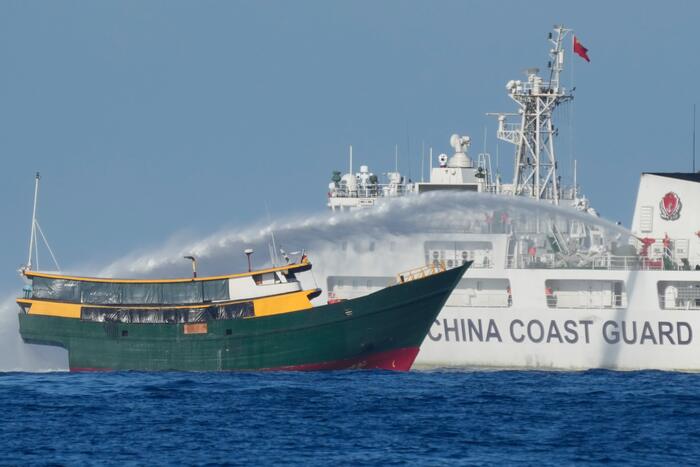
Every twelve months, foreign policy commentators dust off the exact same headline. China and ASEAN made incremental progress on the South China Sea Code of Conduct, they tell us, yet missed another self-imposed deadline.
They frame this as diplomatic failure. They treat the twenty-four-year slog since the 2002 Declaration on the Conduct of Parties in the South China Sea like a broken assembly line that just needs a little more political grease.
That reading gets the entire geopolitical board backward.
The Code of Conduct is not failing to cross the finish line. The negotiation process is the product. For Beijing, an endless, polite, perpetually "almost finished" diplomatic marathon is far more valuable than a signed treaty could ever be. And for half of Southeast Asia, dragging out the paperwork is the only way to avoid choosing between economic suicide and territorial surrender.
When you watch diplomats emerge from summits in Jakarta, Vientiane, or Manila announcing another round of "positive readings" of the Single Draft Negotiating Text, stop looking at the calendar. Look at the water. While diplomats argue over commas and dispute-resolution clauses in air-conditioned hotel ballrooms, concrete has cured, runways have opened, and coast guard hulls have multiplied.
The Myth of the Diplomatic Finish Line
Mainstream coverage treats multilateral diplomacy like a corporate merger. Two sides sit down, iron out terms, sign a binding contract, and enforce the rules. If the deal slips past Q4, analysts call it a setback.
Apply that corporate logic to maritime Asia and you blind yourself to how asymmetric power actually operates.
I have spent years watching maritime security analysts and regional trade desks burn millions of dollars modeling "post-COC stability scenarios." They build elaborate risk matrices assuming that once China and the Association of Southeast Asian Nations ink a final document, gray-zone incidents around Second Thomas Shoal or Scarborough Shoal will magically drop by forty percent. They treat a diplomatic communiqué like an insurance policy.
It is an expensive delusion.
Under international law, the difference between a political declaration and a legally binding treaty is night and day. The 2002 Declaration on the Conduct of Parties (DOC) was explicitly non-binding. It was a promise to behave nicely while working toward a real rulebook. Twenty-four years later, the real rulebook—the Code of Conduct (COC)—remains a moving target.
Why? Because a genuinely binding, enforceable Code of Conduct violates the core strategic interests of the most powerful player at the table.
Think about what a real, teeth-baring treaty requires:
- Clear geographic scope: Defining exactly where the rules apply, which forces claimants to confront China's expansive nine-dash (or ten-dash) line map head-on.
- Legally binding enforcement: Mechanisms that penalize bad actors when water cannons fire or fishing fleets swarm contested reefs.
- Third-party dispute settlement: Access to international arbitration under the United Nations Convention on the Law of the Sea (UNCLOS), precisely the mechanism Beijing rejected after the 2016 Permanent Court of Arbitration ruling in The Hague.
If Beijing signs a weak, non-binding COC, it looks cynical and invites Western ridicule. If Beijing signs a strong, legally binding COC, it voluntarily handcuffs its own maritime militia and coast guard.
So Beijing takes option three. Keep talking. Praise ASEAN centrality. Agree to a three-year deadline, miss it gracefully, and propose a fresh framework at the next summit.
Why Beijing Loves a Perpetual Rough Draft
Time is not neutral in the South China Sea. Time is a weapon, and slow-motion diplomacy is how you buy it without firing a shot.
Consider the timeline of physical facts on the water versus paper progress at the negotiating table:
- 2002: China and ASEAN sign the DOC, pledging self-restraint and promising not to inhabit currently uninhabited features. At this point, Beijing controls a handful of modest outposts on stilts in the Spratly Islands.
- 2013–2016: While diplomats hold solemn working-group meetings on COC guidelines, China dredges millions of tons of sand onto seven reefs, turning submerged rocks into over 3,200 acres of artificial islands complete with deep-water ports, radar arrays, missile shelters, and 3,000-meter runways.
- 2017–2023: Negotiators announce a framework, then a Single Draft Negotiating Text, then complete first and second readings. Meanwhile, the China Coast Guard deploys 12,000-ton "monster" cutters that dwarf Southeast Asian naval frigates, normalizing permanent patrols inside the Exclusive Economic Zones (EEZs) of Malaysia, Vietnam, and the Philippines.
- 2024–2026: Negotiators celebrate accelerated talks and "new guidelines" to finish the pact, yet still cannot close the deal. On the water, grey-zone harassment—lasers, acoustic devices, ramming, and supply blockades—becomes routine daily friction.
Imagine a scenario where a developer is illegally building a skyscraper on your property line. Every time you call the city inspector, the developer invites you to a five-star lunch to negotiate a "Neighborhood Harmony Charter." The developer is charming, agrees with your principles, and insists you two should settle this privately without calling the police or hiring outside lawyers. Six months later, the charter still isn't signed, and the skyscraper is thirty stories tall.
You wouldn't call the Neighborhood Harmony Charter "stalled." You would recognize it as a distraction tactic while the concrete pours.
As maritime legal scholars like Jay Batongbacal and Bill Hayton have pointed out for years, Beijing uses the process of negotiating the COC to shield itself from external intervention. Whenever Washington, Tokyo, or Brussels criticizes Chinese coast guard tactics, Beijing delivers the same rehearsed rebuttal: China and ASEAN are actively negotiating a Code of Conduct; outside powers should stop meddling and let regional countries handle regional affairs.
The unfinished draft is a diplomatic force field. As long as the talks are "ongoing," China can demand that the United States and its allies stay out of the room. The moment talks collapse entirely, ASEAN claimants have every excuse to invite American carrier groups and Japanese patrol vessels deeper into their waters. The moment talks succeed with real rules, China loses its operational freedom.
Perpetual negotiation is the sweet spot.
ASEAN Is Not a Victim Here—It Is Divided by Design
The second lazy assumption in mainstream reporting is treating ASEAN as a unified ten-nation bloc desperately trying to get China to sign on the dotted line.
ASEAN is not a single actor. It is a consensus-driven club of ten vastly different economies with competing existential fears. Under the ASEAN Charter, major decisions require unanimity. One member can quietly tap the brakes and freeze the entire machine.
Look closely at the split inside Southeast Asia:
- The Frontline Claimants: The Philippines and Vietnam bear the direct physical brunt of Chinese maritime expansion. Manila has abandoned quiet diplomacy in favor of radical transparency, embedding journalists on resupply missions to expose coast guard aggression. Hanoi plays a quieter, steadier game, fortifying its own Spratly outposts while hedging with Washington, Tokyo, and Moscow. Both want a COC with real legal teeth, geographic clarity, and zero restrictions on their right to conduct military drills with outside allies.
- The Quiet Claimants: Malaysia and Brunei have overlapping EEZ claims with Beijing, yet both rely heavily on Chinese infrastructure investment, trade flows, and energy partnerships. Kuala Lumpur protests Chinese survey vessels inside its waters, then turns around and welcomes Chinese premier visits and bilateral investment deals. Their appetite for blowing up diplomatic relations over treaty language is near zero.
- The Non-Claimants: Cambodia, Laos, Myanmar, Thailand, Singapore, and Indonesia have no direct territorial claims in the Spratlys (though Indonesia fiercely guards its Natuna Sea EEZ against Chinese fishing encroachments). Landlocked Laos and heavily Chinese-financed Cambodia have zero incentive to champion a tough maritime code that angers their largest creditor and trading partner.
When pundits complain that ASEAN "can't finish talks this year," they miss the internal mechanics. A weak, toothless COC actually hurts the frontline states more than no COC at all.
If Manila or Hanoi signs a watered-down pact just to give diplomats a photo-op, they risk legitimizing the status quo. Worse, Beijing has repeatedly pushed draft clauses that would effectively grant China a veto over joint military exercises between ASEAN states and outside powers, as well as restrictions on joint oil and gas exploration with Western energy firms.
For the Philippines, signing a document that limits its ability to run joint patrols with the U.S. Navy or explore energy reserves in Reed Bank is strategic suicide. For Manila, stalling a bad deal is a victory, not a failure.
Answering the Questions Nobody Asks Properly
When readers search for news on the South China Sea pact, they usually run into the same recycled questions. Let's strip the diplomatic jargon off them.
Will the South China Sea Code of Conduct actually stop Chinese aggression?
No. Even if negotiators sign a final text tomorrow morning, it will not stop gray-zone coercion on the water.
Here is why: a treaty only constrains behavior when the cost of breaking it exceeds the benefit of compliance. Right now, there is no enforcement mechanism on the table that can physically stop a 10,000-ton China Coast Guard cutter from blocking a wooden resupply boat. International agreements without verification regimes, mandatory dispute settlement, and automatic sanctions are just expensive stationery. Look at the 2002 DOC—Clause 5 explicitly prohibited inhabiting uninhabited features, and it was ignored the moment dredging technology made island-building viable.
Why does China refuse to make the Code of Conduct legally binding?
Because "legally binding" brings international courts and third-party arbitration into the picture.
Beijing's core diplomatic doctrine in territorial disputes is strict bilateralism—dealing with smaller neighbors one-on-one where China's massive economic and military weight guarantees leverage. A legally binding multilateral treaty invites external legal scrutiny, forces precise definitions under UNCLOS, and creates a unified ASEAN legal front. Beijing will accept the label "binding" only if the text itself is stripped of enforcement clauses, dispute-resolution tribunals, and clear geographic boundaries.
What happens if the talks collapse completely?
Neither side will let them collapse officially, because collapse carries high reputational costs for everyone.
If Beijing walks away, it confirms every Western warning that China rejects rules-based order, pushing fence-sitting Southeast Asian nations straight into Washington's security orbit. If ASEAN walks away, it exposes the bloc's internal paralysis and shatters the cherished doctrine of "ASEAN centrality"—the idea that Southeast Asian nations sit in the driver's seat of regional security. Both sides need the stage play to continue, even if the script hasn't changed in a decade.
The Uncomfortable Flaw in Realism
Before we write off diplomacy entirely, let's be honest about the downside of treating the COC as pure theater.
Cynicism has its own blind spots. If frontline states abandon the negotiating table completely and rely solely on naval deterrence and bilateral defense treaties, the risk of miscalculation spikes dramatically.
Right now, the ongoing COC talks—alongside hotlines, maritime crisis communication mechanisms, and coast guard dialogue channels—serve as a pressure valve. When water cannons shatter windshields at Second Thomas Shoal, having diplomats scheduled to meet in three weeks gives leaders in Beijing and Manila an off-ramp before a localized collision escalates into a shooting war.
Dismissing diplomatic talks as useless ignores how crisis management works. You do not negotiate with adversaries because you trust them to keep their word; you negotiate to keep phone lines open when radar locks happen at two in the morning. The mistake isn't holding the talks. The mistake is pretending the talks will ever produce a grand legal settlement that freezes the map.
What Smart Operators Do Instead of Waiting for a Treaty
If you run supply chains through the Strait of Malacca, manage offshore energy assets in Southeast Asia, insure maritime cargo, or advise policymakers, waiting for a signed Code of Conduct to stabilize the region is malpractice.
Stop tracking diplomatic communiqués. Start tracking operational reality:
- Price gray-zone friction as a permanent baseline. Stop modeling South China Sea disruption as a binary "peace versus war" switch. The real threat to commercial shipping, subsea cables, and offshore energy is persistent, sub-threshold harassment—ais-spoofing, sudden coast guard exclusion zones, inspection delays, and insurance premium spikes. Build your logistics buffers around chronic friction, not sudden peace treaties.
- Watch minilateral security pacts, not ten-nation summits. The real security architecture in the Indo-Pacific is no longer being built by ASEAN consensus. It is being built through agile, overlapping "minilaterals"—the U.S.-Philippines-Japan trilateral, AUKUS, the Quad, and bilateral defense agreements like the Japan-Philippines Reciprocal Access Agreement. Follow defense budgets, joint coast guard drills, and radar-sharing deals; ignore summit press releases.
- Audit energy and subsea cable exposure. Nearly forty percent of global maritime trade and critical fiber-optic cables pass through these waters. If your infrastructure or supply chain depends on single-point transit or unhedged offshore concessions in contested EEZs, diversify routes and vendor redundancies now while freight rates are manageable.
- Separate trade rhetoric from security alignment. Southeast Asian governments will continue signing massive trade and infrastructure deals with Beijing on Monday while conducting naval exercises with Washington on Thursday. Do not confuse economic integration with geopolitical submission—or vice versa.
The next time a headline announces that China and ASEAN made "encouraging progress" on the South China Sea Code of Conduct but need just one more year to iron out the details, do not call it a delay.
Read the scoreboard. Every year the rough draft stays unsigned is another year the facts on the water harden into permanence.