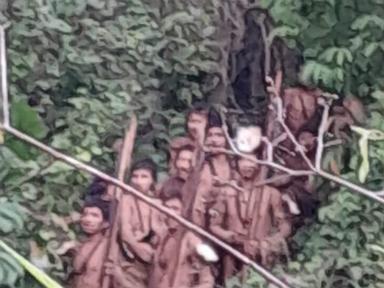
Every few months, a grainy video surfaces from the depths of the Amazon basin. Men with bows step out of the tree line onto a muddy riverbank. They stare at a drone, or a passing boat, or a camera crew hidden behind a blind. Within hours, the Western media machine churns out the exact same headline. Rare encounter with isolated Indigenous people raises concerns over safety.
Then come the predictable hand-wringing op-eds. NGOs issue urgent press releases demanding invisible borders. Armchair anthropologists on social media mourn the loss of Eden. Everyone agrees on the lazy consensus: these people are pristine relics of the Stone Age, entirely cut off from the modern world, and the only moral path forward is to draw a giant circle around them on a map and pretend they live in a museum.
That consensus is a comfortable lie. Worse, it is actively lethal.
When journalists and activists frame groups like the Mashco Piro in Peru or the Korubo and Yanomami subgroups in Brazil as "uncontacted," they aren't protecting them. They are peddling a colonial myth of the Noble Savage that obscures the actual mechanics of survival in the Amazon. These populations are not lost in time. They are survivors of genocide who made a calculated, tactical decision to retreat into the forest to avoid being murdered by rubber barons, gold miners, and state-backed developers.
Calling them "uncontacted" erases their history. Treating them like fragile museum exhibits strips them of their agency. And relying on a "no-contact" policy as a silver bullet is setting them up for catastrophic collapse the exact moment a rogue logger or narco-trafficker breaches the perimeter.
The Lie of the Pristine Bubble
Let’s define our terms properly, because precision matters when human lives are on the line. Anthropologists and Brazil’s own Indigenous agency, FUNAI (Fundação Nacional dos Povos Indígenas), rarely use the word "uncontacted" among themselves. They use the term povos indígenas isolados—isolated Indigenous peoples.
The distinction is massive. "Uncontacted" implies a people who have never seen a metal pot, never heard the buzz of a Cessna engine, and have no idea that a broader civilization exists beyond the canopy. That group does not exist on planet Earth. Every single isolated group in the Amazon knows we are here. They trade scrap metal with settled neighboring tribes. They watch commercial airliners cross the sky. They hear the roar of chainsaws creeping closer to their hunting grounds every dry season.
I have spent years analyzing land-use conflicts and resource extraction policy across South America, and I have watched billion-dollar conservation frameworks fail because Western donors fund a fantasy rather than reality. The donors want to buy a pristine Eden. They want to believe that if they pay enough money to keep satellite imagery green, the people inside will remain frozen in amber.
In reality, these groups are living in a state of permanent, low-grade siege warfare. Look at the historical record documented by researchers like Kim Hill and Robert Walker, who have spent decades studying Amazonian demography. Groups like the Mashco Piro—who frequently appear along the Las Piedras River in Peru, right across the border from Brazil—are the descendants of communities shattered during the Amazon rubber boom of the late 19th and early 20th centuries. Rubber barons like Julio César Arana enslaved, tortured, and wiped out tens of thousands of Indigenous people. The survivors ran. They abandoned agriculture, became hyper-mobile hunter-gatherers, and adopted strict isolation as a military defense strategy.
They aren't hiding because they don't know you exist. They are hiding because the last time they met people like you, their grandparents were butchered.
Why the "No-Contact" Policy Is Failing in Real Time
Since 1987, Brazil has enforced a strict non-contact policy, spearheaded by veteran sertanistas like Sydney Possuelo. On paper, it was a revolutionary shift away from the old assimilationist model, which rounded up tribes and dumped them onto reservations where half of them died of measles within a year. The 1987 policy mandated that the state would demarcate territory, monitor borders from the outside, and never initiate contact unless the group was in immediate physical danger.
For thirty years, it was the gold standard. Today, that policy is being outflanked by reality.
The Amazon is no longer a remote frontier buffered by thousands of miles of impenetrable jungle. It is a fragmented, industrializing zone crisscrossed by illegal airstrips, clandestine highways, and transnational organized crime networks. You cannot maintain a sterile quarantine zone in the middle of a warzone.
Consider what happens when a viral video of an "isolated" tribe hits the news cycle. The media frames the encounter as a rare, accidental brush with the unknown. In truth, when isolated groups step onto riverbanks in broad daylight and demand machetes, bananas, or clothing from loggers and tourists, it is a red flare. It means their buffer zone has collapsed.
Look at the mechanics driving these encounters:
- Resource Compression: Illegal gold miners (garimpeiros) and selective loggers do not respect imaginary lines on a FUNAI map. When they poison rivers with mercury and drive away game animals, isolated groups are pushed into smaller pockets of forest. Eventually, they collide with other isolated tribes or settled communities.
- The Narco-Corridor: The western Amazon, particularly the Javari Valley on the Brazil-Peru border—which holds the highest concentration of isolated groups in the world—has become a major transit hub for cocaine trafficking. Cartels do not care about UNESCO heritage sites or human rights declarations.
- State Hollowing: Monitoring a territory the size of Austria requires massive, continuous funding, armed patrol bases, and political will. Under administrations hostile to Indigenous rights, FUNAI’s field bases were gutted, leaving isolated groups completely exposed to invasion while the official "no-contact" policy prevented experts from intervening before crisis hit.
When you combine a strict "no-contact" mandate with a weak, underfunded state apparatus, you create a deadly vacuum. The state stays out, the anthropologists stay out, and the doctors stay out. Meanwhile, the loggers, miners, and traffickers walk right in.
The Immunological Time Bomb
Here is the brutal biological reality that polite conservationists hate discussing: isolation is an epidemiological trap.
Because these groups have lived in small, dispersed bands away from dense population centers for generations, they lack acquired immunity to common pathogens. A simple rhinovirus—the common cold—or a mild strain of influenza that gives a tourist the sniffles can trigger a 50% mortality rate in an isolated community within weeks. It is not just the virus that kills them; it is the social collapse that follows. When every adult in a band of forty people falls violently ill simultaneously, nobody can hunt, nobody can gather water, and nobody can tend the fires. Dehydration and starvation finish what the pathogen started.
The lazy consensus says: Therefore, keep everyone away forever.
That is wishful thinking masquerading as public health strategy. You cannot keep everyone away forever. The perimeter is already porous. Every time a Mashco Piro warrior picks up a discarded t-shirt left on a riverbank by a sympathetic villager, or trades with an illegal logger for a steel axe, the pathogen roulette wheel spins.
Imagine a scenario where a group of twenty isolated hunter-gatherers makes brief, undocumented contact with an illegal mining camp. One miner has a mild respiratory infection. Two days later, the group retreats deep into the canopy. Under a rigid "no-contact" orthodoxy, state agents cannot follow them to administer antibiotics or antivirals because doing so violates the directive against initiating contact. By the time aerial reconnaissance spots empty clearings and unburied bodies months later, the entire lineage is extinct.
This is not a hypothetical. It happened repeatedly throughout the 20th century, and it nearly happened to the Korubo and the Zo'é. In the mid-2010s, prominent anthropologists Kim Hill and Robert Walker published a controversial paper in Science arguing that the strict no-contact policy was doomed to fail. They proposed "controlled contact"—a proactive, medically supervised process where trained specialists, armed with vaccines, antibiotics, and translators from linguistically related tribes, initiate peaceful contact on the tribe's own terms before miners or missionaries do it violently.
The backlash from the NGO industrial complex was ferocious. Survival International and various Brazilian advocacy groups accused Hill and Walker of advocating ethnocide. They argued that controlled contact destroys cultural autonomy and inevitably leads to dependency and marginalization.
Both sides are right about the risks, and both sides are blinded by their own dogma.
The Uncomfortable Truth About Controlled Contact
Let’s look at the downsides of proactive contact honestly, because pretending it is painless is just as dishonest as pretending isolation is permanent.
History shows that even the best-intentioned, state-led contact missions carry devastating collateral damage. When the Brazilian government initiated contact with the Panará in the 1970s to build a highway through their land, over 80% of the population died within two years, despite the presence of medical teams. Even in modern, carefully managed cases, transition is brutal. Once a group accepts steel tools, medicine, and outside food, their traditional economy unravels. Young men lose status as hunters; elders lose authority as healers. Within a single generation, proud, self-sufficient forest dwellers can end up sitting on the outskirts of frontier towns, battling alcoholism, diabetes, and crushing poverty.
That is the horror the NGOs are fighting to prevent. Their fear is entirely rational.
However, the alternative—pretending that a policy of passive containment works while the forest burns around them—is an abdication of responsibility. You cannot outsource survival to a policy written in 1987 when the realities on the ground have shifted entirely.
When the media reports on a "rare encounter" in Brazil, they almost always frame it as a binary choice: either we leave them completely alone, or we destroy them. That framing is intellectually lazy. It ignores the reality that these groups are actively negotiating their own boundaries.
What Actually Happens on the Riverbank
If you talk to the people who actually work on the ground in the Amazon—not the fundraisers in London or New York, but the field agents and neighboring Indigenous leaders—you get a completely different picture of these "rare encounters."
Isolated tribes are not passive victims stumbling into cameras. They are strategic actors conducting reconnaissance.
When a group like the Mashco Piro appears on the banks of the Las Piedras River, they are often following a precise script. They know that settled Indigenous communities, like the Yine, live downstream. They know the Yine speak a mutually intelligible dialect. Often, these encounters begin with whistling from the treeline, followed by requests for specific, high-value items: machetes, metal pots, and plantains.
Why? Because a steel machete reduces the labor required to clear brush or butcher game by roughly 80% compared to a stone axe. These people are pragmatists. They want the technological upgrade without the colonial subjugation. They want the tools, and then they want you to leave.
The danger spikes when outsiders misread these tactical interactions.
- The Tourist Trap: Adventure tour operators and rogue filmmakers deliberately bait isolated groups with food and tools to capture viral footage. This conditions the tribe to associate riverbanks with free handouts, drawing them out of the deep forest and exposing them to disease.
- The Missionary Incursion: Fundamentalist evangelical groups, often funded by American dark money, view isolated tribes as the final frontier for soul-winning. They illegally enter restricted zones, bringing zero medical protocols and maximum ideological arrogance, determined to "save" people who never asked for salvation.
- The Retaliation Spiral: When loggers encroach on hunting grounds, isolated warriors do what any sovereign nation does when invaded: they defend their border with lethal force. Arrows fly. Loggers shoot back with shotguns. The state steps in only after bodies pile up, usually siding with the economic interests of the frontier over the ghosts in the trees.
Dismantling the Wrong Questions
If you search the internet after one of these stories breaks, you see the same naive questions dominating the conversation.
"Why doesn't the government just send in doctors to vaccinate them?"
Because you cannot simply walk up to a group of terrified, heavily armed people who do not speak your language and stick needles into their children. Without months or years of patient, linguistic bridge-building—usually led by closely related Indigenous groups—a medical intervention looks identical to an ambush. Trying to force vaccines onto an isolated band will get your medical team killed with six-foot bamboo arrows, or force the tribe to scatter deeper into unmonitored territory where they cannot be protected at all.
"Why don't they just join modern society?"
Because "modern society" on the Amazonian frontier does not offer them tech jobs and suburban comfort. It offers them racial discrimination, squalid shantytowns, sex trafficking, and minimum-wage labor on the very cattle ranches that destroyed their homes. Staying in the forest isn't a rejection of progress; it is a rational economic calculation to maintain autonomy and wealth—measured in clean water, abundant protein, and social cohesion—rather than becoming the lowest caste in a brutal frontier economy.
"Can't we just use drones and satellites to protect them?"
Satellites can spot a newly cleared mining pit, and drones can film a village clearing, but neither can stop a bullet or cure pneumonia. Technology has created an illusion of control. Conservation groups love showing off high-res thermal imagery because it looks impressive in donor presentations. Meanwhile, on the ground, a single corrupt local politician can strip funding from a guard post, rendering ten million dollars of satellite monitoring completely useless.
What Needs to Happen Instead
If we want to stop reading obituaries disguised as "rare encounter" news stories, we have to abandon the romanticism and treat isolated Indigenous territories like what they actually are: sovereign, blockaded nations under active siege.
First, shift power and funding directly to neighboring Indigenous nations. The most effective border guards in the Amazon are not federal police flown in from Brasília or Lima who hate the jungle and take bribes from miners. They are the settled Indigenous tribes who live next door to their isolated cousins. Groups like the Matsés, the Yine, and the Asháninka have the linguistic skills, the jungle craft, and the existential motivation to keep invaders out. Give them legal enforcement authority, surveillance tech, and direct funding without filtering 60% of it through Western NGO overhead.
Second, destroy the economic engines driving the invasions. Putting a guard post on a river is treating the symptom while ignoring the disease. Isolated tribes are being pushed out of the forest because global supply chains reward illegal gold mining and deforestation. Until central banks and bullion refineries enforce ruthless supply-chain traceability—banning any gold that cannot be cryptographically verified from legal mines—the garimpeiros will keep coming. You don't save an isolated tribe with a charity donation; you save them by tanking the black-market price of illicit gold.
Third, build rapid-response, Indigenous-led quarantine protocols. We need to stop pretending contact will never happen and build permanent, hyper-localized medical strike teams stationed at the edges of high-risk zones. These teams shouldn't be trying to initiate contact. They should be sitting ready, stocked with broad-spectrum antibiotics, antivirals, and culturally trained translators, prepared to deploy within hours the exact moment an isolated group initiates contact on its own terms.
The next time a viral video shows a group of half-naked men emerging from the Amazonian mist, look past the spectacle. Do not marvel at their "untouched" innocence. Recognize them for what they really are: battle-hardened refugees holding the final line against an industrial machine that wants their land, their gold, and their timber. Stop romanticizing their isolation, dismantle the illegal economies invading their borders, and let the people who actually know how to survive in that forest run the defense.


