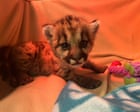
The feel-good machine is back in gear. You’ve seen the headline: a three-week-old mountain lion cub, orphaned and shivering, is "saved" by California biologists. The photos are adorable. The public relations win is massive. The social media comments are a flood of heart emojis and praise for the brave souls in khakis.
It is a lie. If you enjoyed this article, you might want to check out: this related article.
Not a lie of fact—the cub exists, and it was moved from a bush to a crate—but a lie of impact. We are conditioned to treat these individual rescues as triumphs of conservation. In reality, they are expensive, sentimental distractions that allow us to ignore the systemic disintegration of apex predator habitats. We are spending thousands of dollars to curate a "happy ending" for one animal while the very infrastructure of our wilderness ensures its siblings will be crushed by an SUV or starved out by genetic isolation.
The High Cost of Sentimentality
When a biologist "rescues" a three-week-old cub, they aren't returning it to the wild. A cub that young, separated from its mother, is effectively dead to the ecosystem. It cannot be taught to hunt by a human in a lab. It will spend its life in a sanctuary or a zoo. From a genetic and functional standpoint, that mountain lion is gone. For another perspective on this development, check out the latest coverage from NPR.
Yet, we celebrate. Why? Because individual narratives are easy to digest. A single cub with big blue eyes is a "character." A collapsing wildlife corridor is a "zoning issue."
I have spent years watching agencies burn through limited budgets on high-profile interventions because they play well on the evening news. It is easier to get funding for a rescue helicopter than it is to lobby for a $50 million wildlife overpass that would prevent the need for the rescue in the first place. We are treating the sneeze while the patient has stage four lung cancer.
The Myth of the Heroic Intervention
The "lazy consensus" suggests that every life saved is a win for the species. This ignores the biological reality of Puma concolor. Mountain lions are not rare in the sense of being near extinction across their entire range. They are a resilient, wide-ranging species. The crisis isn't a lack of cubs; it’s a lack of connectivity.
In the Santa Monica Mountains, the mountain lion population is suffering from severe inbreeding depression. We see it in kinked tails and undescended testes. This is a "genetic graveyard." Taking one cub out of this environment and putting it in a cage doesn't fix the gene pool. It doesn't move the needle on the Effective Population Size ($N_e$).
If we were serious about conservation, we would stop treating these animals like Disney characters. We would accept that in a functional ecosystem, some cubs die. That is the brutal, necessary math of nature. The tragedy isn't that a cub was orphaned; the tragedy is that the mother likely died crossing a ten-lane highway because we refused to build a bridge.
Why Your "Aww" is Killing the Wild
Every time you share a story about a rescued cub, you are validating a reactive, rather than proactive, conservation model.
- Resource Misallocation: The man-hours spent on a single rescue could have been used for land acquisition or invasive species management.
- Public Misconception: It creates the illusion that the state has "got this." If the biologists are saving the babies, the system must be working, right?
- Domestication of the Wild: We are turning the majestic, terrifying apex predator into a ward of the state.
Imagine a scenario where we diverted every dollar spent on "orphan care" for mountain lions over the last decade into a single endowment for land easements. We wouldn't be looking at a single cub in a crate; we would be looking at thousands of acres of contiguous hunting grounds. But land easements aren't "cute." They don't get 50,000 likes on Instagram.
The Hard Truth About Rehabilitation
Let’s talk about the "rehab" success rate. For a mountain lion cub to be successfully rewilded, it needs to learn the complex mechanics of the ambush. It needs to understand the nuance of deer migration, the danger of larger males, and the boundaries of human encroachment.
Biologists know this. They know that a cub rescued at three weeks has a near-zero chance of ever being a functional wild predator. By "saving" it, we are often just sentencing it to twenty years of pacing behind a chain-link fence. We call it a rescue; a more honest term would be "permanent incarceration for the crime of being orphaned."
Dismantling the "People Also Ask" Delusions
People often ask: Can't we just release them when they're older?
No. Without maternal training, a captive-raised lion sees humans as food providers or nuisances, not threats. A released "rehab" lion is a problem lion waiting to happen. It will end up in a backyard, and it will be shot by a sheriff's deputy.
Isn't it better to save one than do nothing?
Not if "saving one" exhausts the political and financial capital needed to save the thousand. This is the Opportunity Cost of Mercy. By focusing on the micro, we are forfeiting the macro.
The Uncomfortable Path Forward
If you actually care about mountain lions, stop clicking on the rescue stories. Start looking at the boring, "un-sexy" data.
- Demand Wildlife Overpasses: The Wallis Annenberg Wildlife Crossing is a start, but we need dozens of them.
- Fight for Permeability: Demand that new developments include corridors that allow predators to move without hitting a suburban cul-de-sac.
- Accept the Cycle: Nature is a high-turnover business. Death is a functional component of a healthy wilderness.
We have to decide if we want a wild world or a giant, outdoor petting zoo where every "tragedy" is met with a high-tech intervention. If we continue to prioritize the individual cub over the integrity of the habitat, we will eventually have plenty of rescued lions in cages and none left in the mountains.
Stop mistaking a PR stunt for a conservation strategy. The cub isn't a symbol of hope; it's a symptom of a landscape we've broken so thoroughly that we've forgotten what real wildness looks like.
Keep the "aww." Give me the acreage.
The most "humane" thing we can do for a mountain lion is to build a world where it never has to meet a biologist.
Get out of the way. Let the mountains be cruel, as long as they stay connected. That is the only rescue that matters.