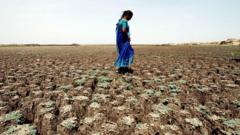
Every year, the mainstream financial press runs the exact same headline with a different date stamped on it. A delayed monsoon or a dry June triggers immediate, reflexive hysteria about crashing GDP growth, soaring food inflation, and rural distress.
The recent data showing India just experienced its driest June in over a decade sent shockwaves through Mumbai and Delhi brokerage houses. Analysts scrambled to adjust their agricultural output models. Media outlets predicted a catastrophic Kharif sowing season.
They are looking at the wrong data points, asking the wrong questions, and drawing conclusions that completely miss how modern agricultural economics works on the ground.
A dry June is not an agricultural death sentence. It is a predictable, manageable seasonal variation that has been weaponized by a legacy media apparatus addicted to disaster narratives, and by a political ecosystem that uses weather volatility to cover up structural policy failures.
The Arithmetic the Financial Press Ignores
Let us look at the actual physics of the Indian monsoon rather than the emotional commentary surrounding it.
The southwest monsoon delivers roughly 75% of India's annual rainfall between June and September. The media treats June as if it carries equal weight to the rest of the season. It does not. Historically, June accounts for a mere 15% to 18% of the total seasonal rainfall. The heavy lifting is done entirely in July and August, which together account for over 60% of the precipitation.
Agricultural scientists and seasoned farm managers know that early sowing in June is frequently a gamble, not a best practice. When farmers rush to sow seeds during early, erratic June showers, a subsequent two-week dry spell can bake the soil, kill the germinating seeds, and force expensive re-sowing.
A dry June keeps farmers from jumping the gun. It forces a delayed, synchronized sowing schedule that aligns perfectly with the heavy, reliable downpours of July.
Data from the India Meteorological Department (IMD) consistently demonstrates a weak correlation between June rainfall deficits and final crop yields. Take a look at historical monsoon patterns over the last two decades. Years with dry starts frequently end with normal or even surplus crop yields, provided the July distribution is uniform. What matters is spatial and temporal distribution in the core monsoon zone during the mid-season, not the aggregate volume printed on June 30.
The Groundwater Cushion and Reservoir Myth
The standard narrative assumes Indian farming is entirely at the mercy of clouds. This ignores the massive expansion of irrigation infrastructure and groundwater utilization over the past thirty years.
More than half of India’s agricultural production now enjoys some form of irrigation protection. In critical northwestern states like Punjab and Haryana, over 95% of the cropped area is irrigated. When June is dry, tubewells turn on. Reservoirs step in.
Commentators point to falling live storage levels in Central Water Commission monitored reservoirs during a dry June as proof of an impending crisis. This is backward logic. Reservoirs are designed to hit their lowest points in June. That is exactly how water resource management works; you draw down the storage during the dry winter and rabi summer months to clear capacity for the incoming monsoon torrents. If reservoirs were full in June, the subsequent July rains would cause catastrophic regional flooding.
The problem facing Indian agriculture is not a temporary lack of rain in June. The real crisis is the systemic distortion of water economics.
The Tragedy of Free Power and Misaligned Incentives
The real villain in Indian agriculture is not a dry spell; it is the political economy of state subsidies.
Imagine a system where you are paid a guaranteed price by the government to grow a crop that your local environment cannot naturally support, using water that costs you absolutely nothing to pump. That is the reality of paddy cultivation in the semi-arid regions of northwestern India.
State governments provide free or heavily subsidized electricity to farmers. The Central Government guarantees procurement of rice through the Minimum Support Price (MSP) mechanism. This combination creates a perverse economic incentive. Farmers pump trillions of liters of groundwater from deep aquifers to flood fields for water-intensive rice varieties in the middle of blistering summers, long before the first monsoon cloud arrives.
A dry June simply exposes this vulnerability. It does not create it.
I have watched agricultural regions deplete their water tables by hundreds of feet over a decade, not because the monsoon failed, but because the policy succeeded perfectly in encouraging resource extraction. The obsession with June rainfall deficits allows policymakers to blame nature for an environmental crisis engineered entirely in state legislative assemblies.
The Crop Diversification Scam
For years, expert committees have advocated for crop diversification. They tell farmers to switch from water-guzzling rice and sugarcane to pulses, oilseeds, and millets, which thrive in low-rainfall environments.
Yet, diversification fails year after year. Why? Because the market infrastructure for non-MSP crops is fundamentally broken.
A farmer will not switch from paddy to lentils just because the monsoon is late. Paddy offers price certainty via government procurement centers. Lentils expose the farmer to volatile wholesale markets dominated by cartels of middlemen. Until the structural risk profile of alternative crops is solved through deep market reforms and contract farming options, farmers will continue to pump the last drops of groundwater to sustain rice crops through a dry June.
Blaming the climate for low diversification is a cop-out. The blame lies squarely on the shoulders of an archaic agricultural marketing system that penalizes risk-taking and rewards environmental destruction.
Agri-Tech Investments Are Targeting the Wrong Problem
Venture capital has poured billions into agricultural technology platforms over the past several years. Most of these platforms focus on predictive weather analytics, satellite-based crop monitoring, and hyper-local rain forecasting.
They are optimizing for the wrong variable.
Giving a farmer a high-accuracy, five-day weather forecast showing a dry June does not change their economic reality if their entire livelihood is tied to an MSP-driven rice crop. Agri-tech needs to move away from weather forecasting and toward real-world supply chain disintermediation, cold storage financing, and direct-to-mill procurement platforms for high-value, drought-resilient crops.
The value is not in telling a farmer it is not going to rain; the value is in creating a market where they can make a profit when it does not rain.
The Path Forward Requires Brutal Truths
Fixing this cycle of annual panic requires dismantling the legacy systems that sustain it.
First, direct cash transfers must replace free electricity for irrigation. Give farmers a fixed cash payout for environmental stewardship and let them pay the real market price for electricity. When pumping groundwater carries a direct financial cost, water-wasting practices vanish overnight. Farmers will naturally delay sowing until the monsoon stabilizes, eliminating the June panic entirely.
Second, the government must phase out open-ended procurement of water-intensive crops in water-stressed districts. MSP incentives should be dynamically linked to regional water table levels. If an area’s groundwater is in the critical zone, government procurement of paddy from that district should drop to zero.
Stop tracking June rainfall percentages as an indicator of national economic health. It is an irrelevant metric that serves only to generate clickbait headlines and volatile commodity trading strategies. Look at soil moisture indices in late July. Look at the structural pricing gap between rice and millets. Look at the state of local groundwater markets.
The monsoon is not breaking Indian agriculture. The policy is. Stop praying for rain and start demanding rational economics.