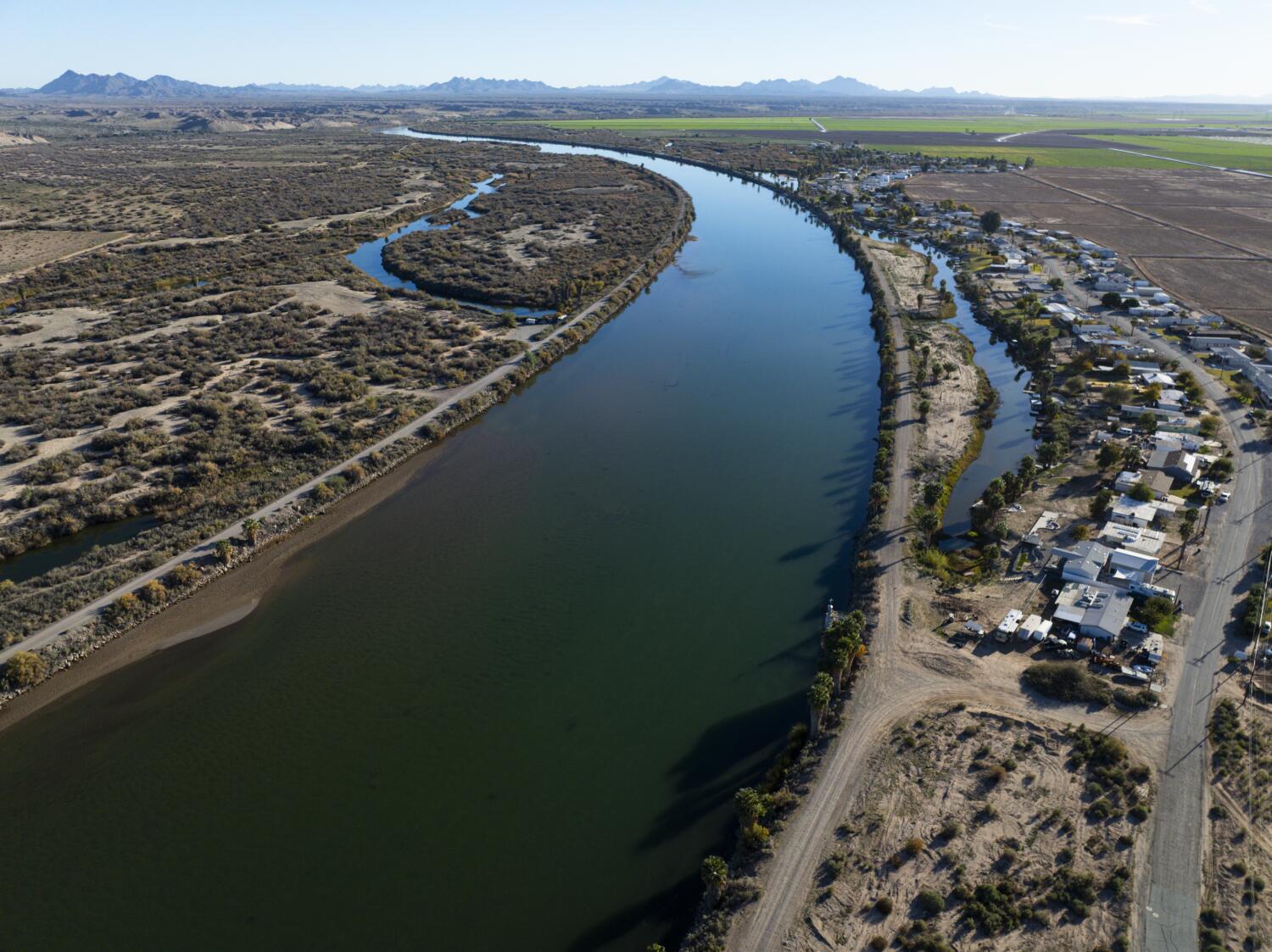
The Colorado River isn't dying because of a "deadline" or a "megadrought." It is being systematically liquidated by a pricing model that treats a finite, non-renewable asset like a public buffet at 2:00 AM.
Competitor narratives love the drama of a falling water line. They zoom in on the bathtub rings at Lake Mead and Lake Powell, using them as visual shorthand for an impending apocalypse. They tell you that "dead pool" is the monster under the bed. They blame the climate, they blame the Bureau of Reclamation, and they blame "inaction." Recently making headlines recently: The Kinetic Deficit Dynamics of Pakistan Afghanistan Cross Border Conflict.
They are wrong. The river is exactly where it should be given the math we’ve applied to it. We aren't suffering from a lack of water; we are suffering from a surplus of stupidity in how we value it.
The Colorado River is the most engineered, litigated, and subsidized plumbing system on the planet. If you want to fix it, stop looking at the clouds. Look at the ledger. Additional details on this are explored by The Washington Post.
The Myth of the "Deadline"
Every few months, a new "critical deadline" passes. The headlines scream about federal intervention and the failure of the seven basin states to reach a consensus. These deadlines are theater.
Negotiations fail because the current system rewards failure. As long as the federal government keeps bailing out agricultural interests and paying "conservation" subsidies, no one has a reason to change their behavior. We are currently paying people not to use a resource they shouldn't have been using in such quantities in the first place.
It’s a circular economy of waste. We subsidize the water, then we subsidize the crop, then we subsidize the fallowing of the land when the water runs out. If you want to see the river recover, you don't need another interstate pact. You need a market clearing price.
Alfalfa is a Luxury We Can No Longer Afford
Let's address the 80% problem. Roughly 80% of the Colorado River's diverted water goes to agriculture. Of that, a massive chunk goes to forage crops like alfalfa and hay.
We are literally exporting the Colorado River to Saudi Arabia and China in the form of compressed green cubes to feed cows. This isn't "feeding the world." This is a massive arbitrage play where foreign entities and domestic corporate farms exploit "senior water rights" established in 1922—a year when the river’s flow was measured during an abnormally wet period.
The Law of the River is a suicide pact based on bad data. In 1922, the Colorado River Compact estimated the annual flow at 17.5 million acre-feet. Modern reconstructions of tree-ring data show the long-term average is closer to 13 or 14 million, and in the era of aridification, we're lucky to see 12.
We are over-allocated by millions of acre-feet every single year. You can’t negotiate with a dry bed.
The Fallacy of Urban Water Conservation
You’ve seen the commercials. "Turn off the tap while you brush your teeth." "Rip out your lawn for a $3 rebate."
While Las Vegas and Phoenix have actually done an admirable job of decoupling population growth from water consumption, urban conservation is a rounding error. If every person in Los Angeles stopped showering tomorrow, the river would still be in crisis.
The "we're all in this together" mantra is a shield for the industrial-scale users who consume more in a weekend than a suburban neighborhood does in a year. By focusing on the individual’s shower habits, we avoid the uncomfortable conversation about the Imperial Irrigation District and the Central Arizona Project.
True conservation doesn't happen at the faucet. It happens at the headgate.
Why "Dead Pool" is Actually an Opportunity
The media treats "dead pool"—the point where water can no longer flow through the dams to generate power or reach downstream users—as the end of civilization.
It’s actually the only thing that will force a structural reset.
As long as the dams keep spinning and the water keeps flowing to the Coachella Valley, the status quo remains profitable. Dead pool is the ultimate margin call. It is the moment when the "paper water" (rights written on napkins a century ago) meets "wet water" (the actual H2O in the pipe).
When the power stops, the subsidies stop. When the subsidies stop, the economics of growing water-intensive crops in a desert evaporate.
The Pricing Solution: A Brutal Market Correction
If you want to save the Colorado River, you have to kill the "Right."
The concept of "Prior Appropriation"—the "first in time, first in right" doctrine—is a relic of the 19th century that has no place in a 21st-century economy. It prevents water from moving to its highest and best use.
Imagine a scenario where water was traded on an open, transparent spot market.
- Tiered Pricing: Basic human needs are met at a low, subsidized rate.
- Industrial/Agricultural Pricing: Every drop beyond the basics is priced at the cost of desalination or alternative sourcing.
- Internalizing the Externality: If you pump from the river, you pay for the restoration of the Delta.
Currently, we treat water as a free commodity with a delivery fee. That is fundamentally broken. If an acre-foot of water costs $20 for a farmer but $1,000 for a microchip manufacturer, the farmer will always flood-irrigate their field because it's cheaper than installing drip systems.
The moment you price water at its true replacement value, the alfalfa disappears. The lawns disappear. The river stays in the channel.
Stop Blaming the Drought
"Drought" implies a temporary condition. It suggests that eventually, the rain will return and we can go back to 1950s-style management.
This isn't a drought; it’s aridification. The baseline has shifted.
The U.S. Bureau of Reclamation spent decades building "The Great Plumbing Store" (the dam system) based on the assumption that we could control nature through concrete. We can’t. The river is reverting to its mean, and our infrastructure is designed for a ghost version of the West that no longer exists.
The Tech Mirage: Desalination and Pipelines
Whenever this topic comes up, someone suggests a pipeline from the Mississippi or a massive desalination plant in Mexico.
These are engineering fantasies designed to avoid changing our behavior. The energy intensity of moving water over the Rockies or stripping salt from the Sea of Cortez is staggering.
$$E = \frac{P \cdot Q}{\eta}$$
Where $E$ is the energy required, $P$ is the pressure (or head height), $Q$ is the flow rate, and $\eta$ is the efficiency. To lift water from sea level to the high desert requires more electricity than the dams currently produce. It is a thermodynamic nightmare.
We don't have a supply problem. We have a demand problem fueled by a pricing hallucination.
The Brutal Path Forward
We need to stop talking about "saving" the reservoirs and start talking about decommissioning them.
Lake Powell is a giant, leaking evaporation pond. We lose roughly 6% of the river's total flow to evaporation and seepage at Glen Canyon. In a world of scarcity, storing water in a high-surface-area desert bowl is insanity.
Move the water downstream to Lake Mead. Fill one bucket instead of two. Let Glen Canyon emerge from the silt.
This is the nuance the "consensus" articles miss: The reservoirs are declining because they are inefficient tools for a new climate. The "deadline" is irrelevant because the physics of the basin have already made the decision for us.
The river is done being your subsidized hobby. Pay the market rate or get out of the way.
Stop looking for a compromise. Start looking for a liquidator.