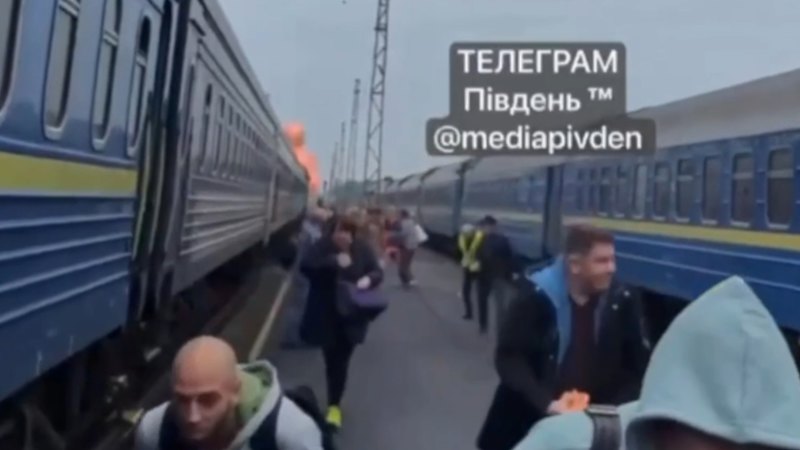
Every time a Western politician steps off a train in Ukraine and a missile lands somewhere in the same oblast three hours later, the commentariat loses its collective mind. Headlines flash across screens with breathless urgency, framing standard wartime logistics as a near-death Hollywood thriller. The implication hangs thick in the digital air: Moscow tracked the VIP carriage, timed the blast down to the minute, and missed by a hair. It is a seductive narrative. It sells clicks, boosts ratings, and feeds the comic-book binary of modern cable news where every geopolitical actor plays a premeditated role in a personal feud.
It is also complete nonsense.
When Boris Johnson—or any other visiting dignitary making the obligatory pilgrimage to Kyiv—rides the Ukrzaliznytsia rail network, they are not dodging a sniper scope aimed directly at their carriage. They are riding a massive, hyper-targeted critical infrastructure grid that Russia attempts to dismantle every single day, regardless of who is waving from the platform. To suggest that a missile strike near a train station shortly after a VIP departure represents a personal near-miss is a fundamental misunderstanding of how modern industrial warfare operates, how military intelligence prioritizes targets, and how cynical political optics shape wartime reporting.
Let us dismantle the lazy consensus piece by piece.
The Logistics Myth of the VIP Target
To understand why the assassination narrative collapses under scrutiny, you have to look at the sheer scale of Ukraine's railway system. Ukrzaliznytsia is the backbone of the entire nation. It moves millions of tons of grain, industrial steel, humanitarian aid, and hundreds of thousands of troops across a country the size of France. It is an arterial network of thousands of kilometers of track, hundreds of switching yards, and dozens of major hubs.
Russia knows this. From the opening weeks of the invasion, Russian doctrine has targeted transportation nodes, electrical substations, and marshalling yards to paralyze logistics. They do not need a former British prime minister to visit a station to justify launching a cruise missile or a drone swarm at a rail hub. They hit those hubs on Tuesday, Wednesday, Thursday, and every other day of the week, rain or shine, VIP or no VIP.
When a strike occurs hours after a high-profile departure, media outlets commit the classic logical fallacy of confusing correlation with causation. In a war zone experiencing daily missile saturation, overlapping timelines are a statistical certainty. If you throw darts at a calendar of daily infrastructure strikes in Ukraine, you will inevitably find a politician visiting a city somewhere in the country within a 24-hour window of an explosion. To stitch those two data points together into an intentional assassination plot requires a profound ignorance of military targeting protocols.
The Zero-Sum Math of Escaped Assassinations
Consider the risk-reward ratio from the Kremlin's perspective. What would be the strategic outcome if a Russian missile actually vaporized a former British prime minister on a Ukrainian platform?
It would be the geopolitical equivalent of kicking a hornets' nest while doused in gasoline. Article 5 invocations, immediate mobilization of frozen Russian assets, deployment of advanced long-range strike packages previously withheld, and an irreversible hardening of Western political will would follow within the hour. For a regime obsessed with operational calculus and self-preservation, killing a high-profile British citizen—even one out of office—offers zero tactical upside and catastrophic strategic downside. It is an invitation to direct NATO intervention wrapped in a smoking crater.
Intelligence agencies do not operate on cartoonish movie logic where villains execute high-risk, low-reward stunts just to send a message. If Moscow wanted Boris Johnson dead, they would not use an indiscriminate Iskander missile on a multi-use railway hub where the margin for error is astronomical and the blowback is existential. The idea that Russian spotters watched him sip instant coffee in a station lounge, called in a strike, and missed by thirty minutes is a narrative designed for people who consume war like a Marvel movie.
The Theater of Wartime Tourism
Why do these visits happen at all, then? Why do politicians continue to ride overnight trains into a war zone, fully aware of the sirens and the air defense batteries?
Because political survival requires high-definition symbolism.
Let us be brutally honest about the nature of these trips. I have watched politicians spend decades calculating the exact visual ROI of a photo-op. A train station in Kyiv offers the ultimate backdrop: gritty, defiant, framed by sandbags, and radiating Churchillian resolve. It costs domestic political capital to ignore Ukraine, and it pays massive dividends to be photographed stepping out of a sleeper car wearing a fleece vest, shaking hands with local officials, and looking out over a scarred landscape.
Security details for these visits are massive, highly coordinated, and heavily choreographed. Both British and Ukrainian intelligence services manage these movements with obsessive precision. The timing of arrivals and departures is rarely left to chance; routes are shifted, communications are locked down, and decoys are frequently utilized. When a strike hits near a station after a departure, it is often precisely because the security apparatus ensured the VIP was long gone before the predictable retaliatory or routine schedule disruption took place.
The danger is real, but it is ambient. It is the baseline hazard of existing in a nation under daily bombardment. By dressing up this ambient hazard as a targeted near-miss, media outlets transform a routine security protocol into high drama.
The PAA Trap: Answering the Wrong Questions
If you type inquiries about these high-profile visits into search engines, the autofill suggestions read like a symptom of mass delusion. People ask:
- Was Boris Johnson the target of the missile strike?
- How did Russia know his exact schedule?
- Why do politicians keep risking their lives on Ukrainian trains?
Let us dismantle each premise with blunt realism.
Was he the target? No. Unless you believe Russian tactical planners possess crystal balls and a death wish for their own command structure, a former prime minister traveling under maximum security is the last thing they want to vaporize.
How did they know his schedule? They didn't need to know his schedule because they were already targeting the logistics grid. Hitting a railway junction is standard operating procedure for an air campaign designed to strangle regional transit.
Why do politicians risk their lives? Because the risk is managed down to an acceptable actuarial threshold, and the domestic political payoff of looking brave in front of a train station outweighs the statistical probability of a direct hit.
The questions themselves are framed by an industry that profits from turning complex military logistics into a personalized soap opera. When you ask whether a politician was hunted, you miss the systemic reality that everyone in Ukraine is under the gun, every single day, whether a VIP is in town or not.
The Complicity of the Media Machine
Journalism covering the war in Ukraine faces a constant temptation: normalization fatigue. When a conflict grinds on for years, audiences stop clicking on articles headlined "Routine Missile Strike Hits Electrical Substation in Kharkiv." That is grim, grinding attrition, and it bores the algorithm.
Enter the VIP visit.
Suddenly, the war has a protagonist. It has a narrative arc. A familiar face steps off a train, alarms wail, an explosion echoes in the distance, and the desk editors back in London or New York suddenly have their front-page splash. The article writes itself: Tension as Ex-PM Evacuates After Blast.
This style of reporting commits a profound disservice to the reality on the ground. It personalizes a structural catastrophe. It suggests that the violence in Ukraine is driven by personal vendettas, near-miss dramas, and high-stakes duels between political figures, rather than industrial-scale artillery exchanges and systemic infrastructure destruction. It turns a war zone into a stage set.
The Uncomfortable Truth About Risk and Reality
Let us strip away the mythology.
When a missile lands near a railway station after a high-profile departure, it is not a failed assassination. It is Tuesday in an invaded country. It is the predictable intersection of a degraded civilian infrastructure grid, a relentless aerial bombardment campaign, and the theatrical necessities of Western political marketing.
The politicians who take these train rides are not fearless heroes dodging death by seconds; they are calculated risk-takers engaging in high-yield diplomatic theater, protected by sophisticated intelligence bubbles that keep them statistically safer inside Kyiv than many civilians driving on highways in Western capitals.
Stop buying the script. Stop looking for the cinematic plot twist in every routine logistical explosion. The reality of war is far more boring—and far more brutal—than any thriller script Hollywood could dream up. It is not about personal targets or narrow escapes. It is about steel, concrete, fire, and the relentless machinery of attrition grinding on long after the VIP has boarded the return train and the cameras have turned off.