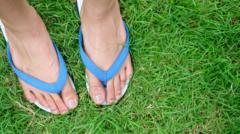
For decades, the footwear industry has sold a simple, profitable lie: your feet are fragile, broken structures that require maximum structural containment to survive a walk to the mailbox. Every summer, the mainstream wellness press trots out the predictable panic piece warning that flat summer sandals are destroying your arches, ruining your posture, and sentencing you to a lifetime of plantar fasciitis.
It is absolute nonsense.
The standard warning against summer sandals relies on a lazy consensus built by brands selling rigid motion-control sneakers and expensive custom orthotics. They want you to believe that the human foot needs a permanent plaster cast disguised as a shoe. I spent years buying into this myth, wearing stiff-soled running shoes in ninety-degree heat because some magazine told me my flat feet needed an artificial arch. All it bought me was weaker muscles, deadened sensory feedback, and feet that felt crippled the moment I stepped onto a beach barefoot.
Let us look at the actual biomechanics instead of the marketing copy.
The Anatomy of a Foot That Does Not Need Your Help
Your foot contains twenty-six bones, thirty-three joints, and over a hundred muscles, tendons, and ligaments. It is an engineering marvel designed to adapt to varied terrain. When you lock it inside a rigid shoe with a thick midsole and a fake arch, you switch off the intrinsic muscles responsible for stabilizing your entire lower kinetic chain.
The conventional health advice warns that flat sandals lack arch support. That is precisely why they are valuable.
An arch is not a static bridge that needs a prop underneath it to keep from collapsing. It is a spring. A spring works by storing and releasing energy through tension. When you slide your foot into a stiff, cushioned orthotic shoe, you remove the load from the spring. Use it or lose it applies to connective tissue just as much as it applies to biceps. By propping up the arch artificially, you atrophy the very structures meant to support your body weight independently.
Now, does this mean you can strap on a pair of paper-thin, unsupportive flip-flops and run a marathon on concrete? Of course not. That is the straw man argument podiatrists love to deploy. The transition from heavily structured footwear to minimalist summer sandals requires a graduated approach. If your feet have spent twenty years in cushioned enclosures, jumping straight into zero-drop leather sandals for a ten-mile city hike will cause tendon strain. That is not a flaw in the sandal; that is a symptom of your deconditioned feet.
Why Podiatrists Love Orthotics and Hate Reality
Let us address the medical establishment in the room. Podiatry has a vested interest in foot pathology. If everyone realized that foot pain is frequently a byproduct of hyper-cushioned shoes rather than a lack of them, half the custom orthotic business model would collapse overnight.
When a patient walks into a clinic with arch pain, the standard protocol is rarely to ask about foot strengthening or intrinsic muscle activation. The default reflex is to hand out a prescription for a rigid piece of plastic molded to fit a collapsed, deconditioned foot in its worst possible state. You are treating the symptom while worsening the root cause. You are putting a crutch on a sprained ankle and leaving it there for a decade until the leg withers away.
Imagine a scenario where you broke your arm and the doctor put you in a cast for the rest of your life. You would lose your muscle mass, your shoulder mobility would freeze, and your bones would lose density. Yet we do this to our feet every single day under the banner of orthopedic health.
The Sensory Deprivation Chamber on Your Feet
Your feet are densely packed with mechanoreceptors. These nerve endings send constant signals to your central nervous system about ground texture, pressure distribution, and spatial orientation. This sensory input is what allows your brain to calculate balance and adjust your stride in real-time.
Thick, bouncy foam soles and rigid orthotics act as noise-canceling headphones for your feet. They numb the conversation between your soles and the pavement. When your brain cannot feel the ground, your gait changes. You heel-strike harder because the cushion absorbs the immediate shock, transferring that unnatural force up through your shins, knees, and lower back.
Summer sandals—when chosen for flexibility and ground feel rather than pure fashion or zero structural integrity—restore that dialogue. They force your foot to interact with the terrain. Your toes splay. Your ankle stabilizers engage. Your posture adjusts naturally to compensate for uneven ground.
How to Wear Sandals Without Wrecking Your Body
If you want to ditch the bulky sneakers this summer without sidelining yourself with Achilles tendonitis, you have to approach the transition like any other physical conditioning program.
First, ditch the flimsy plastic thongs that require your toes to claw downward with every step just to keep them from flying off. You want sandals that secure the foot properly via straps across the instep and around the heel, allowing a natural, relaxed stride.
Second, respect progressive overload. Start by wearing your flat leather or cork-bed sandals for an hour a day around the house or running short errands. Do not jump straight into a twelve-hour walking tour of Rome on day one. Give your intrinsic foot muscles time to wake up from their decades-long hibernation.
Finally, accept the trade-off. True foot health requires vulnerability. You will feel small rocks. Your calves might ache slightly during the first week as your tendons stretch to their natural length. That is not an injury; that is adaptation.
The next time someone warns you that your summer sandals are destroying your feet, ask them why they think human beings walked across the earth for thousands of years without a gel insert. Stop outsourcing your biomechanics to multinational shoe corporations. Take off the crutches.