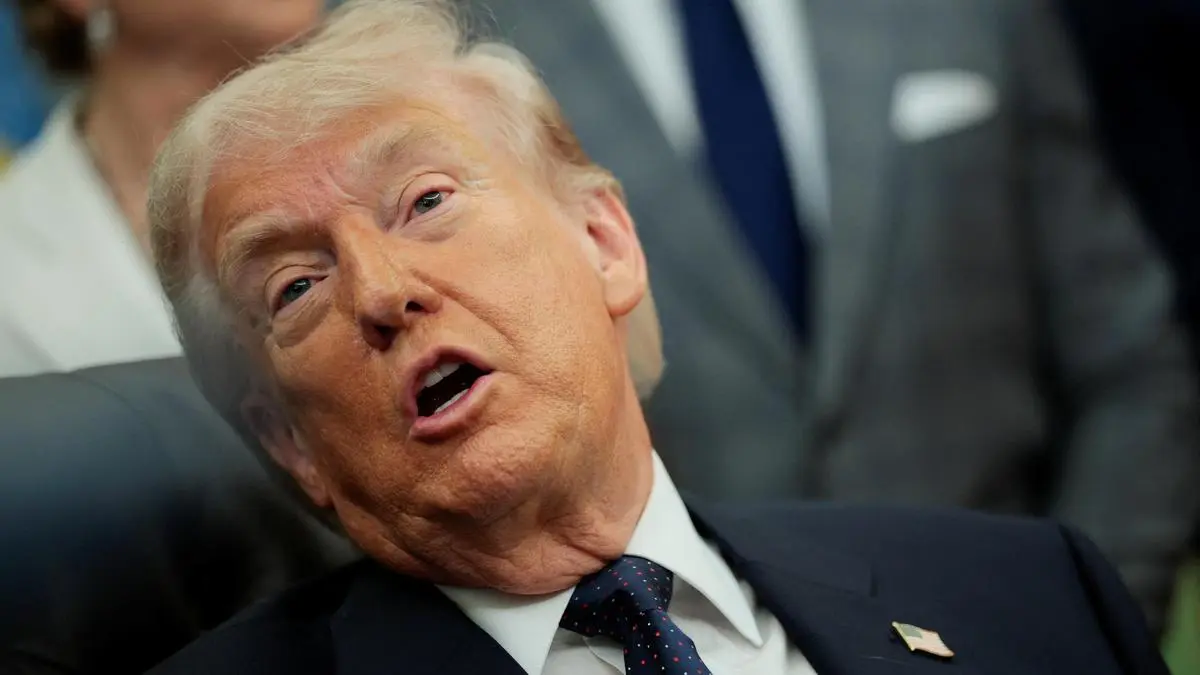
The proposed resolution to the long-standing friction between the United States and Iran under the Trump administration is not a diplomatic olive branch but a calculated exercise in strategic compulsion. The fundamental thesis of this peace proposal rests on the assumption that Iran’s internal economic degradation has finally intersected with its external overextension, creating a brief window where the cost of non-compliance exceeds the cost of a managed retreat. By deconstructing the proposal through the lenses of Economic Asymmetry, Kinetic Deterrence, and Regional Hegemony Trade-offs, we can quantify the likelihood of a "swift end" to hostilities and the structural barriers that remain.
The Tri-Pillar Framework of the US Proposal
The US strategy operates through three distinct mechanisms of pressure. To understand the "swiftness" Trump anticipates, one must evaluate how these pillars interact to constrict Tehran’s decision-making space.
1. The Maximum Pressure 2.0 Sanction Delta
Unlike previous iterations, the current proposal uses sanctions as a variable dial rather than a static wall. The primary mechanism is the targeting of secondary insurance markets and dark-fleet logistics. Iran’s current fiscal architecture relies on the ability to move roughly 1.2 to 1.5 million barrels of crude daily via non-traditional channels. The proposal demands a "zero-export" floor in exchange for the immediate unfreezing of $10 billion to $15 billion in escrowed assets.
The analytical gap in most reporting is the failure to recognize this as a liquidity-for-sovereignty swap. Iran faces a projected inflation rate exceeding 40%; the proposal leverages this internal instability to force a rapid signature.
2. The Credible Threat of Kinetic Escalation
The Trump administration’s doctrine differs from traditional containment by prioritizing asymmetric retaliation. The peace proposal is implicitly backed by a "Shift-to-Target" model. If negotiations stall, the US signals a transition from hitting proxies (the Houthis, Hezbollah) to direct infrastructure strikes within Iranian borders—specifically energy terminals and the Bushehr nuclear facility. This creates a binary choice for the Iranian Supreme Council:
- Acceptance: Preservation of the regime's core physical infrastructure.
- Rejection: Risking the total decapitation of the Islamic Revolutionary Guard Corps (IRGC) economic assets.
3. The Abraham Accords Expansion
The third pillar is the encirclement of Iran through the normalization of relations between Israel and major Arab powers. This creates a Regional Security Architecture that functions as a containment vessel. By integrating air defense systems across the Gulf, the US reduces Iran’s primary leverage—its ballistic missile and drone inventory. The proposal offers Iran a way out of this isolation by suggesting a "limited integration" into regional trade, provided it halts its nuclear enrichment programs.
The Economic Calculus of Iranian Compliance
For Iran to review and potentially accept a US peace proposal, the Regime Survival Function must yield a positive value. We can express this tension through a basic cost-benefit model where $S$ represents Regime Survival:
$$S = f(E + R) - (I + C)$$
Where:
- $E$ = Economic Stability (Liquidity and trade flow)
- $R$ = Religious/Ideological Legitimacy
- $I$ = Internal Dissent (Protests and civil unrest)
- $C$ = External Conflict Cost (War with the US/Israel)
The proposal aims to maximize $E$ while threatening to maximize $C$. The bottleneck for Tehran is that $R$ (ideological legitimacy) is often inversely proportional to $E$ if economic stability requires "capitulating" to the "Great Satan." The US strategy seeks to make $C$ (Conflict Cost) so high that the loss of $R$ becomes the lesser of two evils for the Supreme Leader.
Structural Fault Lines in the "Swift End" Theory
The claim that a war can end "swiftly" ignores the proxy-debt trap. Iran does not operate in a vacuum; it manages a sprawling network of non-state actors. A rapid peace agreement creates several logical inconsistencies that the competitor's article failed to address.
The Hezbollah-Hamas Decoupling Problem
The US proposal likely demands a cessation of funding for regional proxies. However, these groups are not just tools of Iranian foreign policy; they are deep-seated ideological extensions. If Tehran cuts funding abruptly:
- Vacuum Risk: Radical factions within these groups may seek funding from more extremist or non-state sources.
- Credibility Collapse: Iran loses its "Forward Defense" doctrine, leaving the mainland vulnerable to conventional invasion.
The Nuclear Breakout Paradox
The proposal requires Iran to revert to 3.67% enrichment levels and allow permanent IAEA access. From a game theory perspective, Iran’s nuclear progress is its only real bargaining chip. To trade it away for "peace" is to disarm before the final terms are settled. The "swiftness" of any deal is therefore limited by the technical timelines of decommissioning centrifuges and the verification protocols required to build trust.
The Role of External Power Competitors
A critical oversight in standard political analysis is the role of China and Russia in the Iran-US equation. Iran has signed a 25-year strategic partnership with China, which serves as a geopolitical shock absorber.
- China’s Arbitrage: As long as China buys Iranian oil, even at a discount, the "Maximum Pressure" has a ceiling. China benefits from a low-level conflict that distracts US naval assets from the Indo-Pacific.
- Russia’s Interdependence: With the ongoing conflict in Ukraine, Russia relies on Iranian drone technology (Shahed series). Moscow has a vested interest in preventing a US-brokered peace that would pivot Iranian manufacturing away from the defense sector or see Tehran lean toward Western energy markets.
The US proposal must, therefore, offer China a reason to stop backstopping the Iranian economy, likely through trade concessions or energy security guarantees in the Strait of Hormuz.
Quantifying the Probability of Success
If we analyze the variables, we can categorize the possible outcomes into three scenarios based on the current proposal’s trajectory.
Scenario A: The "Grand Bargain" (Probability: 15%)
A comprehensive deal where Iran freezes its nuclear program, limits missile range to 2,000km, and stops proxy funding in exchange for total sanction removal and a seat at the regional security table. This is the "swift end" Trump envisions. It is unlikely because it requires the IRGC to dismantle its own power base.
Scenario B: The "Functional Freeze" (Probability: 55%)
A series of informal "understandings." Iran slows enrichment and orders proxies to reduce attacks on US assets. In return, the US "blind-eyes" certain oil shipments and releases specific frozen funds. This is a stalemate rebranded as a peace proposal. It prevents total war but does not end the underlying conflict.
Scenario C: The "Breakout Escalation" (Probability: 30%)
Iran reviews the proposal and finds the terms equivalent to a "managed surrender." They accelerate enrichment to 90% (weapons grade) to force a better deal. This triggers the US kinetic response, leading to a regional conflagration rather than a swift end.
The Strategic Path Forward
The "peace proposal" is better understood as a strategic ultimatum. For the US to achieve a definitive victory without a kinetic invasion, it must shift from a policy of punishment to a policy of structural substitution.
- Infrastructure Alternative: The US and its allies must offer Iran a path to becoming a primary energy hub for Central Asia, shifting its economic dependence from illicit oil sales to legitimate transit and gas exports.
- Security Guarantees: Any "swift" deal must include a non-aggression pact that involves Israel. Without Israeli buy-in, any US-Iran agreement will be sabotaged by regional sabotage or cyber warfare.
- Internal Market Incentives: The proposal should target the Iranian middle class, offering direct technological and educational integration that creates bottom-up pressure on the regime to maintain the peace.
The success of the Trump proposal will not be measured by the signature on a document, but by the speed at which it can dismantle the IRGC’s monopoly on the Iranian economy. Until the cost of maintaining the status quo exceeds the cost of a radical pivot, "swiftness" remains a political aspiration rather than a geopolitical reality. The next 180 days of maritime activity in the Persian Gulf and enrichment levels at Natanz will serve as the primary data points for whether this proposal has teeth or is merely a tactical delay.