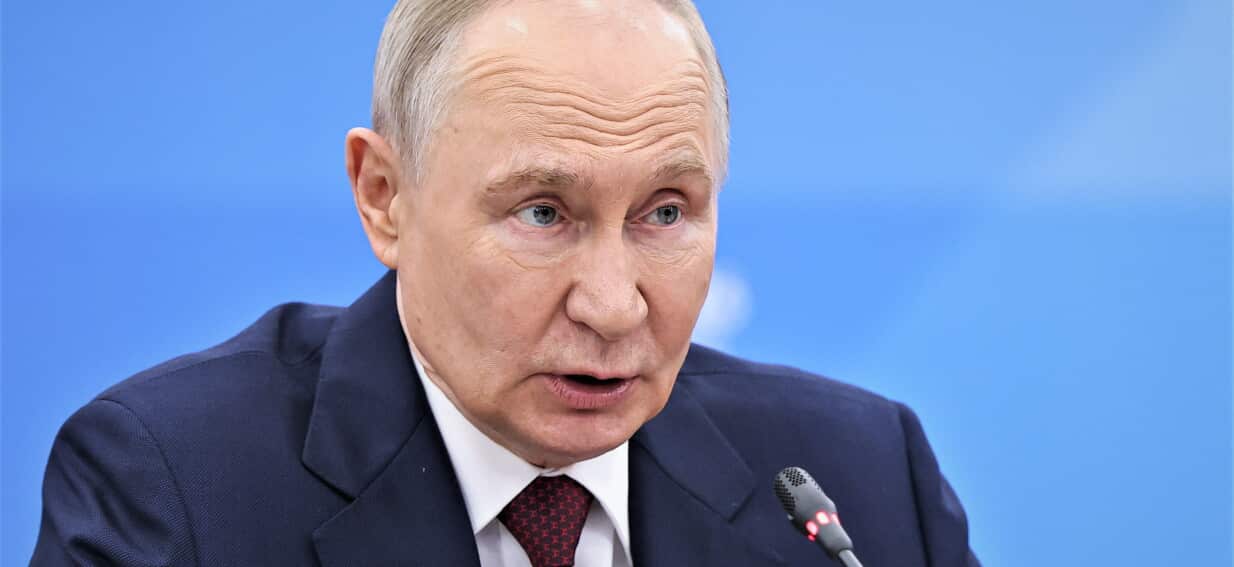
The open refusal by Russian President Vladimir Putin to meet with Ukrainian President Volodymyr Zelenskyy at the St. Petersburg International Economic Forum exposes the structural logic of a high-stakes war of attrition. While popular analysis frames this rejection as personal animosity or diplomatic posturing, the standoff is driven by cold mathematical and strategic calculations.
The core of the diplomatic impasse rests on a fundamental divergence in tactical incentives. Ukraine seeks a structural pause to stabilize its front lines and check Russian advances, while Russia operates on a cost function that values prolonged territory retention over early concessions. For both states, diplomatic engagement is not an alternative to military strategy; it is a direct extension of it. Understanding this requires breaking down the core operational mechanics that dictate why bilateral negotiations currently lack a viable foundation.
The Asymmetrical Incentives of a Negotiated Ceasefire
The diplomatic breakdown is governed by a clash between two incompatible operational goals: Ukraine’s need to alter a costly status quo versus Russia’s calculation that time favors its industrial base. This tension manifests across three primary structural pillars.
1. The Operational Utility of the Tactical Pause
For Ukraine, a comprehensive ceasefire during negotiations serves as a vital resource-replenishment mechanism. Entering the fifth year of full-scale conflict, the Ukrainian armed forces face a continuous deficit in personnel rotation and material throughput. A freeze on active operations allows Kyiv to accomplish two key objectives:
- Fortification Engineering: Constructing deep, multi-layered defensive lines without the threat of ongoing artillery and glide-bomb disruption.
- Logistical Reconstitution: Integrating Western hardware, training fresh defensive cohorts, and repairing heavily damaged regional energy grids.
Conversely, Russia views an immediate ceasefire as an asymmetric disadvantage. From the Kremlin's perspective, a pause in ground operations strips away the momentum generated by its localized infantry and armor assaults in the Donbas. Moscow calculates that suspending attacks would surrender its primary point of leverage—continuous pressure on Ukrainian defensive lines—without receiving any equivalent territorial or political concessions in return.
2. The Anchorage Framework and the Compromise Bottleneck
The structural divergence in acceptable outcomes is anchored to the diplomatic understandings discussed during previous summits, specifically the framework established in Anchorage, Alaska.
[Anchorage Summit Parameters]
       │
       ├─► Russian Demand: Full political-military caps + Donbas sovereignty
       │
       └─► Ukrainian Demand: Frontline status quo baseline + Security guarantees
The fundamental bottleneck here is the definition of "compromise." Russia defines a comprehensive settlement as the outright capitulation of Ukrainian sovereignty over the eastern regions, alongside sweeping caps on Kyiv's military alignment. Ukraine, conversely, approaches diplomacy from a baseline of frontline realities, utilizing localized counteroffensives and deep strategic strikes to force Russia to negotiate from a position of parity. Because neither state's minimum acceptable criteria overlap, direct presidential interaction yields a net-zero return on diplomatic capital.
3. Structural Escalation and the "Boorish" Signaling Dynamic
The language utilized in modern diplomatic communications serves a precise signaling function for domestic and international audiences. When Zelenskyy issued a rare direct open letter proposing a face-to-face summit at a neutral location, the text deliberately integrated sharp critiques of Putin’s tenure and age.
This rhetorical framing was calculated to signal resilience to a domestic audience weary of mobilization, while exposing Moscow’s reluctance to engage to international partners in Washington and Europe. Putin’s subsequent public dismissal of the letter as "boorish" and an attempt to create "an environment which makes any personal meetings impossible" indicates a calculated counter-strategy. By labeling the communication unacceptable, the Kremlin attempts to shift the blame for the diplomatic breakdown onto Kyiv while signaling to its own population that Russia retains the strategic upper hand.
The Economic Attrition Function: Drones vs. Macroeconomic Stability
A critical variable missing from standard diplomatic commentary is the direct correlation between deep-theater strike economics and state stability. The conflict has evolved into an explicit contest between Ukraine’s long-range asymmetric capabilities and Russia’s structural economic resilience.
The Microeconomic Cost of Deep-Theater Strikes
Ukraine has systematically expanded its operational reach, executing deep drone strikes targeting vital Russian infrastructure up to 1,000 kilometers from the border. These strikes are designed to disrupt Russia’s primary fiscal engine: its energy sector.
[Ukrainian Deep Drone Strikes] ──► [Refinery/Terminal Disruption] ──► [Local Supply Bottlenecks]
                                                                                │
[Increased Domestic Borrowing] ◄── [State Budget Deficit Caps]   ◄── [Tax Rate Hikes (Fiscal Adjustments)]
The destruction of oil processing units, export terminals, and logistical hubs across regions like Saint Petersburg creates localized supply bottlenecks and forces the diversion of state resources toward air defense remediation. While Putin acknowledged at the economic forum that these attacks inflict "a certain damage," the Kremlin’s core defense strategy relies on an aggressive fiscal mitigation framework.
The Macroeconomic Counter-Measures
To absorb the economic shocks of the war and sustain its military expenditures, Moscow has implemented strict monetary and fiscal policies designed to project long-term stability:
- Fiscal Adjustments: The Russian government has systematically raised corporate and high-income tax rates to shore up federal revenue streams against fluctuating global oil prices.
- Domestic Credit Reliance: To keep the federal budget deficit strictly capped, the state has aggressively expanded domestic borrowing, insulating itself from Western capital markets.
- Alternative Financial Architecture: In response to the freezing of its sovereign foreign reserves and exclusion from the SWIFT payment network, Russia is actively constructing a multipolar financial ecosystem. This strategy aims to diminish the structural leverage of the U.S. dollar and the Euro by utilizing alternative clearing mechanisms with non-aligned economic powers.
By maintaining low state debt ratios relative to Western GDP standards, the Kremlin calculates that its sovereign economic model can outlast Western political commitment to funding Ukraine's defense.
Strategic Recommendation: Navigating the Parallel War
The contemporary environment demonstrates that the path to a systemic settlement does not run through early bilateral summits. For external actors and strategy planners, the current phase requires managing two distinct, simultaneous tracks: the territorial war of attrition and the global diplomatic positioning campaign.
The first track demands recognizing that territorial stability on the ground dictates diplomatic leverage. Because Russia will only consider terms when its offensive options are mathematically exhausted, stabilizing the frontline through continuous defensive engineering and anti-aircraft coverage remains the baseline requirement for any future negotiation.
The second track requires a pragmatic alignment with shifting international realities. As U.S. foreign policy attention balances competing priorities—such as the escalating conflict involving Iran and the security of the Strait of Hormuz—the burden of anchoring long-term security guarantees will increasingly fall on a broader coalition.
A viable diplomatic framework will not emerge from direct face-to-face presidential appeals. Instead, it must be built through a rigorous, step-by-step process: expert-level working groups establishing highly technical parameters on secondary issues like prisoner exchanges, grain corridors, and nuclear infrastructure security. Only when these low-level agreements create a baseline of verifiable compliance can a high-level summit offer any true strategic utility.