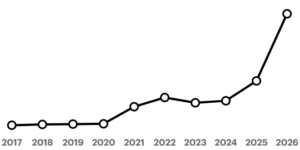
The United Arab Emirates (UAE) currently manages a sovereign wealth aggregate exceeding USD 2 trillion, a figure that serves as a firewall against the volatility of the Levant and Red Sea corridors. While regional instability typically triggers capital flight and currency devaluation in emerging markets, the UAE’s fiscal architecture is designed to decouple domestic economic performance from regional geopolitical risk. This decoupling is not accidental; it is the result of a deliberate transition from a resource-dependent economy to a global capital aggregator.
Understanding this fiscal strength requires moving beyond the surface-level USD 2 trillion figure. The true measure of the UAE's stability lies in the Velocity of Diversification and the Liquidity-to-Liability Ratio of its primary investment vehicles. By analyzing the structural components of this wealth—primarily through the Abu Dhabi Investment Authority (ADIA), Mubadala, and the Investment Corporation of Dubai (ICD)—we can identify the specific mechanisms that allow the federation to maintain growth while surrounding markets face contraction.
The Tri-Pillar Architecture of UAE Sovereign Wealth
The USD 2 trillion asset base is not a monolithic fund. It is distributed across multiple entities with distinct risk profiles and mandates. This internal competition and specialization prevent the "concentration risk" that often plagues oil-rich nations.
1. The Intergenerational Savings Vehicle (ADIA)
ADIA functions as the primary shock absorber. Its mandate is long-term capital preservation, with an estimated portfolio distributed across global equities, fixed income, and alternative assets. Because its exposure to the Middle East is historically low compared to its global footprint, ADIA’s valuation remains largely immune to localized conflict. It acts as a counter-cyclical stabilizer; when regional oil revenues dip or security premiums rise, ADIA’s global dividends provide a consistent floor for the national balance sheet.
2. The Strategic Development Engine (Mubadala)
Mubadala represents the shift from passive investment to active industrial participation. Unlike a traditional hedge fund, Mubadala invests in sectors that provide "dual-value": financial returns and domestic industrial utility. Investments in semiconductor manufacturing (GlobalFoundries), aerospace, and renewable energy (Masdar) create a feedback loop that sustains the non-oil GDP. During periods of regional war strain, Mubadala’s role is to ensure that supply chains for high-tech sectors remain operational, effectively insulating the UAE's industrial ambitions from regional physical disruptions.
3. The Commercial Growth Driver (ICD and ADQ)
These entities focus on the operational efficiency of the UAE’s "national champions"—Emirates Airline, DP World, and Etisalat. The strength here is derived from infrastructure control. By owning the ports and the logistics hubs, the UAE ensures that even if regional trade routes are threatened, its own nodes remain the preferred points of entry for global commerce.
The Geography of Risk Neutralization
The UAE occupies a precarious geographic position, yet its economic strategy treats geography as a variable to be managed rather than a fixed constraint. The "War Strain" mentioned by observers typically affects a nation through three primary channels: increased insurance premiums, disrupted trade routes, and reduced Foreign Direct Investment (FDI). The UAE mitigates these through specific structural hedges.
The Maritime Redundancy Factor
The UAE has invested heavily in bypass infrastructure. The Habshan–Fujairah oil pipeline is a critical example. By allowing oil exports to reach the Gulf of Oman directly, bypassing the Strait of Hormuz, the UAE eliminates the single point of failure that defines the energy security of its neighbors. This physical redundancy translates directly into lower sovereign risk premiums.
Capital Flight Inversion
In most conflict zones, capital moves from the center of instability to global safe havens like London or New York. The UAE has positioned itself as the "Local Safe Haven." Through the Dubai International Financial Centre (DIFC) and Abu Dhabi Global Market (ADGM), the federation captures the capital fleeing other parts of the Middle East. Instead of losing liquidity during regional crises, the UAE often sees a net increase in deposit bases and family office relocations. The legal framework—based on English Common Law in these zones—provides the institutional trust necessary to keep capital within the region.
Quantifying the Non-Oil Multiplier
The assertion of financial strength is validated by the ratio of oil-derived revenue to non-oil GDP. For a sovereign state to be truly "strong" during war, its ability to service debt and fund government operations must be independent of the commodity prices that regional wars often destabilize.
The UAE’s non-oil sector now contributes over 70% of the total GDP. This shift changes the Sensitivity Analysis of the national budget. A $10 drop in oil prices no longer triggers a fiscal crisis; instead, it is offset by the growth in the services, tourism, and logistics sectors.
- Logistics Resilience: DP World’s global footprint means that even if Jebel Ali experiences a temporary slowdown, the parent company’s revenues from London, Rotterdam, and Dakar continue to flow back to the UAE balance sheet.
- Fiscal Buffer: The UAE maintains one of the lowest debt-to-GDP ratios globally. This provides the "dry powder" necessary to stimulate the economy if regional tensions cause a temporary private sector retreat.
Institutional Trust and the Regulatory Moat
A USD 2 trillion asset base is only as effective as the legal system that protects it. The UAE’s "Financial Strength" is a byproduct of its regulatory evolution. By implementing the Corporate Tax in 2023 and aligning with FATF (Financial Action Task Force) requirements to exit the "grey list," the UAE has signaled to global institutional investors that it is a transparent, predictable jurisdiction.
This transparency creates a Regulatory Moat. Competitors in the region may have high liquidity, but they often lack the sophisticated legal infrastructure required to host global headquarters. The UAE’s strength is therefore found in its "Stickiness"—the difficulty for businesses to leave once they have integrated into its ecosystem.
The Cost of Stability
Maintaining this position is not without expense. The "Security Premium" involves high military expenditure and intelligence capabilities to ensure that the physical safety of the hubs matches the fiscal safety of the banks. Furthermore, the UAE must manage the "Pegged Currency Risk." As the USD fluctuates, the UAE Dirham follows, which can occasionally hurt export competitiveness in non-oil sectors. However, the peg provides the currency stability essential for a global trading hub, particularly when neighboring currencies are experiencing hyperinflation or extreme volatility.
The Strategic Play: Capitalizing on Instability
The ultimate analytical takeaway is that the UAE does not merely "survive" regional strain; it uses its liquid position to acquire distressed or undervalued assets across the broader Middle East and North Africa (MENA) region.
The strategy for the next 36 months involves three specific maneuvers:
- Aggressive Infrastructure Acquisition: Using ADQ and Mubadala to purchase critical nodes (ports, telecommunications, energy grids) in Egypt, Jordan, and the Horn of Africa. This expands the UAE’s sphere of influence while providing a higher yield than traditional Western bonds.
- Digital Sovereign Identity: Transitioning from a physical hub to a digital finance leader. By leading in AI regulation and crypto-asset frameworks, the UAE intends to capture the next generation of global wealth that is untethered to physical geography.
- The Hydrogen Transition: Reinvesting oil surpluses into green hydrogen infrastructure. This ensures that the UAE remains an energy superpower in a post-hydrocarbon world, effectively future-proofing the USD 2 trillion valuation.
The UAE’s financial position is a masterclass in Risk Transmutation. It has taken the inherent instability of its home region and turned it into a competitive advantage by becoming the sole provider of institutional-grade stability in a 3,000-mile radius. Investors and analysts should focus less on the total asset value and more on the Reinvestment Rate of these funds into self-sustaining, non-extractive industries. The resilience is not in the gold or the oil; it is in the structural insulation of the capital itself.