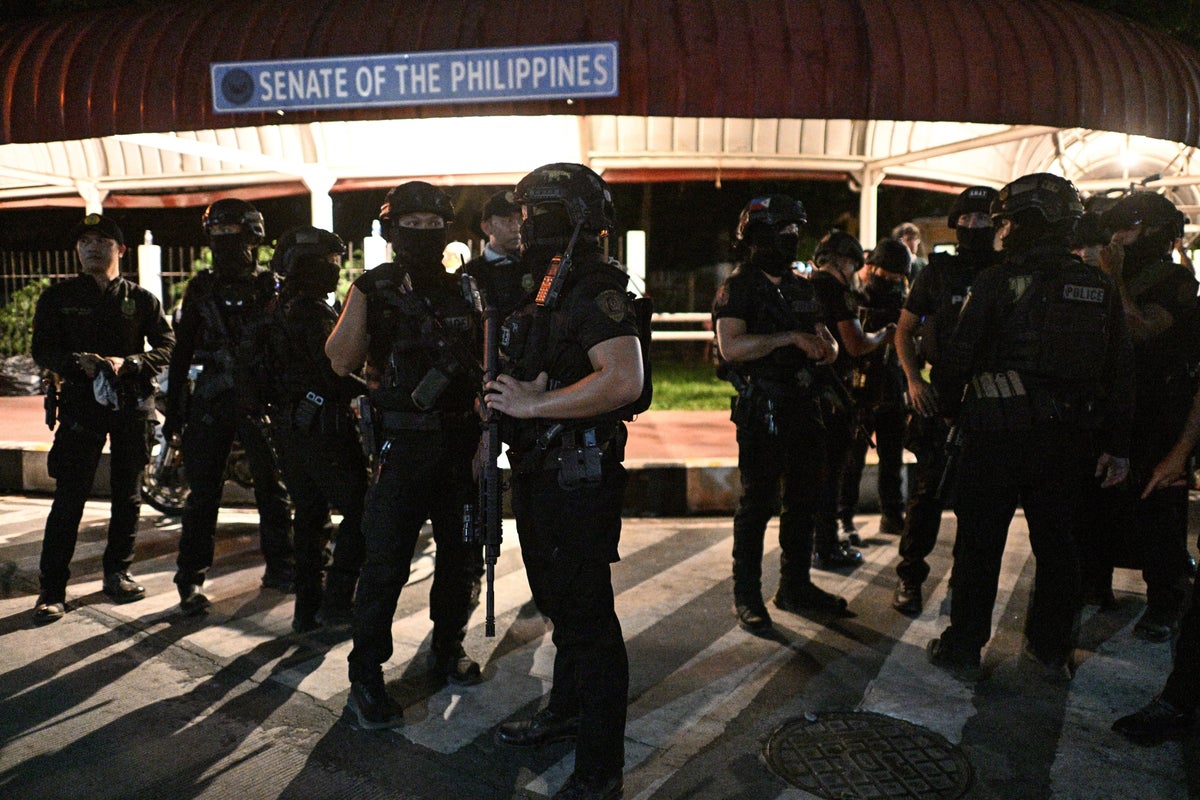
The discharge of firearms within the Philippine Senate complex signifies a terminal breakdown in the tacit security protocols that historically insulated the nation’s legislative elite from the violent mechanics of criminal procedure. This event is not merely a localized security breach; it is a manifestation of the Institutional Friction Model, where the executive branch’s mandate for law enforcement aggressively intersects with the legislative branch’s traditional role as a sanctuary for political actors. When the state attempts to execute high-stakes arrest warrants against former high-ranking police officials—individuals who possess deep integration within the security apparatus—the resulting conflict shifts from a legal dispute to a kinetic engagement.
The Triad of Jurisdictional Conflict
The attempted arrest of a former police chief within the Senate grounds highlights three specific fractures in the Philippine state’s internal logic. These fractures dictate the probability of violence in any future high-profile detention effort.
- The Sanctuary Paradox: Legislative buildings are symbolically designated as spaces of immunity. However, this immunity is often customary rather than constitutionally absolute regarding criminal felonies. When a suspect utilizes the Senate as a physical shield, it forces the executive branch into a binary choice: concede authority or violate the sanctity of the chamber.
- The Security Parallelism: High-ranking police veterans maintain loyalist networks within the very organizations tasked with their arrest. This creates a "dual-loyalty" bottleneck. The presence of armed private security details alongside official Senate security personnel introduces a variable of unpredictable command and control.
- The Escalation Ladder: The transition from service of a warrant to the exchange of gunfire follows a predictable path of failed negotiations. In this instance, the failure to establish a "cordon-and-wait" strategy led to a direct kinetic confrontation, suggesting a collapse in inter-agency communication.
Mechanisms of Tactical Failure in High-Value Arrests
The violence at the Senate provides a case study in the mismanagement of High-Value Target (HVT) extraction within civilian infrastructure. In urban warfare or high-stakes policing, the environment dictates the outcome. The Senate's architectural layout—characterized by narrow egress points and high-density public areas—makes it an objectively poor choice for a forced entry team.
The tactical failure can be quantified through the Asymmetric Risk Gradient. The arresting officers faced a high risk of collateral damage and political blowback, while the target’s security detail operated under a "nothing-to-lose" psychological profile. This imbalance frequently results in the early discharge of firearms as a means of establishing dominance or creating a diversion for extraction.
The Logistics of the Standpoint
Three variables defined the physical encounter:
- Response Latency: The time between the initial entry and the first shot fired indicates the level of resistance encountered. A short latency suggests an immediate refusal to comply, forcing the police to escalate force.
- Ordnance Disparity: Reports of the caliber used suggest that the target’s security was equipped for a sustained firefight, rather than simple defensive posturing. This indicates a premeditated strategy to resist state authority through lethal means.
- Perimeter Integrity: The fact that shots were fired within the complex proves that the initial perimeter set by Senate security was breached or bypassed, highlighting a critical vulnerability in legislative physical security.
The Political Economy of Murder Charges in the Police Hierarchy
To understand why a former police chief would risk a shootout in the Senate, one must analyze the Professional Continuity of Violence. Within the Philippine National Police (PNP), senior leadership often oversees operations that blur the line between state-sanctioned force and extrajudicial action. When the legal tide turns, these individuals do not view the judicial process as a neutral arbiter but as a tool of political liquidation.
The specific murder charges in question serve as the catalyst. In the Philippine context, murder charges against high-ranking officials are rarely about a single isolated incident; they are often the result of a shifting political alignment that renders previous "protective" umbrellas obsolete. The target’s resistance is a rational response to the perceived inevitability of a life sentence or targeted elimination within the prison system.
Breaking the Chain of Command
The incident reveals a deep-seated issue with Institutional Cohesion. When the police are ordered to arrest one of their own "fathers" of the service, the chain of command experiences significant "slippage."
- Information Leaks: It is highly probable that the target was aware of the impending arrest, allowing for the fortification of his position within the Senate.
- Hesitation Factor: Tactical teams often hesitate when facing a former superior, providing the target’s private security with the vital seconds needed to draw weapons.
- The Martyrdom Variable: For a political figure, a shootout in the Senate creates a narrative of persecution that a standard arrest in a private residence cannot achieve.
Structural Recommendations for Legislative Security
The current model of "gentlemanly" security within the Philippine Senate is fundamentally incompatible with the era of hyper-polarized criminal prosecution. To prevent a recurrence of kinetic conflict within the halls of power, the following structural shifts are required:
- Demilitarization of Private Details: The Senate must enforce a strict "zero-weapon" policy for the private security of its members and guests, regardless of their former rank. This removes the secondary power center that allows for armed resistance.
- Clear Jurisdictional Handover Protocols: There must be a codified, public document that dictates how the PNP and the Senate Sergeant-at-Arms interact during the service of warrants. Ambiguity in these moments is where the first shot is usually fired.
- The Extraction Buffer Zone: High-stakes arrests should be legally mandated to occur at designated "neutral" transfer points, removing the theater of the Senate as a backdrop for violence.
The event signals a new phase in Philippine governance where the physical boundaries of the law are no longer respected by those who once enforced them. The move from legal debate to gunfire within the Senate is the ultimate indicator of a state whose internal institutions are now in direct, violent competition with one another. The immediate priority is not the resolution of the murder case, but the re-establishment of the Senate as a space where the executive branch can execute the law without triggering a miniature civil war. Failure to do so will result in the permanent "bunkerization" of Philippine politics, where every legislative session becomes a potential theater of combat.