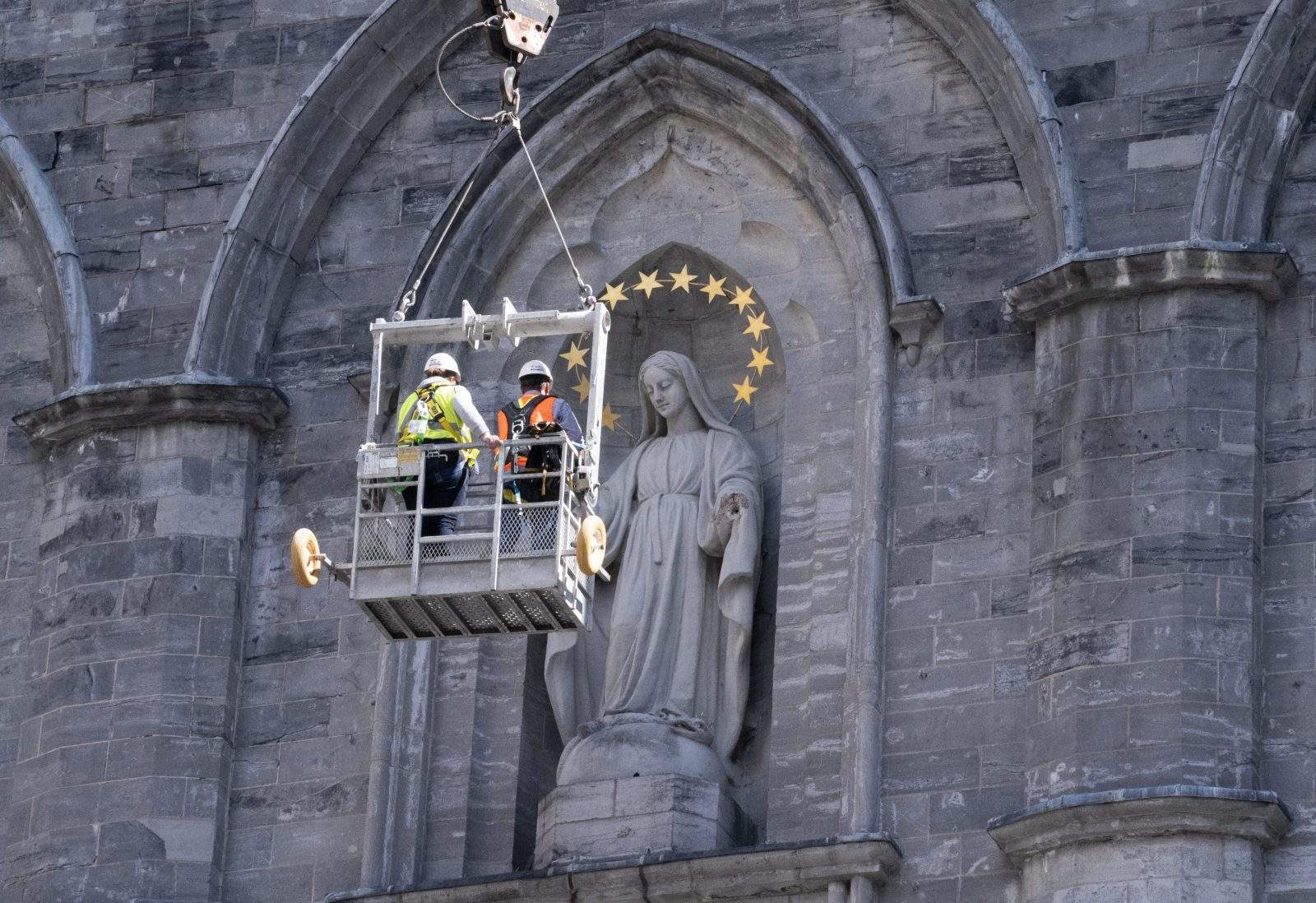
Capital expenditure in architectural restoration is rarely governed by aesthetics alone; it is an exercise in risk mitigation, material longevity, and structural load distribution. When scaffolding is systematically removed from a major heritage asset such as the Notre Dame Basilica in Montreal, it marks the terminal phase of a multi-year capital intervention. This transition from intervention to stabilization provides a clear case study in how heritage infrastructure absorbs financial, logistical, and material stress. Understanding this phase requires moving past surface-level observations of visual transformation and examining the underlying mechanical, economic, and operational frameworks that govern urban historical preservation.
The removal of scaffolding is not merely a symbolic unveiling. It represents the successful closure of a temporary structural system designed to counteract material degradation while maintaining the continuous operation of a high-traffic civic anchor. To deconstruct this process, we must examine the primary variables that dictate large-scale urban restoration projects: load path redistribution, supply chain constraints for specialized masons, and the municipal cost function of heritage maintenance.
The Structural Mechanics of Façade Remediation
Historic masonry structures, particularly those constructed with regional limestone and sandstone, rely on compressive strength and gravity loads. Over decades, freeze-thaw cycles, atmospheric deposition, and rainwater infiltration compromise mortar joints and stone integrity. When scaffolding is erected against a historic façade, it serves two distinct functions: access provision and temporary stabilization.
The primary engineering challenge during façade restoration is the management of differential settlement and load transfer. As damaged stone blocks are stitched, pinned, or replaced with historically compatible quarried stone, the building experiences micro-shifts in load distribution. Scaffolding systems must be anchored into non-critical structural points or braced externally to avoid inducing localized stress concentrations that could fracture adjacent heritage fabric.
The removal phase reverses this mechanical dependency. The temporary framework is detached incrementally to allow the restored masonry envelope to gradually reassume its full, unassisted dead load. Engineers monitor displacement sensors and crack-gauge arrays during this process to verify that the structure settles within predicted elastic limits. If mortar has not cured under optimal thermodynamic conditions, or if anchors have been prematurely loaded, micro-fissures propagate along the mortar lines. The successful clearance of scaffolding validates the mathematical models used to predict material compatibility between original substrates and modern lime-based replacement mortars.
The Cost Function of Urban Heritage Assets
Maintaining a landmark like the Notre Dame Basilica involves an asymmetric economic model. Unlike commercial real estate, where capital investments yield direct rental revenue multipliers, heritage assets generate diffuse economic value through tourism, civic identity, and cultural capital. However, their maintenance costs follow strict exponential curves driven by specialized labor scarcity.
The economic equation for heritage restoration can be modeled through three primary cost drivers:
- Labor Specialization: The supply of artisans capable of executing traditional stone-carving, lime-plastering, and lead-work is strictly limited. Project timelines are dictated by artisan availability rather than capital allocation, creating a persistent bottleneck.
- Material Authenticity Mandates: Conservation standards require materials to match the chemical and physical properties of the original construction. Sourcing geographically identical stone often involves reopening dormant quarries or commissioning custom chemical analyses of mortar aggregates.
- Intervention Disruption Costs: Because major basilicas remain operational for cultural and religious programming, physical interventions must be phased around public access. This temporal constraint inflates labor overhead and extends project life cycles.
When scaffolding is finally dismantled, it signals the cessation of these compounding operational costs and the return of the asset to a steady-state maintenance cycle. The financial objective shifts from active capital expenditure to passive preventive conservation.
Material Degradation Vectors in Urban Microclimates
Montreal presents a severe microclimatic environment for exterior stone architecture. The city experiences extreme annual thermal amplitude, with winter temperatures dropping below minus twenty degrees Celsius and summer highs exceeding thirty degrees. This fifty-degree swing accelerates the physical weathering of masonry through distinct mechanisms.
Moisture trapped within porous stone or behind poorly ventilated flashing freezes, expanding by approximately nine percent. This volumetric expansion exerts internal pressures that exceed the tensile strength of sedimentary stone, leading to spalling and exfoliation. Furthermore, historic urban centers accumulate anthropogenic pollutants, including sulfur dioxide and nitrogen oxides, which react with moisture to form weak acids. These acids convert calcium carbonate in limestone into more soluble calcium sulfate, washing away fine architectural details and weakening surface cohesion.
Restoration teams combat these degradation vectors through targeted interventions: replacing degraded units with stone of matching porosity, repointing with vapor-permeable lime mortars that allow trapped moisture to escape harmlessly, and installing discreet flashing systems to redirect water away from decorative reliefs. The removal of scaffolding exposes these interventions to the ultimate test: real-world climatic cycling without the microclimatic shelter or shading the scaffolding frame previously provided.
Operational Logistics in Dense Urban Corridors
Executing a multi-year restoration project in the heart of a dense historic district requires complex supply chain coordination and municipal traffic management. The staging area for a project of this scale is typically constrained by surrounding urban infrastructure, pedestrian walkways, and commercial zones.
Logistical efficiency relies on just-in-time delivery of stone blocks, mortar components, and structural steel elements. Cranes and hoist systems integrated into the scaffolding framework act as the primary vertical transportation arteries for both heavy materials and waste extraction. The dismantling phase requires its own specialized logistical choreography: reverse-sequencing the removal of anchors, lowering steel modules through narrow urban corridors, and restoring sidewalk access without disrupting municipal commerce.
This operational transition highlights the interdependence between private heritage stewardship and public municipal infrastructure. The street closures and pedestrian rerouting necessitated by scaffolding represent a temporary tax on urban mobility, offset by the long-term preservation of a structural anchor that drives regional tourism revenue.
Strategic Forecast for Heritage Asset Management
The completion of façade stabilization at Notre Dame Basilica underscores a broader shift in urban asset management. Traditional reactive repair cycles—where structures are ignored until catastrophic failure forces intervention—are being replaced by predictive, data-driven maintenance frameworks.
Moving forward, the integration of non-destructive testing methods, such as thermographic imaging for moisture detection and acoustic emission monitoring for internal crack propagation, will dictate the frequency of future interventions. By treating heritage assets as engineered systems subject to quantifiable material fatigue, custodians can transition from emergency capital campaigns to predictable, amortized maintenance schedules. The removal of the scaffolding is not the end of the building's lifecycle management; it is simply the calibration point for the next multi-decade operational window.