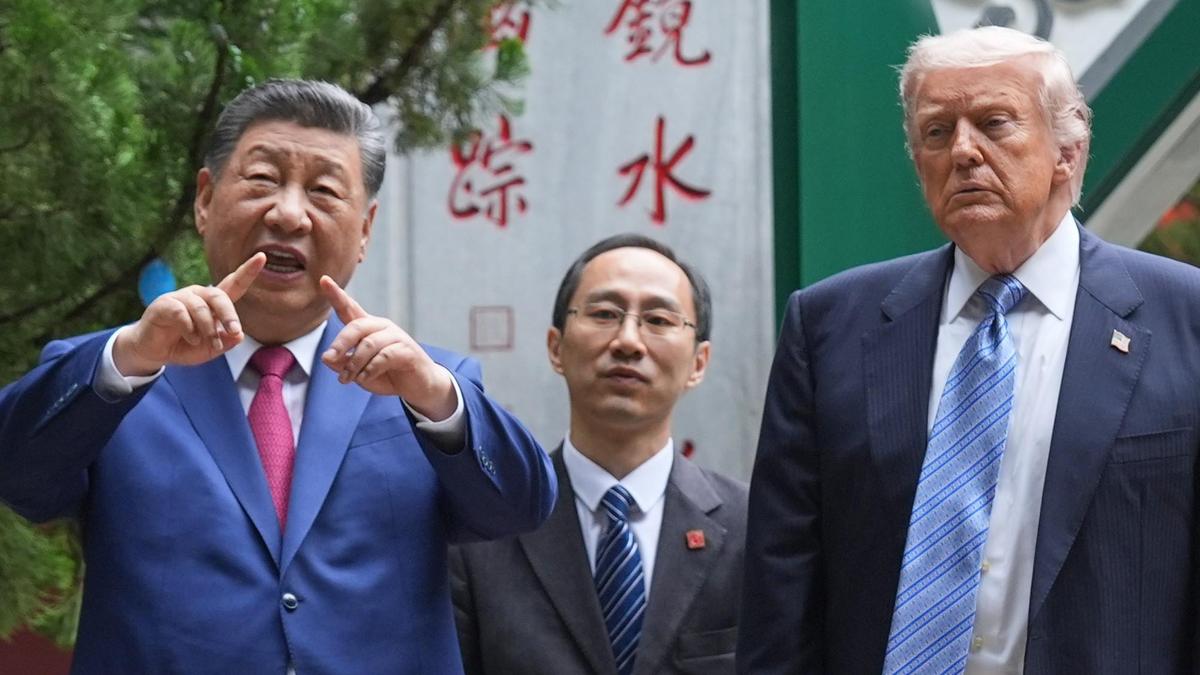
The pursuit of "fantastic deals" in high-level diplomatic summits often obscures the underlying mechanics of structural trade deficits and the divergent economic architectures of the United States and China. When a political administration frames trade via transactional procurement—large-scale purchase agreements in energy, aviation, and agriculture—it prioritizes optics over the systemic realignment of market access. The fundamental friction is not found in the volume of goods traded, but in the irreconcilable differences between a market-driven consumer economy and a state-directed industrial apparatus.
The Procurement Paradox
High-profile signings, such as multi-billion dollar commitments for Boeing aircraft or liquefied natural gas (LNG), function as temporary relief valves for political pressure. However, these agreements rarely represent a net increase in long-term demand. Instead, they constitute "re-allocative trade," where existing demand is shifted toward specific vendors to achieve a diplomatic objective.
The utility of these deals is limited by three specific variables:
- The Fulfillment Lag: Aerospace and energy contracts operate on multi-year delivery cycles. A "deal" announced today may not impact the balance of trade for 36 to 60 months, rendering it useless as a tool for immediate economic stabilization.
- Substitution Elasticity: In many sectors, China maintains a diversified supplier base. Forcing procurement from the United States often results in a corresponding decrease in orders from other Western allies, shifting the geopolitical friction rather than solving the trade imbalance.
- Non-Binding Clauses: Most large-scale "deals" announced during state visits are Memoranda of Understanding (MoUs) rather than legally enforceable purchase orders. The conversion rate from MoU to realized revenue is historically volatile, subject to shifting domestic priorities within the Chinese state-owned enterprise (SOE) framework.
Structural Asymmetry as a Trade Barrier
Focusing on the "billions of dollars" in trade ignores the regulatory and structural barriers that prevent American firms from scaling within the Chinese domestic market. The trade deficit is a symptom of an uneven playing field rather than a lack of competitive products.
The Chinese economic model utilizes "Assisted Capitalism," where the state provides low-cost credit, land grants, and utility subsidies to domestic champions. This creates a cost-floor that foreign entities cannot match through efficiency alone. When a U.S. President celebrates purchase orders, they are effectively treating the symptom while the underlying disease—the lack of reciprocal market access—remains unaddressed.
The barriers are categorized by their impact on capital flow:
- Equity Caps: Forcing foreign firms into joint ventures (JVs) ensures that local entities capture a significant portion of the value chain and intellectual property.
- Licensing Bottlenecks: The use of opaque "security reviews" or administrative delays to prevent foreign software and financial services from entering the market.
- Subsidized Overcapacity: When Chinese SOEs produce steel, aluminum, or solar panels beyond domestic demand, the resulting global price depression forces more efficient Western producers out of the market.
The Intellectual Property Extraction Function
A critical failure of transactional diplomacy is the omission of the "Technology for Market Access" trade-off. For decades, the price of doing business in China has been the systematic transfer of proprietary technology. This creates a decay function for American competitive advantage.
The logic of the Chinese firm is to internalize foreign expertise, replicate the technology via indigenous R&D, and then export the resulting product at a lower price point back to the global market. Any trade deal that focuses on selling raw materials (soybeans, oil) or finished goods (planes) without securing the protection of the underlying IP is facilitating a long-term wealth transfer.
The mechanism of this extraction is often subtle. It occurs through mandatory localized R&D centers, "security audits" of source code, and the placement of Communist Party cells within foreign-owned subsidiaries. These are not glitches in the system; they are core features designed to achieve technological parity and eventual dominance.
Quantifying the Value of Energy and Agriculture Commitments
Energy and agriculture are the two sectors most easily manipulated for political optics because they involve bulk commodities with transparent pricing.
In the energy sector, the push for China to buy U.S. LNG serves a dual purpose. It reduces the trade deficit on paper while theoretically diversifying China’s energy security. Yet, the physical infrastructure—regasification terminals and pipelines—creates a hard ceiling on how much volume can actually be moved. Without massive capital expenditure in Chinese port infrastructure, "record-breaking" energy deals remain theoretical.
Agriculture is even more volatile. The Chinese state uses agricultural procurement as a geopolitical lever, turning the spigot on or off to target specific American voting demographics. This "weaponization of the soybean" demonstrates that trade volume in this sector is not a sign of market health, but a sign of diplomatic temperature. Relying on these deals creates a precarious dependency for American producers, who must calibrate their planting cycles to the whims of bilateral relations rather than global market demand.
The Fallacy of the Bilateral Deficit Metric
The obsession with the bilateral trade deficit is an analytical error. In a globalized supply chain, a product "made in China" often contains high-value components from Japan, South Korea, and Taiwan, with design and branding value originating in the United States.
By focusing on the gross value of imports from China, the administration overlooks the "Value-Added" reality. If a $1,000 smartphone is assembled in China but only $20 of that value is added by Chinese labor and overhead, the trade deficit is overstated by $980. The real competition is for the high-margin components of the value chain—semiconductors, software, and advanced materials. Transactional deals that focus on the final assembly volume fail to address the core of where economic power resides.
The Operational Reality of Foreign Direct Investment (FDI)
While the headlines focus on exports, the real shift is occurring in FDI patterns. American companies are increasingly adopting an "In China, For China" strategy. This means they are decoupling their Chinese operations from their global supply chains to mitigate political risk and comply with local data localization laws.
This shift results in a "hollowing out" of the trade relationship. If an American company builds its products in China using Chinese components to sell to Chinese consumers, that activity does not appear in trade deficit statistics, nor does it benefit the American worker. It benefits the shareholders, but the economic multiplier remains within Chinese borders. A strategy that celebrates trade deals while ignoring the migration of the industrial base is fundamentally flawed.
Strategic Realignment Requirements
To move beyond the theater of state-visit "deals," a strategy must transition from procurement to systemic reform. This requires a departure from the "fantastic deal" rhetoric in favor of a granular, sector-by-sector enforcement mechanism.
First, the implementation of "Reciprocity as a Default" is necessary. If Chinese firms are allowed to invest in American energy infrastructure or tech sectors, American firms must be granted identical rights in China, free from the requirement of joint ventures. If reciprocity is not met, equivalent restrictions must be applied to Chinese entities operating in the U.S.
Second, the focus must shift to the "Middle of the Supply Chain." The U.S. must prioritize the reshoring or "friend-shoring" of critical components—specifically semiconductors, rare earth processing, and active pharmaceutical ingredients (APIs). Trade deals that increase exports of low-value commodities (corn, oil) are a poor trade-off for the continued loss of high-value industrial capacity.
The final strategic play is the move toward "Defensive Decoupling." This is not an abandonment of the Chinese market, but a calculated withdrawal from dependencies that create national security vulnerabilities. Future negotiations should not be measured by the dollar amount of signed MoUs, but by the measurable reduction in Chinese state subsidies and the verifiable protection of intellectual property. Anything less is merely a choreographed exchange of promises that leaves the structural imbalance untouched.